






The European equity market was once almost as significant as the US on the global stage, but decades of falling behind on technological innovation and investing in domestic equity markets have left it a diminished force, according to Niall Gallagher, lead manager of the £2.6bn Jupiter European fund.
“Through the early 2000s, the European market in aggregate – including the UK – was almost as significant as the US but we have been totally eclipsed by the US market. The global importance of Europe has faded,” he said, noting that North America now sits at around 70% of the MSCI World index.
One of the clearest reasons for why is that the US has been much better at technological innovation, he explained, with the Magnificent Seven mega-caps all headquartered in the US.
“But another reason is internal flow dynamics,” he said, noting that the US is “much better at harnessing its savings and putting them into the stock market through things like the 401(k) or corporate equity plans”.
In contrast, the retail market across Europe typically put their money in the bank, meaning there isn’t the same positive flow dynamic into domestic markets.
“If more money goes into equities, valuations go up and companies are more likely to list there, whereas in Europe they either sell out, remain in private equity, or go and list in the US,” Gallagher said.
It is not all bad news, however. Below, Gallagher explains how the over-concentration now visible in global indices has made Europe’s broader sector mix and valuation discount increasingly difficult to ignore.
What is the philosophy of the fund since you took over in May 2025?
Before Jupiter, I was at T. Rowe Price, BlackRock and then GAM managing European equity funds – so I have been doing this for over 20 years and, more specifically, have gone through the process of taking over a fund and putting my stamp on it three times.
The main lesson I have learned from previous experience is that as soon as you are responsible for managing a fund, you own the performance. You can’t look back and blame somebody else for things that go wrong or right in the portfolio.
So, when I joined from GAM over a year ago, the idea was very much to continue what we were doing there and translate that investment success into Jupiter European. Our approach is different than the previous team’s – we are style flexible and style agnostic. We run more concentrated, high-conviction portfolios with different holdings that we like – you can’t be hanging on to positions you didn’t pick.
What has driven the fund’s recent outperformance?
If I were to highlight one of the most significant areas, I would say we made a lot on European banks. A year ago, they were very cheap and earnings estimates were too low – we believed the market was underestimating this. It paid off.
We own large positions in very traditional retail and commercial banks that have outperformed significantly – particularly the Spanish ones.
We still think European banks are on the cheap side of fair value and are going through a long period of re-rating. It could take 10 years – maybe longer, maybe less – but we are not fully through it yet.
Performance of the fund vs sector and benchmark since May 2025
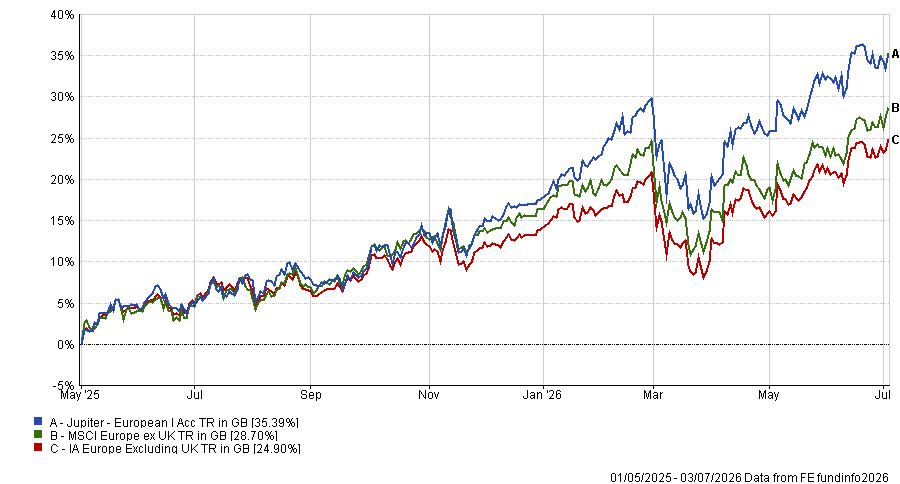
Source: FE Analytics
Does the impact of the Middle East conflict change your thinking around investing in the energy sector?
We are believers in the need to transition to increase the amount of primary energy that comes from electricity as opposed to fossil fuels. That requires heavy investment across all aspects of electricity generation, transmission, distribution and resilience.
I don’t think the conflict in Iran really changes anything – it probably does the opposite over the medium term, as it boosts the case for more oil and gas development as countries look to diversify their supply. We may well see accelerated development in new oil basins.
However, we must be careful when thinking about oil and gas as a Europe-focused fund. While the rest of the world thinks in terms of security and economics, a lot of thinking in Europe is ideological.
We do need to decarbonise, but the way several European countries – including the UK – have gone about decarbonisation is completely irrational and economically self-defeating. To put it bluntly: the rest of the world is not that stupid.
I think we need to take a broader sweep in terms of energy policy. Using AI data centre demand as an example: we are increasingly seeing the big data centres looking to buy their own power – whether that is gas turbines, gas engines, fuel cells or even potentially nuclear.
What have been your best and worst calls since taking over the fund?
As mentioned, our very large position in banks like BBVA has served the fund well [and the stock price is up 69.5% year to date].
Then there is Prysmian in Italy, which makes high-voltage transmission cables and also medium- and low-voltage cables. That stock has returned 180% – a remarkable performer for the portfolio over the past 12 months.
Our worst stock has been Beiersdorf, the personal care company that owns brands like Nivea. The stock fell 40% while we owned it, costing us a fair bit in underperformance.
We have sold it now, but when we owned it we thought it was cheap versus its history and that it was worth more than the share price. However, the execution by the management team has been, frankly, awful.
Do you think weaker sentiment has created stronger future opportunities in European equities?
After more than a decade in which capital flowed relentlessly toward US markets – partly through the growth of global fund allocations – political uncertainty has begun to concern investors who are increasingly uncomfortable with the concentration within their portfolios.
Europe is not the only potential beneficiary of reallocations but it is one of the few developed markets offering genuine diversification at a time when global equity exposure has become increasingly concentrated in the US and technology.
About 60% of the revenues of our market are now derived from outside Europe. Portfolio holdings like Prysmian are world leaders in what they do – they are not just selling into Europe.
Add in the fact that European equities are trading closer to long-term average valuations and at a significant discount to the US, and we believe there could be a meaningful tailwind for European markets.
What do you do outside of fund management?
I have children, so that takes up a lot of my free time. In terms of hobbies, I like cycling.