






The £2.6bn M&G Global Dividend fund has a strong long-term track record, posting a first-quartile return of 215.5% over the 10 years to the end of June 2026, but the first half of 2026 told a different story, as the strategy posted a fourth-quartile return in the IA Global Equity Income sector, up just 5.7%.
Managed by Stuart Rhodes since the fund’s launch in 2008 (who is supported by John Weavers and Kathryn Leonard), it aims to deliver a rising income stream, a yield above the MSCI ACWI index over rolling five- year periods and a higher total return than the index over the same timeframe.
But has the fund’s strong long-term record become a smokescreen for a strategy losing its edge, or is its recent struggles simply the cost of admission for genuinely active management?
To find out, Trustnet asked fund pickers whether M&G Global Dividend is a buy, hold or fold.
Performance of the fund vs sector and benchmark in H1 2026
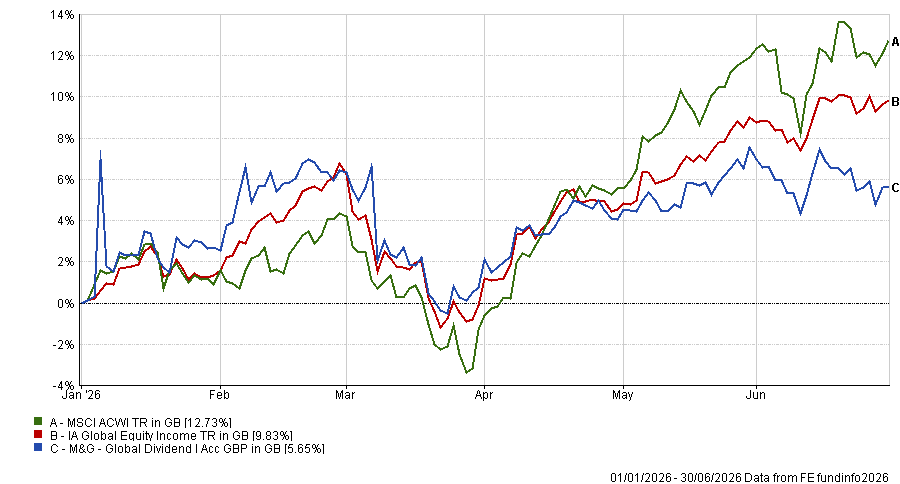
Source: FE Analytics
Rob Morgan, chief analyst at Charles Stanley, described M&G Global Dividend’s 2026 performance as a “short-term blip in relative terms” that should not concern investors.
He pointed to the fund suffering from a lack of tech exposure, especially in terms of pure AI-related names. Indeed, the fund is some 20 percentage points underweight the tech-dominated US compared to the MSCI ACWI index, as well as 12 percentage points underweight the technology sector.
“The portfolio will instead always contain a core of ‘dividend bankers’ which are multinational businesses in strong industry positions,” Morgan said. “Among these, healthcare and consumer staple holdings in particular have been weak.”
Despite this, Morgan said the fund remains a buy, pointing to its annualised returns of around 11% since launch – similar to the MSCI AC World index, despite the fund’s structural lack of technology exposure.
“Income seekers also have reason to be satisfied,” he said, noting that the fund “won’t ever be the highest yielder in the peer group given its focus on dividend growers but the strategy has delivered compound annualised dividend growth of around 7% since inception”.
“The manager has a good long-term record and has come through periods of weaker performance before by sticking to his fundamental analysis and making good investment decisions,” Morgan added.
Ben Yearsley, director at Fairview Investing, added that the fund has also suffered due to Rhodes’ decision to buy quality stocks.
“Unfortunately, no one wants them at the moment, so they are arguably instead getting even cheaper,” Yearsley said.
Nonetheless, he also said the fund remains a ‘buy’, noting that Rhodes’ excellent long-term record means he is “not really bothered” by the short-term performance.
A fund like M&G Global Dividend should be a core holding in an investor’s portfolio, Yearsley added.
Darius McDermott, managing director at FundCalibre, added to the ‘buy’ consensus view, arguing that M&G Global Dividend’s long-term performance “speaks to the consistency of Rhodes’ process rather than a lucky run”.
“The fourth quartile showing in the first half of 2026 is a reminder that this is an active, high-conviction fund rather than an index-hugger – and dividend growth strategies of this kind will naturally lag when markets favour a narrower set of themes,” he said.
“Short-term volatility is the price of admission for the long-term outperformance the fund has shown.”
Ernst Knacke, head of research at Shard Capital, also said that M&G Global Dividend remains a buy. He noted that the portfolio trades at a meaningful valuation discount to its benchmark, similar to that seen at the end of 2021.
“In 2022, it subsequently outperformed the MSCI ACWI by approximately 12 percentage points,” Knacke said.
He added: “Its high active share and lower market sensitivity also provide genuine diversification at a time when many portfolios are increasingly dependent on the same underlying winners.”
Sheridan Admans, founder and chief investment strategist at Infundly, also agreed that the fund’s deviations from the benchmark “are not necessarily a cause for concern, as this is a dividend-growth strategy and several of these companies are less likely to fit an income strategy’s dividend-growth and valuation criteria”.
The fund’s positioning elsewhere has also been less helpful, with materials representing around 14% of the portfolio against 3.6% for the index, while energy accounts for 9.1% versus 3.5%.
“The fund also has sizeable positions in companies such as Amcor, Methanex, Keyera and Gibson Energy – in a portfolio of only 41 holdings, individual stock setbacks can have a visible effect,” Admans said.
Nonetheless, he said that the fund remains a ‘hold’, as six months of fourth-quartile performance is not enough of a reason to abandon a fund with a strong 10-year peer group record.
All fund pickers said M&G Global Dividend serves as a strong core global equity income holding for an investor’s portfolio, providing a rising income stream alongside strong total returns, rather than the highest headline yield.
When looking at funds that could work well alongside it, McDermott suggested fellow M&G strategy M&G Corporate Bond as an example of a lower-risk income source, Schroder Oriental Income for more targeted Asia-Pacific exposure and the growth-focused Mid Wynd International Investment Trust for capital appreciation without duplicating the income mandate.