






With the next Budget just weeks away, speculation is mounting over potential changes to pension taxation, rises to capital gains tax and fresh measures to address the UK’s shrinking fiscal headroom.
Recent Budgets have been followed by a surge in volatility, with unexpected increases to employer National Insurance contributions rattling smaller companies in 2024 and gilt yields surging following a proposal for unfunded tax cuts in 2022.
Yet trying to position a portfolio around specific Budget outcomes is difficult – and acting on rumours may cost investors more than it saves them.
With that in mind, Trustnet asked fund selectors which UK funds and investment trusts they would back – not to predict the Budget but to weather whatever it delivers.
Rather than trying to second-guess which sectors will benefit or suffer from the Budget, Sheridan Admans, founder of Infundly, said the more reliable approach is to back a fund whose process is specifically designed to find opportunity when market uncertainty creates indiscriminate selling.
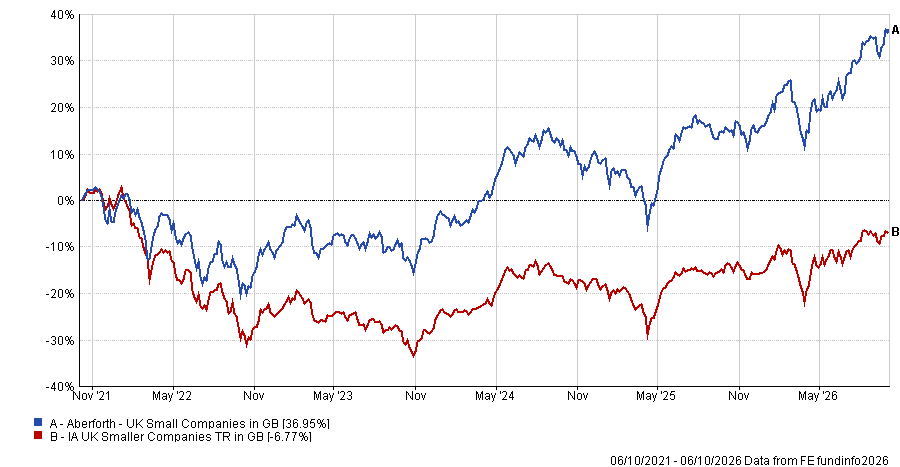
He suggested the £192m Aberforth UK Small Companies fund, which is co-managed by a large team, including Euan Macdonald, Peter Shaw and Jeremy Hall.
“Aberforth UK Small Companies interests me because its team has spent decades looking for smaller British companies whose share prices have fallen below what it believes the businesses are worth,” he said, with top holdings including CMC Markets, MONY Group and Rathbones Group.
Admans believes this approach could become “particularly useful” if a Budget surprise prompts investors to sell broadly.
“The fund does not assume every falling share is a bargain,” he said, adding that the fund is backed by sector specialists who examine what has changed for each business, “including whether a setback is temporary or points to a more lasting problem”.
“This process allows it to add where it concludes that a company’s problems are more than reflected in the price – that matters more to me than a claim to know which sectors will benefit from a particular Budget outcome,” Admans said.
Nonetheless, a small-cap-focused fund is not a shelter for short-term losses, as smaller UK businesses can be volatile and are naturally more sensitive to the domestic economy.
“But for an investor with a longer time horizon, Aberforth UK Small Companies offers a disciplined way to look for opportunities that market anxiety may create, while challenging whether the underlying businesses remain sound,” Admans said.
Performance of the fund vs sector over 5yrs
Source: FE Analytics
For investors looking for a UK equity fund that is more insulated from domestic fiscal changes than it might first appear, Joseph Hill, fund research analyst at Quilter Cheviot, pointed to Artemis Income – a fund whose holdings generate the majority of their revenues from outside the UK, despite being listed in London.
The fund is managed by FE fundinfo Alpha Manager Adrian Frost, Nick Shenton and Andy Marsh and targets both income and capital growth over a five-year period.
“With the Budget approaching and the associated speculation, rumour and debate about potential policies already becoming impossible to avoid, investors will be wise to remember that the UK stock market and the UK economy are different beasts,” Hill said, noting that the UK stock market “remains home to many world-class companies, despite the media narrative”.
Crucially, many of these companies are international giants – so, although they are listed in London, they sell their goods and services across the globe.
Artemis Income largely invests in such businesses, with almost 60% of revenues generated by companies in the portfolio coming from outside of the UK, Hill pointed out, with top holdings including NatWest Group, Aviva and BP.
“While events like the Budget can therefore dominate headlines and affect share prices in the short term, they just aren’t that important over the long term,” he said.
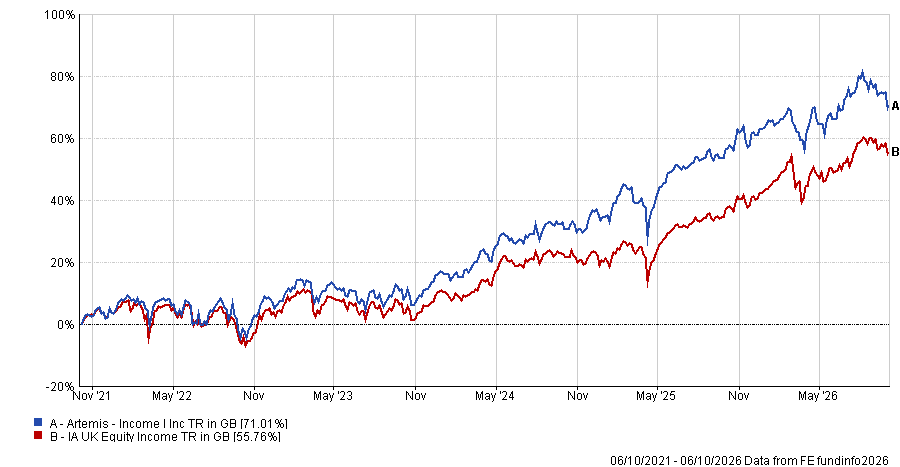
Hill also pointed to the fund’s “unrivalled long-term track record”, in which it has posted a first quartile return over 10 years to the end of September 2026, gaining 128.4%.
“It has shown over the years that it can shrug off fiscal events and the associated market impact, keeping a steady approach that makes it a good long-term option,” he said.
Performance of the fund vs sector over 5yrs
Source: FE Analytics
Darius McDermott, managing director at FundCalibre, took a similar view on overseas earnings as a source of insulation. However, he added that investors may also want to look at funds with a long track record of resilience that stretches back decades rather than years.
He suggested City of London Investment Trust, managed by Job Curtis since 1991, with David Smith serving as deputy manager since 2021.
With top holdings such as HSBC, M&G and Rio Tinto, many of the trust’s positions also earn a large share of their profits overseas, which offers some insulation from domestic policy.
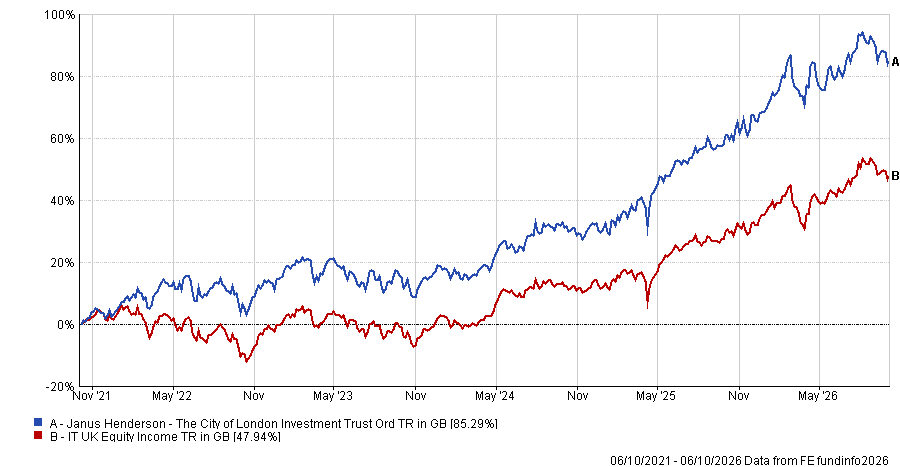
The £2.9bn City of London Investment Trust has also just increased its dividend for the 60th consecutive year, the longest record in the investment trust sector.
“It has managed this track record through the high inflation of the 1970s, the 1990s recession and the global financial crisis,” McDermott noted.
The trust takes a bottom-up, value-driven approach focused on companies capable of paying a dividend yield between 15% and 35% above the FTSE All Share, backed by strong balance sheets and cashflow generation to ensure those dividends are sustainable.
There could also be upsides to the Budget which could benefit the trust, McDermott said.
“For example, the government is pushing hard on defence and reindustrialisation, which should benefit companies such as BAE Systems, one of the trust’s holdings,” he said.
Performance of the trust vs sector over 5yrs
Source: FE Analytics
For investors who want to go a step further and actively dampen the volatility that a Budget surprise could trigger, McDermott said the £1.6bn Janus Henderson Absolute Return fund could profit from market moves in either direction.
Like the City of London Investment Trust, the Janus Henderson fund has benefited from consistent leadership, co-managed by Alpha Managers Ben Wallace and Luke Newman since 2009.
“They can take long and short positions, so they can profit from companies they expect to struggle as well as those they expect to thrive,” McDermott said.
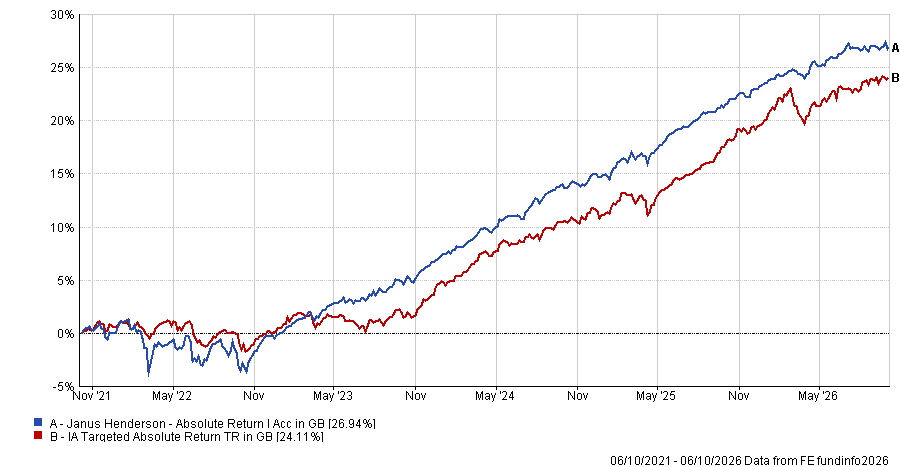
According to Titan Square Mile analysts, the fund has exhibited a net long bias, typically 15% to 30%, “so we would not expect it to be completely immune from broad trends in stock markets, [however] this has not undermined its ability to preserve capital to a high degree in the past”.
Investors should note the fund charges a 20% performance fee based on beating the Bank of England base rate over rolling three-year periods.
McDermott added: “The UK is at the core of their universe, and they typically keep net market exposure low, so returns are driven by stock selection rather than the direction of the FTSE.”
Performance of the fund vs sector over 5yrs
Source: FE Analytics