


A global pandemic, rampant inflation, an aggressive rate-hiking cycle, geopolitical upheaval and the recent AI revolution show the past six years have been extraordinary for investors.
Despite all the ups and downs, overall investors have done well so far this decade. But while the average has been good, there have been some truly standout performances.
To highlight this, Trustnet looked at the best-performing funds and investment trusts across the entire Investment Association (IA) and AIC universes from 1 January 2020 to 21 October 2026.
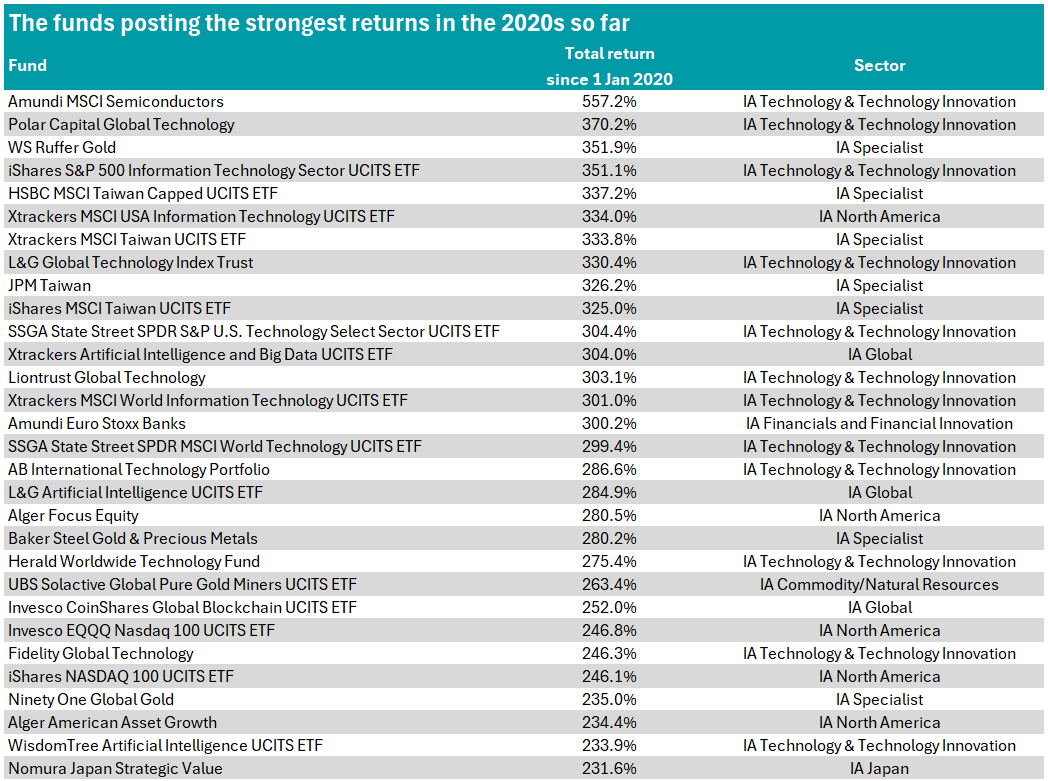
Looking at funds first, technology dominated the list of the best performers of the 2020s so far, with more than half sitting in the IA Technology & Technology Innovation sector or focused on technology-related themes, such as AI.
Many of these technology-focused funds are exchange-traded funds (ETFs), including iShares S&P 500 Information Technology Sector UCITS ETF, Xtrackers MSCI USA Information Technology UCITS ETF and Xtrackers Artificial Intelligence and Big Data UCITS ETF.
Source: FE Analytics
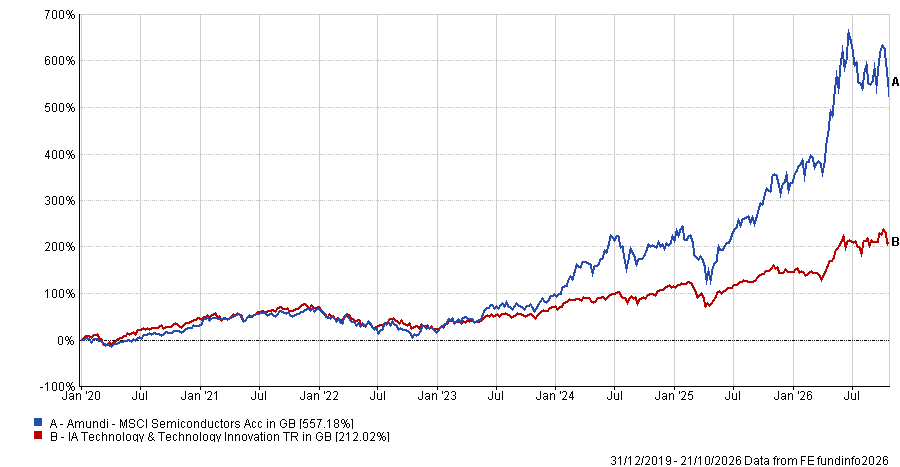
The £2.3bn Amundi MSCI Semiconductors topped all Investment Association (IA) sectors with a 557.2% return since the beginning of 2020, putting it almost 190 percentage points ahead of second place in the table.
The fund tracks the MSCI ACWI IMI Semiconductors & Semiconductor Equipment Filtered index and logged first quartile returns in 2023, 2024 and 2025. However, in 2022 – when equity markets globally struggled – the fund fell to the third quartile, losing almost 30%.
Performance of the fund vs sector in the 2020s
Source: FE Analytics
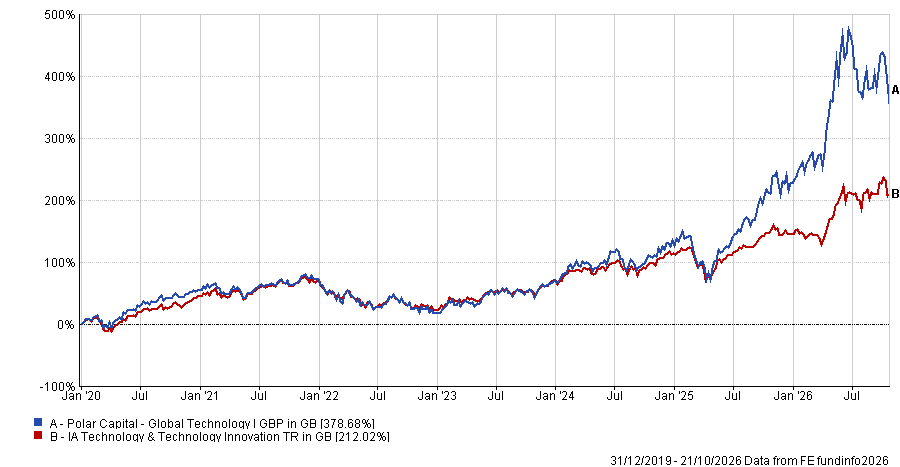
Among active tech funds, the £16.7bn Polar Capital Global Technology was the best performer, gaining 370.2% – the second-best return overall.
It is run by co-managers Ben Rogoff, Nick Evans, Fatima Iu and Xuesong Zhao, who blend top-down thematic views with bottom-up stock selection to formulate its 60-85 holdings with no benchmark constraints.
Polar Capital Global Technology was also recently highlighted for its strong returns during the Iran ceasefire. The fund has also logged a strong longer-term performance, returning 938.9% over 10 years to the end of September 2026.
Performance of the fund vs sector in the 2020s
Source: FE Analytics
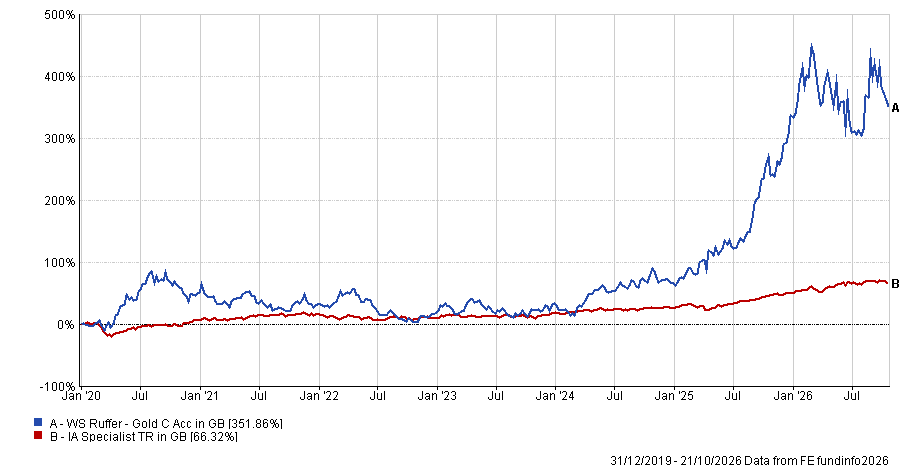
Gold is another big theme among the funds with the strongest returns of the 2020s. The metal first rallied as a safe-haven asset in the Covid pandemic. Inflation, wars and trade tensions then kept demand high, with a dramatic surge in late 2025 sending the yellow metal above $4,000 per ounce.
Baker Steel Gold & Precious Metals, UBS Solactive Global Pure Gold Miners UCITS ETF and Ninety One Global Gold returned 280.2%, 263.4% and 235% respectively, while WS Ruffer Gold logged the strongest return among commodity specialists, ranking third across all IA sectors with a 351.9% gain.
WS Ruffer Gold has been managed by Paul Kennedy since 2015 and has an FE fundinfo Crown rating of five.
Performance of the fund vs sector in the 2020s
Source: FE Analytics
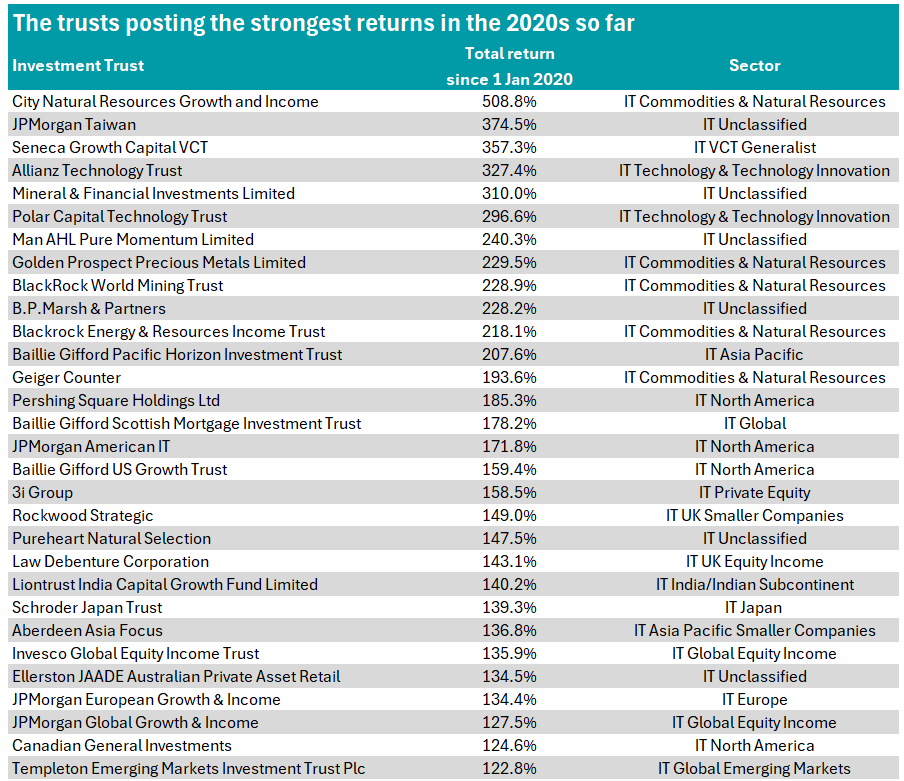
Turning to investment trusts, natural resources led the way, with five trusts in the IT Commodities & Natural Resources sector making the list.
Source: FE Analytics
Commodity prices first took off as economies reopened after the first swell of the Covid pandemic, while Russia’s invasion of Ukraine in 2022 pushed energy and metal prices higher still.
Miners and oil firms used the windfall to pay out big dividends, which helped the likes of BlackRock World Mining Trust and BlackRock Energy & Resources Income. The two BlackRock trusts returned 228.9% and 218.1% respectively.
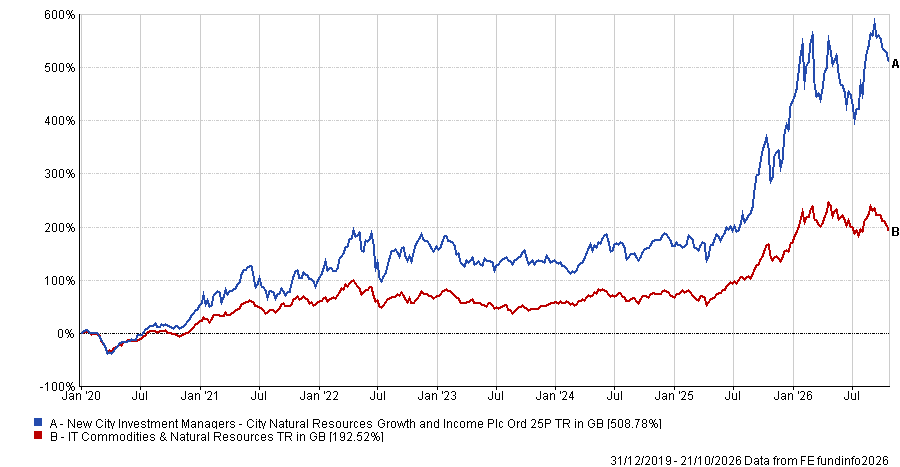
City National Resources Growth and Income topped the trust table, logging a 508.8% gain since 1 January 2020, more than 130 percentage points clear of second place.
The £156.1m trust, co-managed by Ian Francis, Keith Watson and Rob Crayfourd, predominantly invests in resource and mining equities.
In more recent months, the managers have benefited from holdings in refinery companies, such as Valero and Par Pacific, as the Middle East conflict continues to impact the global oil supply chain.
In contrast, the trust is more cautious on more economically sensitive base metals like copper, in part due to elevated valuations on copper miners but also concerns that higher oil prices and increasing interest rates could hurt emerging market economies the most – and these regions are key drivers of base metal demand.
It is currently trading at a 2.8% premium to the net asset value (NAV).
Performance of the trust vs sector in the 2020s
Source: FE Analytics
Meanwhile, gold’s record run lifted Golden Prospect Precious Metals, which gained 193.6%. Elsewhere, uranium specialist Geiger Counter gained 193.6%, benefiting as governments turned back to nuclear power to shore up domestic energy security and, more recently, as AI data centres have driven up demand for electricity.
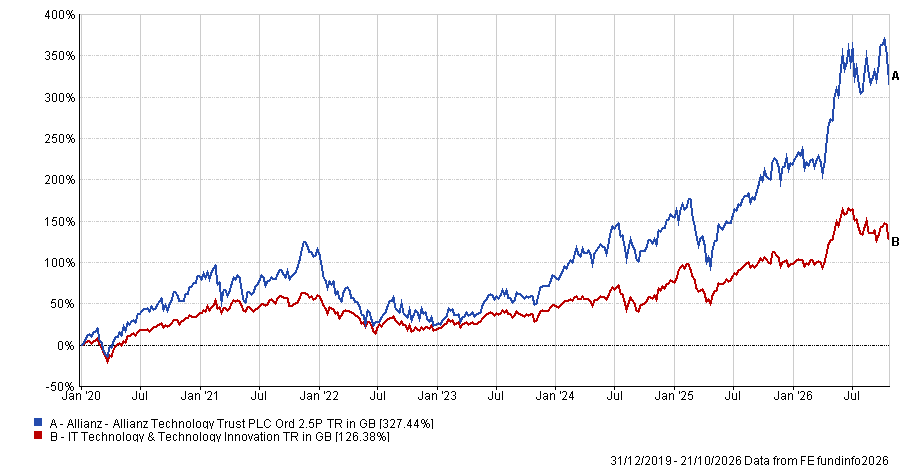
Similarly to the IA universe, technology has emerged as one of the dominant sectors for growth in the investment trust universe. Allianz Technology Trust, which is managed by Michael Seidenberg, has returned 327.4% since 1 January 2020.
In the trust’s full year results, published in March, Seidenberg doubled down on AI-driven secular growth and continued post-Covid technology demand as continued sources of strong returns for the trust.
With its closed-ended structure, the trust is not subject to concentration limits for its holdings and, as such, it has been significantly weighted in the tech mega-caps. Its top holding is Nvidia (9.5%), followed by Microsoft (7.2%), Alphabet (6.9%) and TSMC (6.2%).
Performance of the trust vs sector in the 2020s
Source: FE Analytics
Unlike the IA universe, UK-focused investment trusts broke into the top 30 for returns among investment trusts, with Rockwood Strategic from the IT UK Smaller Companies sector gaining 149%, while Law Debenture Corporation sits in the IT UK Equity Income sector and gained 143.1%.