


For much of the decade following the global financial crisis, investors benefited from an era of abundance. Low inflation, declining interest rates, globalisation and ample liquidity supported strong equity returns, while bonds provided effective diversification. For many investors, the traditional 60/40 portfolio worked exceptionally well. Today’s environment looks markedly different.
Markets have demonstrated resilience in 2026, but several structural forces are reshaping the investment landscape. Geopolitical tensions, supply chain realignment, growing power demand and years of underinvestment in critical infrastructure and resource production have contributed to a less certain inflation outlook, new secular growth drivers and rising investor interest in the so-called “HALO” trade (hard assets, low obsolescence).
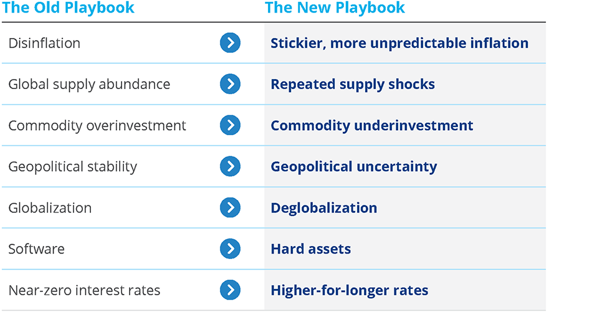
Many of the assumptions that shaped portfolios over the past decade are being challenged
Source: Cohen & Steers
Inflation can weaken the diversification investors have historically received from stocks and bonds. When inflation is elevated or unpredictable, stock/bond correlations may become less reliable, challenging traditional portfolio construction.
At the same time, new secular themes have created growth drivers ranging from AI-related data demand to deglobalisation and demographic change, accelerating the buildout of essential assets. Meanwhile, years of underinvestment have led to higher commodity prices, as scarcity is meeting increasing demand.
Equity markets are also highly concentrated, leaving many portfolios increasingly dependent on a narrow group of companies and sectors. Meanwhile, stock/bond correlations are high, meaning the traditional balance that bonds provide in moments of market volatility may not be dependable.
Together, these conditions are leading investors to look beyond traditional asset classes for diversification, inflation sensitivity and long-term growth.
Why investors are increasingly considering real assets
Real assets are the tangible structures and raw materials that underpin the global economy. They include commercial real estate, infrastructure, natural resource equities and commodities.
Unlike traditional assets, real assets derive their value from physical usage, productivity, scarcity and essential economic demand. Real assets are tangible, essential and different from traditional securities and can enhance a portfolio in many ways, but they share three unifying characteristics:
1) Diversification
Real assets can respond differently to economic forces than traditional stocks and bonds. Their distinct revenue drivers and return streams can broaden portfolio diversification across market environments. Because real assets have low representation in many market cap–weighted equity indexes, investors may also have less exposure than they realise.
2) Inflation sensitivity
Many real-asset cash flows are influenced by inflation, physical demand and/or replacement costs. This can make real assets a valuable source of portfolio resilience during periods when inflation surprises pressure traditional financial assets.
3) Growth potential
Real assets are connected to durable secular themes, including AI-driven data demand, rising electricity consumption, deglobalisation, demographic change, decarbonisation and resource scarcity. These trends rely on the physical assets, networks, materials and energy systems that enable economic activity.
Understanding the real assets toolkit
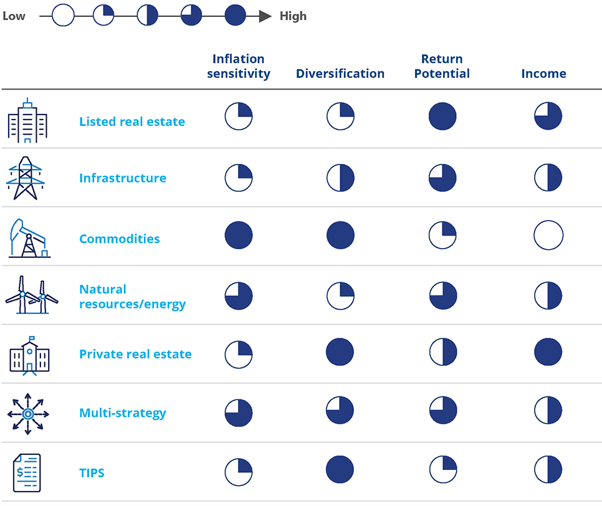
A common misconception is that real assets represent a single asset class. In practice, they are better viewed as a toolkit of complementary investments, each offering distinct portfolio characteristics.
This ranges from listed real estate, which has historically outperformed other real assets but offers lower inflation sensitivity, to commodities, which have delivered lower historical returns but offer the highest inflation sensitivity among the “core four” real asset categories.
Each real asset category provides something different to a portfolio
Source: Cohen & Steers
Effective implementation begins with defining the desired portfolio outcome and selecting exposures that support it. Before selecting individual strategies, investors should first determine what they are trying to achieve. The key question is “What portfolio objective am I trying to solve for?”
1. Seeking diversification: Investors concerned about equity concentration, changing market leadership and less reliable stock/bond diversification may consider a broad real assets allocation. Combining several real assets categories can introduce return drivers tied to physical demand, scarcity and asset-specific fundamentals.
2. Seeking inflation resilience: Investors focused on inflation may emphasise commodities, natural resources and energy-related investments, which have historically demonstrated stronger sensitivity to inflation surprises. Infrastructure can add inflation-linked characteristics with a different risk profile, helping diversify the allocation.
3. Seeking balanced outcomes: Investors seeking a mix of diversification, inflation sensitivity, income and growth may prefer a diversified allocation spanning multiple real assets categories. A broader mix can reduce dependence on any one asset class while keeping the portfolio aligned with multiple objectives.
How much real assets allocation should investors consider?
There is no single allocation appropriate for every investor. The size and composition of a real assets allocation should reflect the investor’s objectives, risk tolerance, time horizon, liquidity needs and existing allocations. Any allocation to real assets is better than no allocation, but we believe a meaningful allocation starts around 5%.
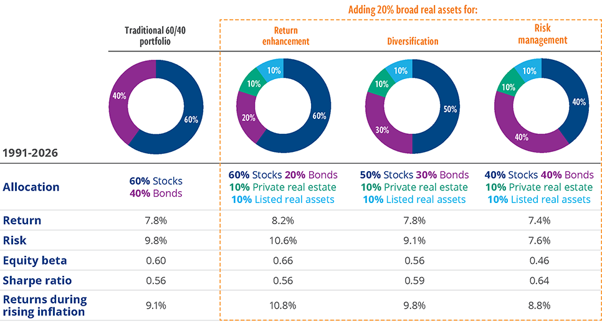
Historical analysis illustrates how a 20% broad real assets allocation could be introduced alongside stocks and bonds in different ways. The examples emphasise different goals: return enhancement, diversification or risk management. The analysis is illustrative and demonstrates the flexibility of real assets within a broader portfolio framework.
The practical lesson is to begin with the outcome, then determine the appropriate allocation size and the investments most likely to support it. An investor prioritising inflation sensitivity may build a different real assets mix than an investor prioritising income or lower equity beta.
Real assets can help improve investor outcomes
Source: Cohen & Steers
Choosing an approach to real assets implementation
Once investors determine the role real assets should play, the next decision is how to access them. The three approaches can be summarised as “build it, buy it or blend it.”
For example, an investor seeking inflation resilience could build a custom allocation emphasising commodities and natural resources. However, removing commodity or natural resources allocations in response to a near-term tactical view could materially change the inflation characteristics of the portfolio. A diversified core with targeted satellites around it may help preserve the strategic objective while still allowing room for conviction.
Building a better portfolio with real assets
The case for real assets today extends beyond the latest market cycle. Investors are navigating evolving inflation dynamics, changing sources of economic growth, elevated market concentration and uncertainty about traditional diversification assumptions.
By starting with portfolio objectives, understanding the distinct roles of each real assets category, and selecting an implementation approach aligned with those objectives, investors can build allocations designed to broaden diversification, improve inflation resilience and participate in long-term growth opportunities.
Real assets are not a replacement for stocks and bonds. They are an additional set of tools that can help investors build portfolios for the environment ahead.
Jeffrey Palma is head of multi-asset solutions at Cohen & Steers. The views expressed above should not be taken as investment advice