


Britons could invest two to six times more in the UK market than their international peers and it would still be a “reasonable range”, according to experts.
The UK market has been shunned for many years but might be more attractive now due to its cheapness and the potential it offers to move away from the high-flying tech names that have been driving returns recently.
Rob Morgan, chief analyst at Charles Stanley, said an ideal weighting to UK equities would be between 10% and 20%, despite the domestic market making up just 3-4% of global indices.
For income investors, particularly those drawing from an ISA or a SIPP in retirement, he suggested that range could be even higher at between 15 and 20%.
“If you’re buying funds, then anywhere between 10% and 20% would seem very reasonable to me,” he said.
He reminded investors that they are free to depart from the benchmark, unlike institutions, which tend to be more cautious, and active fund managers, who can be worried about career risk.
Right now, owning the index means a heavy weighting to a few US technology giants. While they can continue to do well, diversification is key as investors are “consciously or unconsciously” taking on more risk through global indices at present.
It is a shift that is becoming more popular. The Autumn 2026 Berenberg Investor Barometer, a survey of almost 300 global investors representing more than $1trn in assets, found 34% planned to increase their UK exposure over the next 12 months, against 10% looking to reduce it. Among those actively reallocating, 77% planned to increase rather than decrease.
Darius McDermott, managing director at Chelsea Financial Services, said the main driver for the renewed interest was price, but cautioned against treating this as a blanket call.
“UK equities simply got too cheap to ignore and the third quarter of 2026 was when the market recognised that,” he said. “But the macro backdrop remains difficult and rising gilt yields are not helpful, so this is an opportunity that rewards selectivity rather than blanket optimism.”
Morgan also said valuations were the main argument and added that years of underperformance and outflows had left expectations low.
“The hurdle for UK companies is really quite low,” he said. “They just have to carry on doing what they’re doing. And if they get some positive surprises and maybe some M&A as well, which can be an uplift to valuations, then you can get some very decent returns from the UK going forward.”
He also pointed to diversification. Because the UK market is weighted towards healthcare, industrials, energy, mining and utilities, which are described with the acronym HALO (heavy assets, low obsolescence), it could hold up, Morgan said, if the AI trade slows – which it has done in the past month, as the chart below shows.
Performance of fund against index and sector over 1 month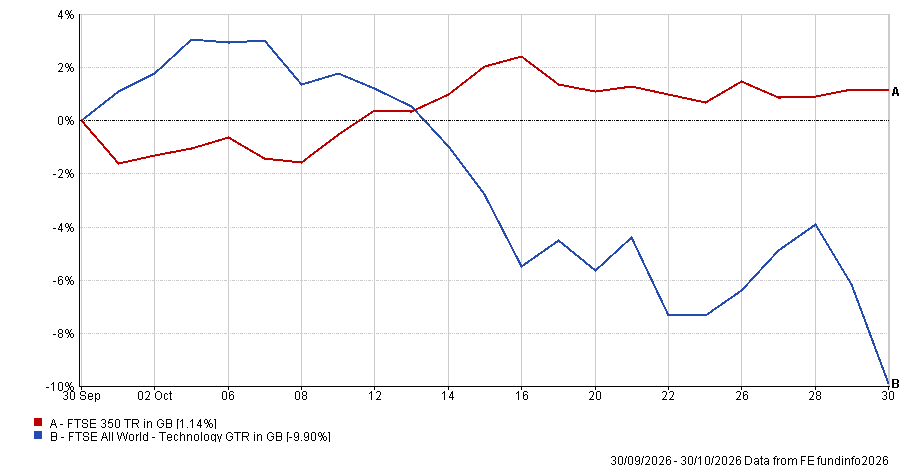
Source: FE Analytics
Morgan also recommended selectivity, as profit warnings have clustered in construction and in industrial businesses facing higher energy costs.
Where the opportunity lies
Both experts pointed to smaller companies. McDermott said the discount to large-caps has widened over the past year and that overseas buyers have noticed.
“The most compelling valuations are lower down the market-cap scale. Despite a strong quarter, UK smaller companies have become even cheaper relative to large-caps over the past year. That gap is not lost on overseas buyers, who continue to pick off bargain-priced businesses.”
Morgan said mid- and small-caps now offer a higher dividend yield than large-caps, which has not been the case in the past. “You’re not having to give up income for going down the market-cap spectrum,” he said.
Both also listed the risks. McDermott said smaller companies were more exposed to the domestic economy and higher rates, and that AI was a growing disruption risk for intermediaries such as mortgage brokers and investment platforms.
Morgan noted the lack of a re-rating trigger was a problem in the current political and economic climate. “I don’t know what that catalyst is going to be,” he said. “So it’s more of a slow burn than expecting a re-rating to be around the corner.”
He also pointed to the danger that “the really good-quality companies get picked off first, leaving the ones that aren’t so attractive”. He said takeover activity has slowed due to higher interest rates and that he hoped a cyclical upturn in IPOs would replenish the market.
The Barometer suggested a slower recovery: 32% of investors expected IPO activity to increase over the next 12 months, down from 63% in the spring.
Among individual sectors, McDermott said defence could be a winner following last week’s Budget. While some viewed it as ‘uneventful’, the Chelsea Financial Services managing director said the government’s push to reindustrialise and raise spending should help companies such as BAE Systems and Rolls-Royce.
Indeed, chancellor John Healey announced a £2.5bn agreement with Rolls-Royce to build jet engines in the UK. Plus, “the old ESG objection to defence has largely fallen away as investors recognise that more spending is needed,” McDermott said.
How to get exposure
For smaller companies, Morgan favoured active management, saying the index was skewed and the market inefficient. He cited the closed-ended structure of Aberforth Smaller Companies Trust, which he said allowed the manager to access smaller companies without liquidity concerns and which often held takeover candidates.
He also named Mercantile Investment Trust as a more balanced option with quality and value characteristics, and Artemis Income as an all-cap core fund for investors seeking a growing dividend.
For large-caps, Morgan said a FTSE All-Share or FTSE 100 tracker could serve as the core holding, with an active mid-and-small-cap or all-cap fund alongside it.