


When Gore Street Capital was founded, the aim was to put capital to work in an asset class that matters for the fight against climate change and the energy transition. Battery storage was that asset class, as it supports the energy transition by storing surplus renewable power and releasing it when it is needed. But how do we know the capital we manage is actually helping?
Funds with sustainability objectives now publish a lot of numbers: tonnes of carbon avoided, homes powered or megawatt-hours of clean energy generated. Most of these figures are calculated carefully. But they can sit far from the investment itself and there are many assumptions that need to be made along the way to arrive at these numbers.
In practice, it comes down to how clearly a fund can show the real-world outcomes of the assets it holds. Here the differences between funds are large, and this is where advisers can help clients see past the marketing.
How far is the number from the asset?
Consider a global equity fund that reports avoided emissions. Typically, this avoided emissions metric is the sum of the avoided emissions of all portfolio companies held by the fund, attributed relative to the share the fund holds in the portfolio company. The avoided emissions of the portfolio companies may employ different methodologies based on factors such as data availability or asset class, meaning the overall fund number combines avoided emissions calculated using different methodologies. With each additional assumption and each different asset class within the fund, it becomes more and more difficult to really understand the size and scale of the positive outcomes the fund claims.
The listed fund we manage, Gore Street Energy Storage Fund, owns and operates utility-scale battery storage sites across five grids: Great Britain, the island of Ireland, Germany, Texas and California. The data behind its sustainability figures comes from metered charging and discharging at each site. The chain is short, compared to many more traditional private equity funds: asset, meter, outcome. A shorter chain makes the outcome easier to trace, but does not necessarily make it easier to measure.
Two challenges apply to any avoided-emissions figure. First, avoided emissions are measured against what would have happened otherwise, so the choice of baseline matters. Is it the realistic alternative or a convenient one? For battery storage, the realistic alternative is not the grid’s average mix but the power station that would otherwise have been called on at that moment. Therefore, our methodology models the power plant a battery displaces in each market settlement period based on electricity price rather than using an annual grid average, but it is still a model.
The second is a decarbonisation paradox. Many avoided-emissions figures, for wind and solar as well as storage, are measured against a grid’s average carbon intensity. So as grids get cleaner, each megawatt-hour appears to avoid less carbon, even though clean assets are becoming more essential to the system. The carbon intensity of the grids we operate in has fallen 36% on a weighted basis since 2021/22, which shows how quickly such a baseline can move. Because our methodology measures against the marginal power plant rather than the grid average, that fall does not feed directly into our figures, but it is essential context for reading avoided-emissions numbers elsewhere. Over time, as renewables set the price more often, the marginal plant itself will change too, which will decrease avoided emissions. Using this methodology, GSF's operational portfolio avoided an estimated 15,142 tCO₂e in 2025/26.
Grid carbon intensity in the geographies GSF operates in
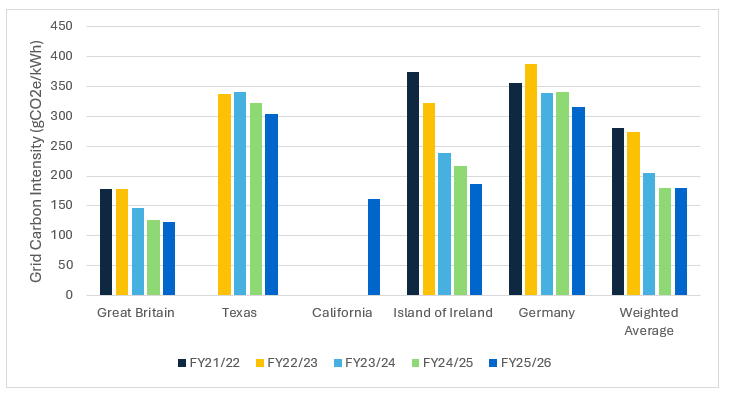
Source: Gore Street Capital. Texas and California assets came into operation later, therefore not all five years are available.
Battery storage adds its own complications since a battery generates no electricity of its own. Its contribution depends entirely on when it charges and discharges, and some energy is lost with every cycle. Even the renewable electricity it stores is an estimate: it is calculated from the renewable share of each grid at the time of charging, not from a direct connection to a wind or solar farm.
Some benefits are not counted at all. The current methodology does not capture ancillary services for example, such as frequency response and reserve, or capacity market contracts, which pay batteries to be available when the system is under stress. These roles have traditionally been filled by gas plants. As batteries take them over, gas plants can be switched off or retired, which is one of the most important ways storage helps to decarbonise the grid. These services don’t translate into megawatt-hours shifted, and there is no established industry method for quantifying their emissions benefit, so they are excluded.
Alongside these benefits, the fund also discloses its own footprint: 49,226 tCO₂e in the same year, most of it Scope 3, which are indirect, value chain emissions. That includes the embodied carbon of building new sites and emissions attributed to the grid electricity the assets buy and sell. Reading the benefits and the footprint together gives a fuller picture than either does on its own.
We participate in battery energy storage industry networks to help advance consistent methodologies, improving the transparency, comparability and credibility of avoided emissions across the sector.
Questions advisers can ask
When a fund presents sustainability outcomes, these questions help separate solid figures from weaker ones:
1) How directly does the figure come from assets the fund owns or controls?
2) Which methodology is used, who developed it and is it applied consistently from year to year?
3) What does the figure leave out and is the manager transparent about it?
4) Is the fund’s own carbon footprint disclosed alongside the benefits it claims?
No fund can measure its contribution perfectly. But funds that can trace their numbers back to real assets, and explain their limits, give advisers something far more useful than a single statistic. They give them an answer they can stand behind when a client asks what their money is really doing.
Sophie Sax is head of ESG at Gore Street Capital. The views expressed above should not be taken as investment advice.