


Indian IT services companies have pivoted fast enough to survive the threat from artificial intelligence, according to Gaurav Narain, manager of the India Capital Growth trust, who said the sector was one of India’s best performers over the past month.
That would mark a reversal after global software and services shares sold off on fears that AI would make them obsolete, which experts refer to as the ‘SaaSpocalypse’.
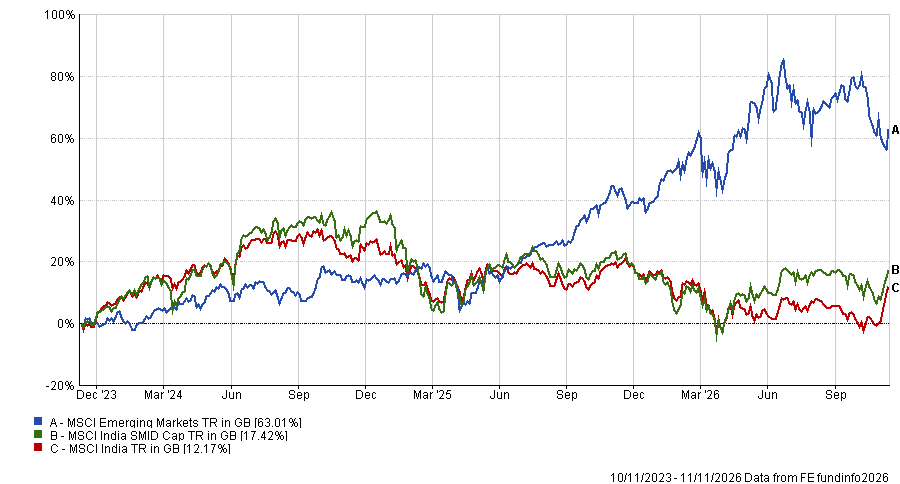
Alongside them, the whole Indian market has lagged too, peaking in September 2024 and trailing the MSCI Emerging Markets index by 55% since, as the chart below shows.
Performance of indices over 3yrs
Source: FE Analytics
Foreign investors pulled about $30bn out of Indian equities in the year to October. The rupee has fallen almost 14% in 18 months and oil has traded above $100 a barrel, a problem for a country that imports almost 85% of its oil.
In the 15 years Narain has been at the helm of India Capital Growth and 30 years in Indian equities, he has “never seen the Indian market underperform the way it has. [recently]. It’s unheard of”.
India has been a great market to “reallocate resources from” as it has grown into a liquid but expensive area. With growth now appearing in other countries (both developed and emerging), there has been a “flood” of money moving out of the country. As a result, “everyone called India the big anti-AI trade”, he said.
But the market was up 5% last week and some of that money has returned, with investors tentatively starting to dip their toes back in.
The index trades at about 16x earnings, meaning investors pay $16 for every $1 of annual profit, against an average of 18x to 19x for emerging and developed markets, Narain said, noting that the fear for the SaaSpocalypse is overblown.
“If you look at it from a global perspective, everyone feels their model is decimated simply because you don’t need coders anymore,” he said. “When you speak to the Indian companies, the view is very different.”
Narain holds two mid-tier IT services companies, each with between 40,000 and 45,000 employees. Both are growing earnings by more than 25% a year and winning their largest deal orders, he said, with one recently announcing eight multi-year contracts.
Each has also built its own small language models, scaled-down AI systems derived from larger ones that it uses to change how they write code and to put AI into their clients’ operations, Narain said.
“What they say is that what you finally need is domain knowledge, and they are so integrated with the clients that someone has to do the implementation,” he said.
The picture is more mixed at the larger firms, where the legacy business is shrinking while the AI business grows. Overall growth there is perhaps in the low single digits, he said. The larger firms are still changing their model, while the smaller ones have already done so.
“They’re still winning multi-year deals. The clients actually need someone to package the whole thing together and ensure all the different businesses run together,” he noted.
In the meantime, domestic investors are taking a different view of the market than foreigners. Domestic funds took in $75bn this year, about $3.5bn a month, and almost $300bn over five years.
“In the domestic market, you are seeing a flood of capital flowing into mutual funds,” Narain said.
That money has fed a busy market for new listings. India has had about 110 initial public offerings (IPOs) this year, almost 95% of them in mid- and small-caps, according to Narain, who said they have been hugely oversubscribed.
The India Capital Growth portfolio, which holds 30 to 35 stocks and is virtually all mid- and small-caps, sits in that part of the market, which the manager said has been unaffected by the foreign selling.
“So you see that reversal happen. I don’t know how sustainable it is, [but] I think it’s happening,” he said.
Over the year to date, the trust has returned 7%, well above its IT India/India Subcontinent peers, all of which made losses, as shown in the chart below.
Performance of fund against index and sector over 1yr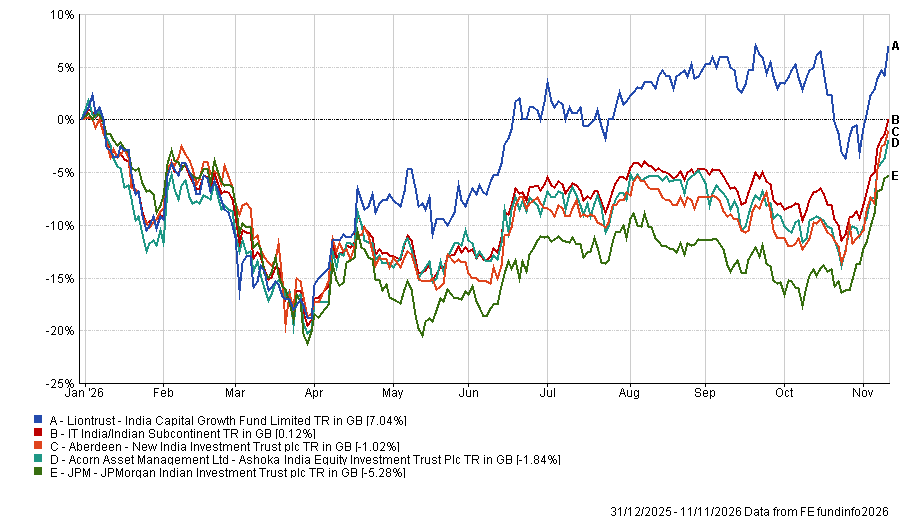
Source: FE Analytics