


Tech has been in a downward spiral over the past few months and took another leg down earlier this month with the Democratic sweep of the House and Senate in the US midterms, yet some are using this short-term fall as a long-term buying opportunity.
One such fund manager is Giles Tulloch, who co-manages the J. Stern & Co World Stars Global Equity fund alongside Chris Rossbach and Katerina Kosmopoulou.
“You had a blue wave, the blue tsunami. You saw a real downdraft in the market, especially in semiconductors. The semiconductor index fell 12% on the Thursday. You saw quite a few high-profile funds being liquidated as well and it really created a rethink, I think, amongst investors in terms of artificial intelligence,” he said.
In particular the big story was Texas, where around 25% of all the new data centre construction in America is expected to take place, he said.
The new Democratic governor, Gina Hinojosa, campaigned on a pause to data centre construction, said Tulloch, which “freaked out” investors and caused a panic that AI could be “finished”.
In the initial days, the manager said he was active, buying some of the AI-related names. In particular, J. Stern & Co World Stars Global Equity was added to hyperscalers such as Amazon and Alphabet.
This is because demand for the technology is scaling at pace. What started as a question-and-answer mechanic is quickly becoming a task-based service, such as booking tickets. Humans are more bound by their own imagination than what AI can do than its actual capabilities, he said.
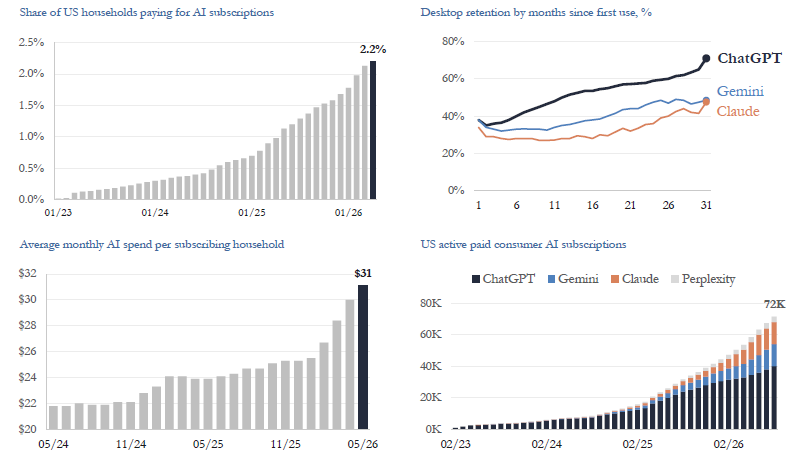
Source: J. Stern
As such, unlike normal cycles where there are early adopters, then it becomes a fad and eventually fades away, “with AI what we're seeing is [demand] just steadily builds and builds”.
While there are always companies that come under pressure, particularly with new technology, Tulloch said this is more likely to be seen in neocloud companies, which are cloud developers specifically designing products for AI. These are “quite levered”, he said.
“We invest in quality companies, we invest for the long term and we invest in the hyperscalers,” he said.
He highlighted Amazon, noting the company is accustomed to acquiring land, building facilities and rerouting power to these areas, as it has done this for years. “It's not their first [time] building a data centre,” he said.
While the Democrat victory may delay the build-out, he argued that this could instead be viewed as avoiding a “crunch” in getting these facilities built in the next one-to-two years.
It may have a “smoothing-out effect” on the build-out, which could benefit hyperscalers while impacting supply-chain companies, a group he has cut back recently. “We think [supply-chain] companies have had an artificial – pun intended – benefit from this pull-forward in demand”, he said.
Another area J. Stern & Co World Stars Global Equity has built a position in is networks, which was implemented over the summer through the likes of Arista. These companies connect different parts of the data centre together, reducing the latency between connections of GPUs and racks.
“Arista's developed really from the cloud computing era and now it's moving into the AI era,” Tulloch said, noting that if the firm can increase the number of connections then the number of use cases for its technology “multiplies exponentially”.
“So that's an example of a great business where it's taking its existing business model, providing that for the normal sort of cloud computing, and now within AI, it's turbocharged,” he said.
Conversely, the fund has largely stayed away from semiconductors, which Jean-Yves Chereau, portfolio manager for the firm’s multi-asset investment strategy, noted was “very cyclical” and so “wouldn’t fit into what we call quality”.
That meant missing the rush early in the year, which he described as “one of the issues for us this year”.
One stock that is no longer in the portfolio, however, is consumer luxury brand LVMH, which was sold over the summer. The firm behind fashion house Louis Vuitton and drinks brands Moët and Hennessy is one of Europe’s largest companies, but was sold as part of an adjustment to the fund’s consumer stocks.
“With LVMH, we felt that there were headwinds in China,” Tulloch said, where the firm is facing strong local competition. “Local Chinese brands are coming through and there was an intellectual property dispute as well,” he noted, adding that he felt that the management handling of that probably not quite as good as it could have been.