


From war in the Middle East and $100 per barrel for oil to soaring government debt and an AI spending frenzy, it has been an eventful year for markets.
Yet big question marks remain heading into 2027, from stretched US valuations to France’s debt problems and the direction of the yen.
Speaking at AJ Bell’s Investival conference, investment director Russ Mould set out themes he believes will shape markets next year and beyond.
US equities: AI boom or bust?
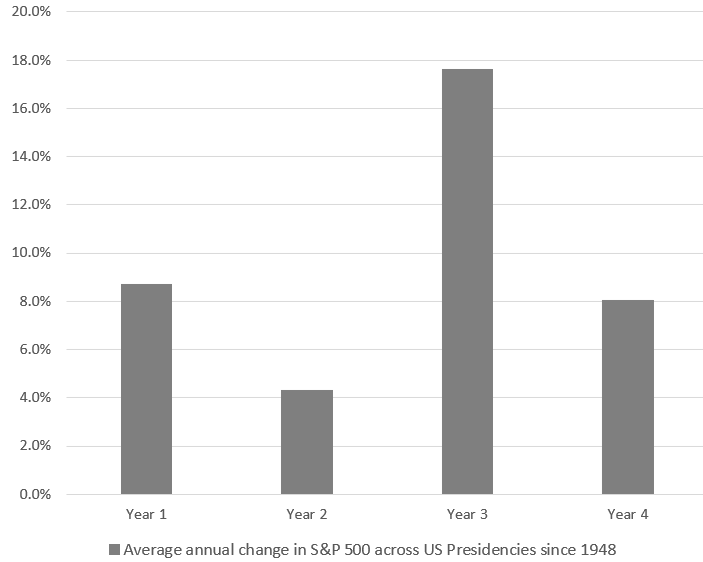
The third year of a presidential term is “normally an absolute belter”, Mould said, with the S&P 500 delivering a double-digit average capital gain, compared with single digits in the other three years, meaning another strong year could be on the cards for US equities in 2027.
He put this down to “presidential pump priming”, as the party in power ramps up spending to stay in the White House.
Average annual change in S&P 500 across US presidencies since 1948
Source: AJ Bell, LSEG Refinitiv
However, while the US equity market is an “earnings powerhouse”, Mould warned that valuations look “pretty full”.
A price of 18x to 20x next year’s earnings may not look bad, he said, but he questioned whether earnings forecasts are reliable. “Are we in an earnings bubble, if not a valuation bubble?”
If so, AI is likely to be the root cause. It is a big factor in forecasts for 32% earnings growth in 2026 and 15% in 2027, he said.
Mould is unsure whether AI is a bubble but called it “certainly a very big investment boom”. Markets have been “feeding off” companies raising their AI spending plans but if this slows or goes into reverse “that could be when there’s trouble” for global markets as well as the US, he warned.
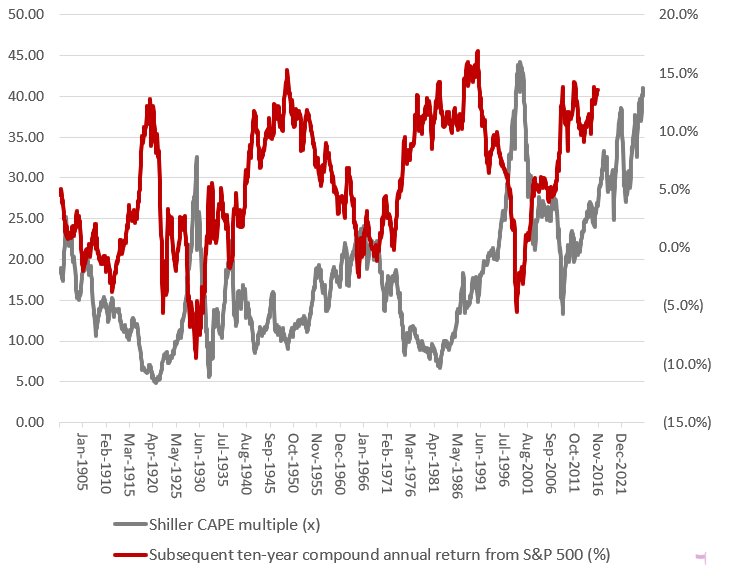
Longer term, Mould pointed to the Shiller cyclically adjusted price-to-earnings (CAPE) ratio, which compares share prices with average company profits over the past 10 years. The lower the multiple, the higher returns tend to be over the following decade and vice versa.
Current levels are “extremely uncomfortable”, he said. US shares now trade at around 40x their average profits over the past decade, close to the peak of the dot-com bubble.
US share valuations vs returns over the following 10yrs
Source: AJ Bell, LSEG Refinitiv
“I do fear that we’re probably near an earnings bubble, if not a valuation bubble – but that might not stop people getting excited for next year,” he said.
Europe: Selective opportunities
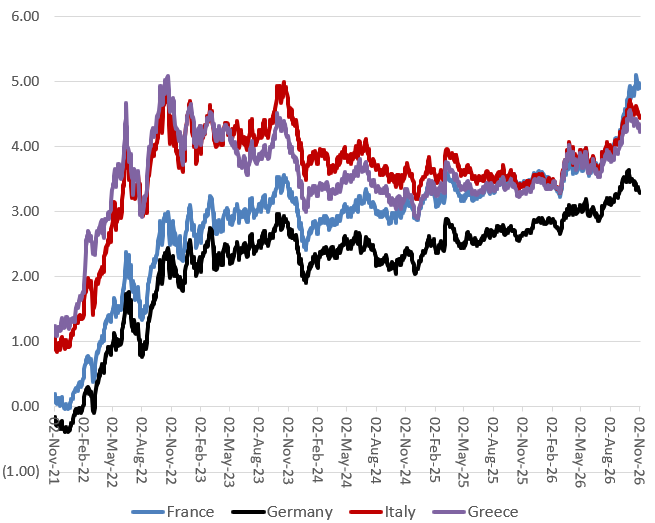
In Europe, Mould flagged France, noting it now costs more to borrow for 10 years than it does in Greece.
“That is not a glowing endorsement of your sovereign financial prospects,” Mould said.
10yr France sovereign bond yields
Source: AJ Bell, LSEG Refinitiv
The French populace is resisting cuts to benefits and pensions, even though the government is struggling to fund them, he added.
With the government already spending around 57% of GDP – one of the highest levels in the eurozone – Mould expects this to remain a major challenge. If a crisis is coming in Europe, it is likely to come from “the core of Europe and its debt situation”, he said.
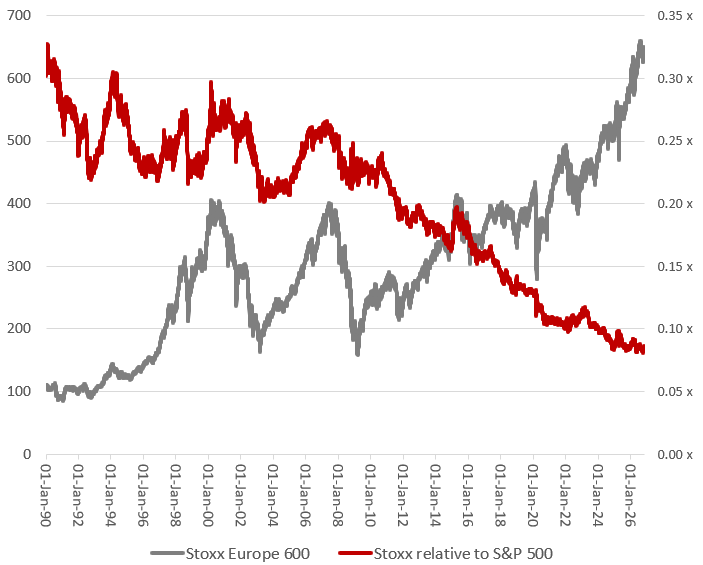
Despite these concerns, the European equity market is at record highs. However, it has fallen far behind the US since 1990, as the chart below shows.
European share prices vs the US since 1990
Source: AJ Bell, LSEG Refinitiv
Europe may be relatively cheap but Mould questioned whether this is enough to “make investors want to leave the US behind and embrace Europe”.
Oil: One eye on the Middle East
With the Middle East conflict still raging, oil is another theme on Mould’s radar. At around $100 a barrel, the price of oil remains well below its nominal high of $147, or its inflation-adjusted peak of more than $220.
Mould believes this is because traders are “taking the view that there will be a peaceful resolution”, which would give central banks, consumers and corporate profit margins “some breathing space”.
However, as of 17 November, the Strait of Hormuz remains blocked and a resolution between the US, Israel and Iran has not been reached.
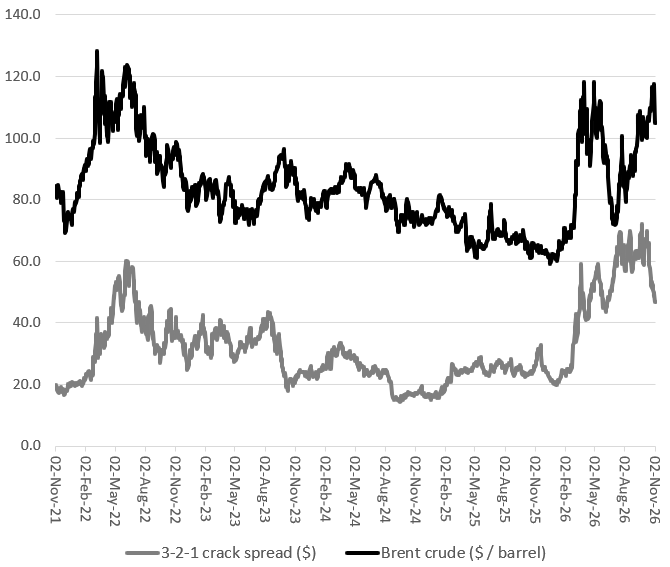
For signs of trouble ahead, Mould pointed to the crack spread – the gap between the price of crude oil and the fuels refined from it. He said the spread “shot right up” when the conflict began, as refiners worried about supply, but has since started to fall.
Mould suggested this means refiners either expect a peaceful resolution or are “starting to get worried about demand destruction because of high oil prices” – a possible sign of economic slowdown.
Crack spread since November 2021
Source: AJ Bell, LSEG Refinitiv
Sovereign debt: Will the US crack?
Developed market government bonds are another theme to watch, according to Mould, as higher yields make them more attractive while soaring debt remains the elephant in the room.
With yields up from 0% to around 5% in some markets, “now we are getting paid to take at least a little bit of the credit, inflation and interest rate risk”, he said.
“The past 15 years have been an aberration; interest rates at 0% make no sense.”
However, the degree of debt some developed markets are taking on is a concern, such as the US.
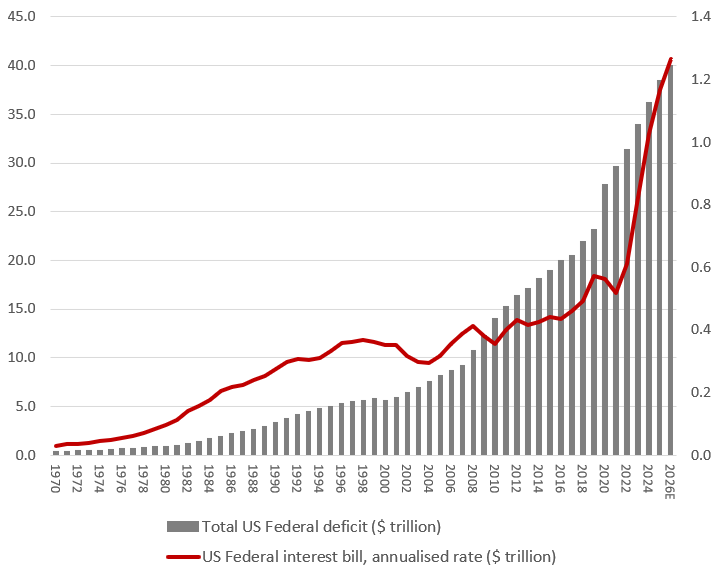
“The US deficit is currently 6% per annum and debt just topped $40trn, so the interest bill is $1.2trn,” Mould said.
“If you think the UK is in trouble, with 10p of every pound going on interest, in the US it’s 20 cents in every dollar – and that probably can’t go on forever.”
US deficit vs interest bill since 1970
Source: AJ Bell, St. Louis Federal Reserve database, US Congressional Budget Office
Mould does not know when the situation will come to a head but said the bigger risk is an unexpected US slowdown.
In the event of a slowdown or a bubble bursting, Mould expects investors to rush into bonds to ensure “some capital appreciation as well as valuable income”.
But this could create a bigger problem further down the line.
Mould said: “Normally a recession adds six percentage points to the annual US deficit. Can we really go from 6% to 12%?
“A 12% annual US deficit is enough to make what’s left of my hair fall out, and it certainly would make you wonder whether even a 5% yield is sufficient compensation, given the onerous supply.”
The yen: A changing narrative
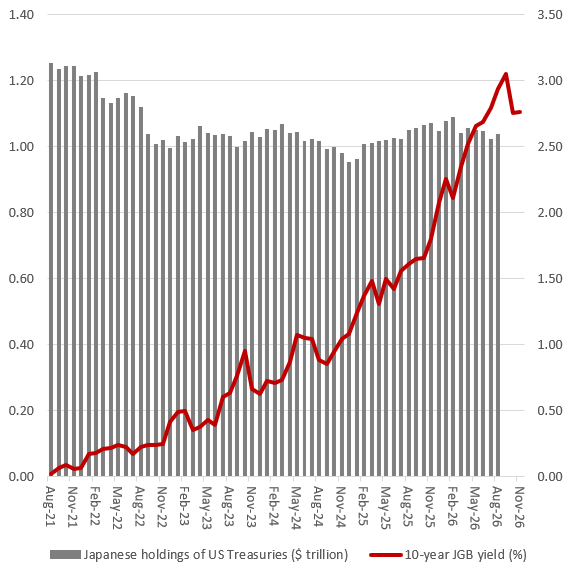
A sudden rise in the yen could also cause trouble for investors around the world, Mould warned. The currency has been the “sacrificial lamb” in recent years, falling sharply as Japan brings down its debt of more than 200% of GDP by letting inflation push up growth while keeping interest rates low.
“Maybe this is the ultimate solution for other countries: the US or the Europeans have to sacrifice their currency,” Mould said.
US treasuries owned by Japan
Source: AJ Bell, St. Louis Federal Reserve database, LSEG Refinitiv
US Treasury secretary Scott Bessent is likely watching closely, he added. Japan is the biggest overseas holder of US government bonds, and selling them to buy yen would push up US yields and interest costs.
The biggest risk is a yen that rises too quickly, Mould argued, noting that many hedge funds borrow in yen “because it costs you nothing” and that money can be used to fund overseas positions.
“If the yen starts zooming up against you, you close out, sell your overseas positions and the markets start getting ugly,” he said.