


Ahead of Anthropic’s stock market debut later today, new research from Aberdeen Investments suggests public market investors may already be arriving after the most lucrative stage of growth has passed.
The asset manager’s analysis of successive generations of landmark US and UK technology listings revealed that one of the most dynamic phases of a company’s growth increasingly takes place before it reaches public markets, allowing private investors to capture much of the upside.
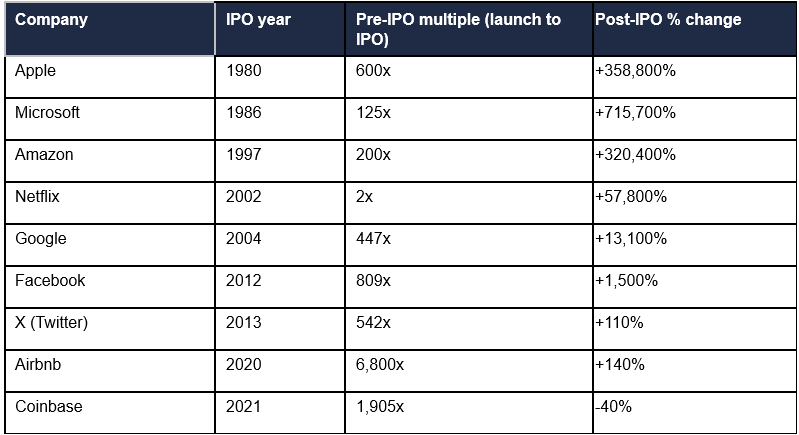
As shown in the table below, while companies such as Apple, Microsoft and Amazon generated substantial value after listing, more recent technology businesses have followed a different trajectory, generating huge value before going public, with public market outcomes proving far more mixed.
Source: Aberdeen, Securitize, FactSet
A similar pattern has emerged in the UK, according to Aberdeen.
Across five UK-founded or UK-listed technology companies, valuations increased by a median 31.7x between the first institutional funding round and IPO. Yet the median change in value after listing was just 2%.
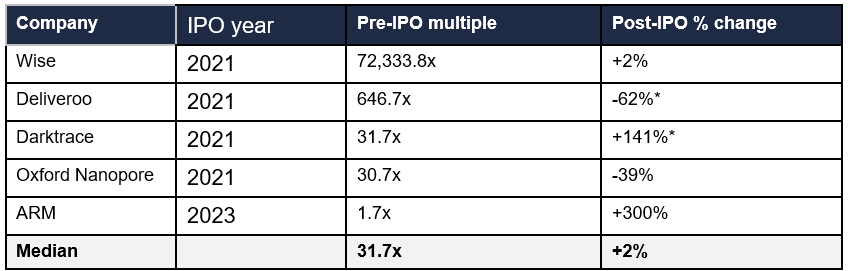
Source: Aberdeen, PitchBook, FactSet. Darktrace was taken private by Thoma Bravo in October 2024 and Deliveroo was acquired by DoorDash in October 2025.
Nalaka De Silva, head of private markets solutions at Aberdeen Investments and manager of Abrdn Global Private Markets, said: “Anthropic’s listing is a significant moment for AI and for markets but it also tells a wider story about where growth is built.
“Companies are staying private for longer and our research shows that by the time many of them reach the stock market, a lot of value creation has already happened.”
Separate research from Dimensional Fund Advisors appears to support the argument that public market investors often struggle to replicate the returns generated before a company lists.
Its analysis of more than 600 US IPOs between 2016 and 2025 found Russell 3000 IPOs returned an average 0.75% loss per month up to their first anniversary, compared with an almost 1% gain for the wider index.
Large listings have proved particularly challenging. According to Dimensional, three-quarters of the largest US IPOs over the past 20 years underperformed the market in their first 12 months, with a median underperformance of 33%.
The study also found that 60% of US IPOs between 2005 and 2024 had negative earnings at the time of going public, while the average IPO was more than twice as expensive as the broad market.
How many shares are available to trade can also affect post-listing performance.
Dimensional found the average US-listed company has 96% of its shares available to trade. For companies that listed between 2005 and 2024, however, that figure was just 34% one month after listing because insiders retained a large proportion of stock and were prevented from selling.
When these lock-up periods expire, typically six to 12 months later, the increase in shares available to trade can put downward pressure on prices.
Thomas Meinke, investment director at Dimensional, said: “This combination is usually bad news for investors, because companies with high prices relative to fundamentals and low profitability usually underperform.”
These questions will be put to the test later today, when Anthropic begins trading on the Nasdaq under the ticker ANT, having priced its IPO at $83 per Class A share.
The company was last valued at $965bn in May, with first-half revenue of $16.3bn – up from $1.2bn a year earlier.
The IPO price comes in below Morningstar’s $92 fair value estimate.
Malik Ahmed Khan, senior equity analyst at the firm, said that this estimate “reflects the significant growth we expect from AI adoption and Anthropic’s position at the frontier of model development, particularly in areas such as coding and cybersecurity”.
“However, investors should not mistake a discount to fair value for an absence of risk,” Khan said.
“Anthropic will need to sustain rapid growth while managing the enormous cost of developing and running its models and there is still considerable uncertainty around how the competitive landscape and economics of generative AI will evolve.”
Guy Thornewill, director of direct equities at Canaccord Wealth, said Anthropic’s stock market value is set to exceed $1trn, although he expects this to fluctuate significantly once trading begins.
“In recent months, investors have become more concerned about the sustainability of AI capital expenditure and the returns it will generate, which could put a dampener on initial enthusiasm for Anthropic shares,” Thornewill said.
He added that there is “little doubt” Anthropic has a huge revenue opportunity but said the company “needs to continually demonstrate this to maintain a strong market valuation – and token prices are likely to keep falling fast”.
De Silva maintained that a public listing remains a very important step for companies, as it provides liquidity, broadens ownership and establishes a market price.
“But they increasingly look like a milestone in a company’s development rather than its starting point, and the range of outcomes after listing, from ARM to Deliveroo, shows that public investors are not guaranteed the upside,” De Silva said.