


The fund management industry has changed markedly in the more than two decades that veteran stock picker Ben Whitmore has been running money on behalf of clients.
Starting at Schroders and moving to Jupiter, the star manager has enjoyed a long career following the value investing principle of buying cheap stocks and waiting for them to rebound.
But the style has been out of favour for a long time. When he started, Whitmore noted there were four very big fund management firms that dominated the UK asset management landscape: PDFM, Gartmore, Mercury Asset Management and Schroder Investment Management.
“PDFM and Schroders were value managers and the other two probably weren’t,” he said, making the industry a 50:50 split between growth and value. Today, while there are far more options for investors, that percentage shrunk down significantly.
“When interest rates were zero, or almost zero, it was harder for value investing because there was, if you like, no discount rate,” he noted, describing much of the post-financial crisis environment.
This led many to move away from the style, but over the course of history, there have been periods where value investing would work for a long period of consecutive years. Over the past 150 years, “low valuation as a starting point is a very good guide to subsequent returns”, he said.
“So I think we always stick to that premise, and it might be the case that value investing has a good run for a longer period or a harder run for a period, but that’s not something that we particularly worry ourselves about, because the long-run aggregate data is very powerful,” he said.
While noting that it is “not a timing tool”, investors may be interested in the strong performance of his more recent fund, launched last year.
Whitmore left Jupiter to set up Brickwood Asset Management and launched the TM Brickwood UK Value fund in February 2025. Since then, it has beaten the IA UK All Companies sector by more than 10 percentage points and the FTSE All Share index by 4 percentage points.
Performance of fund vs sector and FTSE All Share index since launch
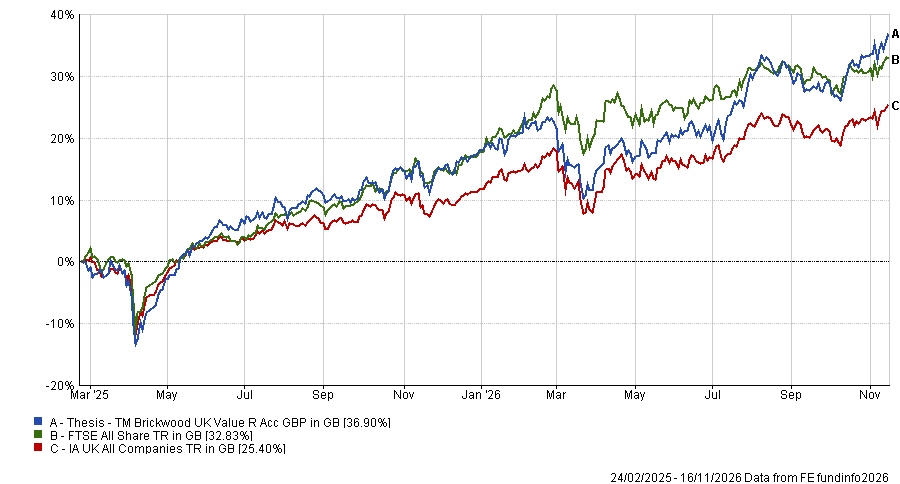
Source: FE Analytics
But when looking back across his entire career, which spans multiple decades at Jupiter and Schroders, his successes are almost at par with his failures.
“Over the long sweep of history, we’ve got just shy of 60% of our decisions correct and just around 40% incorrect,” he said, noting that it is impossible to know ahead of time which ones are going to sit in which category.
“You’ve always got things that have gone well and things that have gone badly. That is part and parcel of fund management.”
Once you understand and accept that mistakes are part of being an active fund manager, he said that this makes people think “very differently” about what they are investing in. For Whitmore, it means that his winners have to win more than his losers lose.
He borrows the phrase “look down, not up, when making your initial investment decision” from US value investor Joel Greenblatt: for each stock, the manager asks how much it can lose before looking at potential gains.
To ensure this is taken into account, he looks at trough valuations and asks what the impact on profits would be from a financial crash as severe as 2008’s. The Brickwood team wants downside of around 30% to 40% against upside of 100% to 200%.
“What we don’t want is the sort of, you know, make 60, lose 60,” he said. “That’s not what we’re interested in.”
Whitmore pointed to a recent example from his TM Brickwood UK Value fund: Travis Perkins. The builders’ merchant has struggled under rising interest rates, which slowed home moving and house building, and poor past management.
“The business has new management, and they’re managing it better, but it wasn’t managed well [historically] and so you had a sort of double whammy of poor management and a poor operating environment, which meant that the shares did very badly indeed,” he said.
“That presents itself to us as value investors as screening very attractively.”
Travis Perkins has lease liabilities and its profits have fallen, so it looks unattractive, but the manager argued that the small net cash position on its balance sheet means investors are not taking on financial risk, while a change in management direction could produce strong upside.
“If we had a period where house building and remodelling was at more normal levels, the normalised earning power of the business is substantially higher than any of the forecasts,” he said,
“For us, that’s the attraction: the low valuation, not taking a risk on the balance sheet, and where people are put off because the macro is against it and its recent set of profits have all been trending down.”
In his TM Brickwood Global Value fund, he highlighted Zimmer Biomet, one of the world’s largest hip and knee reconstruction businesses, as suffering from a “very poorly executed merger” between Zimmer and Biomet that led to significantly higher costs.
“The valuation was very low, but it was the world leader,” Whitmore said. “The returns are high and that would just be another case where there are issues, but they’ve been worked through.”
Overall, the UK fund has 50 stocks, while the global portfolio holds 55 names. Both are built from screens: the first is a cyclically adjusted price-to-earnings (CAPE) ratio that divides a company’s market cap by its 10-year average earnings, adjusted for inflation. The second is a Greenblatt screen, which ranks shares on valuation and quality.
But screens do not tell a full picture – which is why the active research is so important.
Indeed, at present the top ideas in the UK right now suggested by his screens are heavily dominated by companies exposed to construction. Anyone blindly following these screens would end up with “a fund that might have 70% in UK construction”, Whitmore said.