






The boom in private credit has eaten into the high-yield bond market, holding back its growth for a decade, according to Mark Benbow, co-manager of Aegon High Yield Bond.
“Private credit has effectively been cannibalising our asset class [high yield],” Benbow said. “Ten years ago, the high-yield market was around $2.2trn in size – a decade later and I would have expected the market to have at least doubled.”
However, in 2026 the high-yield asset class has hovered around the same size.
Size of the global high-yield market
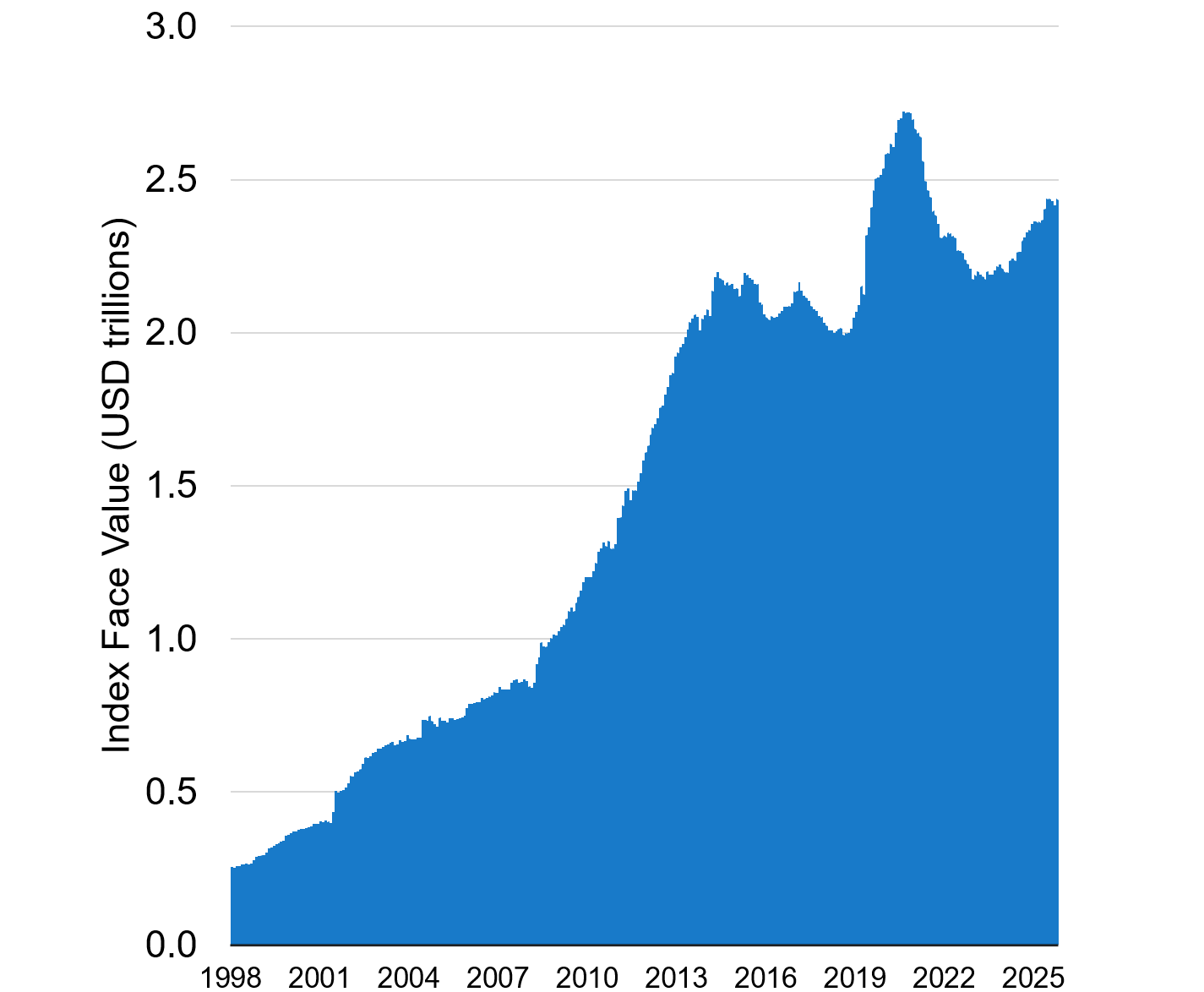
Source: Aegon, ICE BofA, Bloomberg. The face value of the ICE BofA Global High Yield index from 31 December 1998 to 31 October 2026.
Benbow attributed this stagnation to the scale of inflows into private credit and direct lending.
“Companies disappear from our universe into private, and they will come back a few years later – meanwhile, the high-yield market is growing a bit but not nearly as much as it should be growing,” he said.
Historically, private credit “didn’t really exist” before the global financial crisis, Benbow said, and was mainly used by companies too small to issue public bonds. But it grew rapidly as an asset class after Basel III rules made banks hold more capital against such loans, leaving direct lenders free to step in.
Now, the market can chase bigger borrowers who would once have gone to the public bond market, he said.
Global private debt assets under management
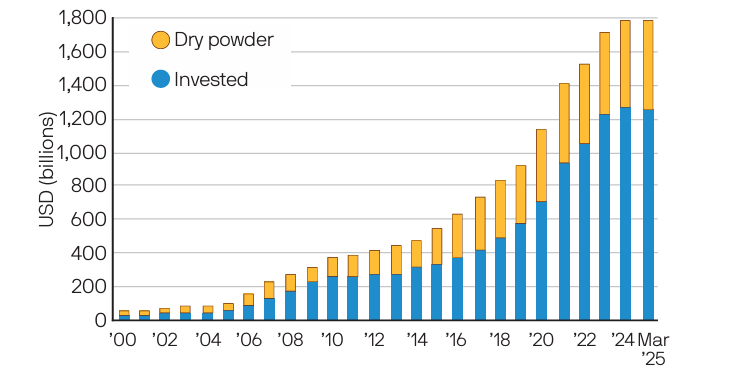
Source: JPMorgan Asset Management, Prequin. Data as at March 2025.
This is an issue that high yield managers will have to get used to, as Benbow does not expect investors to turn their backs on private lenders any time soon.
“Private credit is definitely here to stay,” he said. “There’s too much money in the system that wants to be put into private instruments.”
With this in mind, Benbow highlighted the positives and negatives of the asset class.
The pros for companies and investors
One benefit is that direct providers of private credit are able to provide favourable terms to companies – which could be a negative for the high yield market.
“The problem is they are giving these larger public companies cheaper terms it seems then we are giving them,” he noted.
“The weird thing about private credit now is it is cheaper for the companies to go private than public, and I think that is just a function of them having so much money to spend that they have to lower the funding rates.”
For investors, despite offering more favourable rates, a lock-in period of five to nine years means they can demand a higher return than in liquid bond funds.
There is also an illusion of stability, he noted. Because private loans are not traded, the lenders are also able to set their own prices, so in a downturn they can keep valuing them at par even when another market, such as high yield, has fallen 10%.
“It can make private credit look like it is doing amazingly well – but, if that bond was listed in a public market, it would drawdown with the rest of the market,” he said.
The cons for investors
There is one major drawback to private credit, and that is the lack of transparency.
In public markets, a company raising money goes through a bank, which then offers the deal to asset managers so that a fair price is set by supply and demand. In private credit, the borrower skips the bank and goes straight to a large direct lender with no view of the terms.
“The only thing we know is that the company has agreed a deal privately, so that bond will not be on any of our screens – it has no ISIN or identifier,” Benbow said.
The asset class is also narrower, with around 30% made up of software companies, Benbow said. This caused an issue earlier in the year, when AI caused mass panic that these businesses would come under serious pressure.
Since unlisted funds have no share price and still value their loans at par, investors tried to cash out of them and buy listed equivalents at roughly half price, Benbow said. That rush led many funds to block withdrawals, prompting fears that private credit was about to face its first real test or even a wider unwind.
“Every asset class needs to be tested at some point, and private credit had never yet been tested for outflows,” he said.
Although flows seem to have recovered, with so much private credit tied up in software, Benbow argued that anyone who expects AI to be widely adopted should be more wary of the asset class.
The silver lining for high yield
For high-yield investors, however, the rise of private credit has had an upside, as it has kept high-yield defaults artificially low and lifted the overall credit quality of the market, Benbow argued, “because all the dodgier companies have generally gone private”.
High yield is offering all-in yields of over 7%, lower fees and a better-quality market, with ‘BB’-rated bonds rising from 34% of the US market in 2000 to 55% in 2026 and defaults averaging under 1% since the Covid pandemic, according to the Insight Investment research.
US high-yield default rates, 2005-July 2026
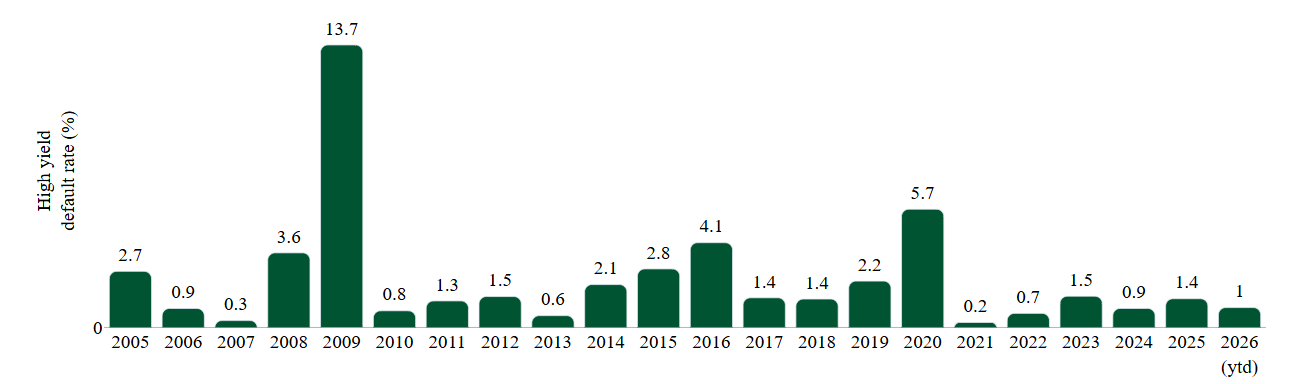
Source: Insight Investment
Insight Investment also found that concerns surrounding private credit are growing, with the extra return for locking money away shrinking while scrutiny over fees, liquidity, sector risks and regulation has increased.
The illiquidity premium within private credit over the first half of 2026
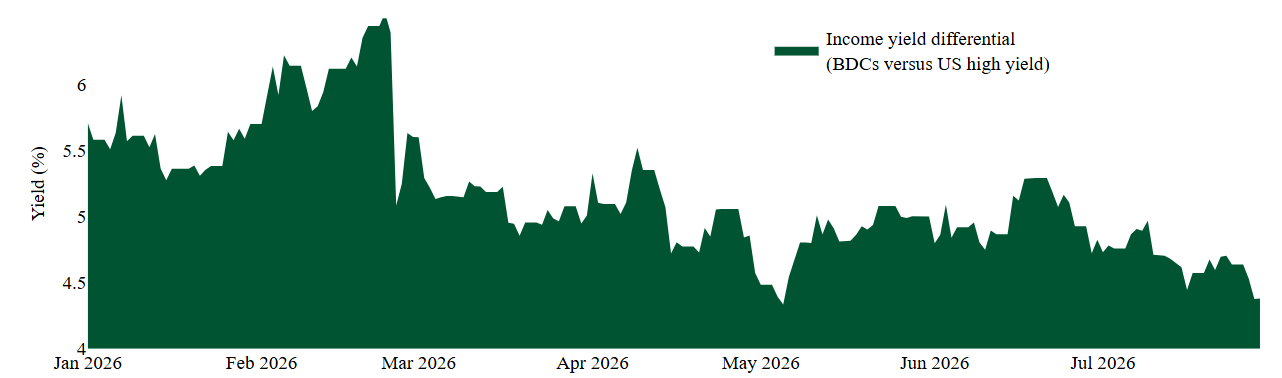
Source: Insight Investment
Additionally, the breadth of the high yield market is a benefit for those worried that AI will disrupt the software sector, which private credit is highly linked to.
“Meanwhile in public bond markets, AI has been more of an investment grade phenomenon than a high yield phenomenon, although there has been some growth,” Benbow said, noting that around 4% of the high yield index is in data centres.