






Global equity income funds play an important role for investors seeking diversified sources of dividends and long-term total returns. Their appeal has been reinforced by the IA Global Equity Income sector’s top-quartile performance against all Investment Association sectors over three, five and 10 years to the end of March 2026, suggesting the approach has held up across different market environments.
Among the most established options in the sector are Artemis Global Income and Guinness Global Equity Income – two funds with long track records but notably different ways of capturing global income opportunities.
Artemis Global Income has been managed by Jacob Tusch-Lec since launch in 2010 and co-managed by James Davidson since 2020. It blends income and capital growth, creating a portfolio tilted towards financials, industrials and emerging markets.
It has delivered the stronger short-term performance of the two funds, with first quartile returns in 2021, 2024 and 2025 – although its longer-term record includes several fourth-quartile years.
This is indicative of the Artemis strategy’s higher volatility profile with its 10-year volatility of 14.3% placing it in the most volatile quadrant of the sector. However, this higher-octane style has supported strong upside capture overall, with previous Trustnet analysis identifying the fund as a standout performer across multiple metrics over the past three years.
In contrast, the less volatile Guinness Global Equity Income, co-managed by Ian Mortimer and Matthew Page since 2010, has produced a more consistent long-term pattern of returns, sitting in the first or second quartile in most of the past 10 years – though it lagged in 2025 while the Artemis strategy excelled.
Performance of the two funds vs the sector over 10yrs
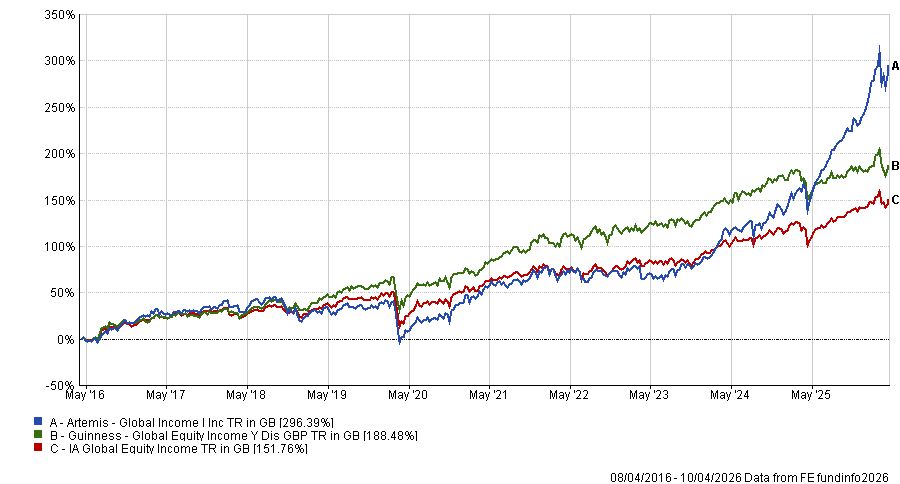
Source: FE Analytics
The Guinness strategy’s high-conviction, quality-focused philosophy emphasises companies with high returns on capital and a preference for dividend growth over high yield. The portfolio has big exposures to industrials, consumer staples and the US.
In addition, it is slightly cheaper with an OCF of 0.77% compared with 0.83% for Artemis Global Income and offers a marginally higher yield of 2.6% versus 2.4%.
But which is the better option for investors’ portfolios?
Kate Marshall, lead investment analyst at Hargreaves Lansdown, said the investment platform currently favours Artemis Global Income – a fund which features on its Wealth Shortlist.
“The Artemis fund has an excellent performance track record,” Marshall said, noting that, since the inception of each fund, the Artemis strategy has grown by 627.2% compared with 336.2% for the Guinness strategy.
“We like that income from the Artemis fund is generated through a variety of sources – from mature, reliable dividend payers to lower quality, higher yielding companies,” she added.
She said that the management team has “stayed true” to their philosophy during tougher periods but has also shown flexibility depending on market conditions.
Meanwhile, Darius McDermott, managing director at FundCalibre, said choosing one over the other depends on an investor’s style preference.
“If you expect value to continue leading, Artemis Global Income is an excellent option,” he said. “If you favour quality-growth, then Guinness Global Equity Income is among the strongest in its class.”
On balance, McDermott suggested that the Artemis strategy “has the edge” in the current environment, which is reflected in its superior three-year performance.
“With higher rates and more normalised inflation supporting value-style investing, that process has been well rewarded,” he said.
This doesn’t mean Guinness Global Equity Income should be overlooked, however.
“If the next phase of the market favours resilience, pricing power and balance sheet strength – particularly against a more uncertain geopolitical backdrop – Guinness’ portfolio looks increasingly appealing,” he said.
Scott Heaney, investment research analyst at Titan Square Mile, said there is currently a place for both in a portfolio – a choice that he has made for his personal investments.
“The Guinness fund, with its quality bias, matched up with the Artemis fund, with its value, contrarian style, work really well together,” he said.
Heaney noted that the Artemis Global Income managers are “really good at creating a macro overlay for the fund and thinking about where the obstacles in the road ahead could be – positioning the fund accordingly”.
He pointed to the fund’s high allocation to financials and industrials – two sectors that have outperformed in recent years – as an example.
However, he noted that the fund is “probably more volatile and could face larger drawdowns”.
Heaney said this is where the Guinness strategy comes into its own as a more “all-weather” strategy which “invests in companies that can endure through economic conditions, applying a strong quality filter”.
“The Guinness strategy is low turnover, low transaction costs – definite positives,” he said.
“However, the concentration of around 35 equally weighted stocks does increase individual stock risk. If one holding suffers, it has a noticeable impact.”
A different fund in the sector appealed to Dzmitry Lipski, head of fund research at interactive investor. If he had to select one fund, his preferred option is Fidelity Global Dividend – a more cautious strategy with lower US concentration and a focus on sustainable dividends.
“However, blending the Fidelity strategy with Artemis Global Income and Guinness Global Equity Income reduces reliance on any single driver – whether value rotation (Artemis), quality-growth leadership (Guinness) or broad diversified income (Fidelity) – and creates a more balanced global income allocation within a portfolio focused on both income and long-term capital growth,” he said.
McDermott also suggested a more flexible strategy could be utilised to bridge the gap between the styles targeted by the Artemis and Guinness funds, such as the high-conviction global growth portfolio offered by Nutshell Growth.