






Only 3.4% of equity funds stayed in the top quartile of their sectors through both the Iran war sell-off and the subsequent ceasefire rally, research by Trustnet has found.
On 28 February 2026, US and Israeli forces launched nearly 900 strikes in 12 hours against Iran, killing supreme leader Ali Khamenei and dozens of senior officials. Iran responded the same day with Operation True Promise IV, striking Israeli cities and Gulf Arab capitals including Abu Dhabi, Riyadh and Kuwait.
A 48-hour suspension of strikes beginning 27 March, followed by the tentative Islamabad Accord, gave the market some respite, then a two-week ceasefire brokered by Pakistan took effect in early April. US president Donald Trump extended the ceasefire on 21 April, though the US naval blockade of Iranian ports remained in place.
FE Analytics shows the MSCI AC World index fell 7.4% in sterling terms over the one month that followed the beginning of the conflict. Then, in the month after the hostilities started to cool, between 28 March and 27 April, global equities rebounded 9.3%.
Over the full period (28 February to 27 April), the MSCI AC World has gained 1.2%.
Equity funds were hit hard when markets sold off. Of the 2,226 funds in the Investment Association’s equity sectors, just 19 – or 0.9% – avoided making a loss in the first month. They rebounded strongly, however, with 2,167 equity funds – or 97.3% – making a positive return in the ceasefire rally.
This means that 863 equity funds (or 38.8%) are in positive territory since the Iran war started on 28 February.
In this article, Trustnet is looking for the funds that managed to stay in the top quartile of the equity peer groups in both the initial sell-off and the subsequent rally. Our analysis found that just 3.4% of equity funds – or 76 – have managed to do this.
Source: Finxl
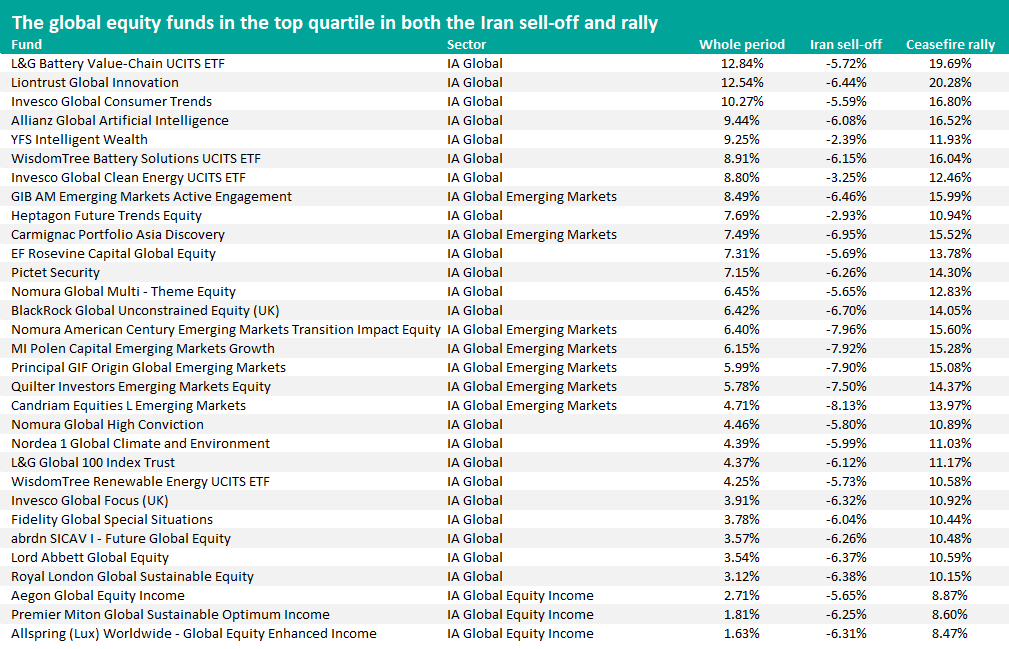
Some 31 of these reside in the IA Global, IA Global Equity Income or IA Global Emerging Markets sectors and can be seen in the table above, ranked by their total return over the full period under consideration.
At the top of the list is L&G Battery Value-Chain UCITS ETF, which is up 12.8% since the start of the conflict (following a 5.7% decline in the sell-off and a 19.7% rally after the ceasefire).
As its name suggests, the fund invests in the end-to-end value chain of battery technology, which is critical to applications such as electric vehicles, consumer electronics and grid storage.
WisdomTree Battery Solutions UCITS ETF is also found on the list of funds that achieved top-quartile returns in both the up and down-market phases of the Iran conflict, as are Invesco Global Clean Energy UCITS ETF, Nomura American Century Emerging Markets Transition Impact Equity and WisdomTree Renewable Energy UCITS ETF. Investors bought into battery technology and renewables stocks in the belief that higher oil prices would spark more interest in alternative energy sources.
Other than this, few clear trends can be seen in the list of funds above. Many take a broader approach to investing than the focused strategies already mentioned, such as Aegon Global Equity Income, Fidelity Global Special Situations and Lord Abbett Global Equity.
BlackRock Global Unconstrained Equity is one fund singled out by the FE Investments team for its track record in performing strongly in both up and down markets.
“Since launch, the fund has shown it can benefit from strong market rebounds, as seen in 2020 and late 2022 into 2023,” they said. “When its approach has been out of favour, such as in 2021, 2022 and Q2 2024, it has still held up better than many peers thanks to its focus on high-quality businesses and a requirement that at least half the portfolio is in steadier, more resilient companies.”
Source: Finxl
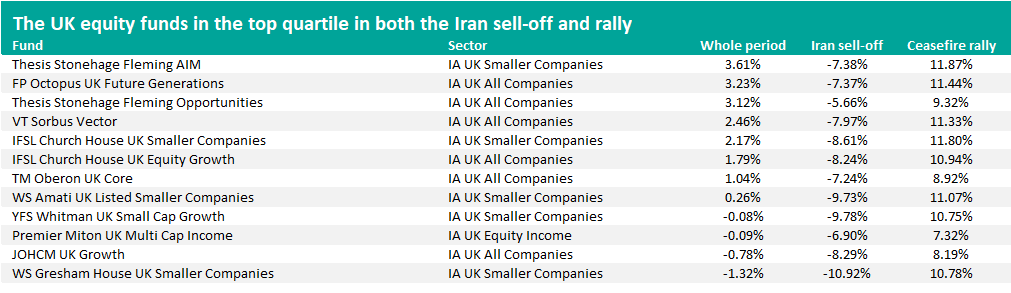
Turning to UK equities, there are 12 funds in the IA UK All Companies, IA UK Equity Income and IA UK Smaller Companies sectors in the first quartile during both periods. The returns over the entire time frame are much lower than those from the global sector, with the best performer on the list above – Thesis Stonehage Fleming AIM – making a 3.6% total return since the war’s outbreak.
This fund focuses on the UK Alternative Investment Market, which is a sub-market of the London Stock Exchange designed for smaller, growing companies. This hints at the wider theme seen among the best UK equity funds in this research: a bias to smaller companies.
Almost every fund on the list above has its portfolio tilted towards smaller companies, even those that reside in the IA UK All Companies and IA UK Equity Income sectors. This appears to be down to fortuitous stockpicking by these funds as the UK small-cap market has underperformed over the same period: the MSCI United Kingdom Small Cap is down 5.1% compared with a 4.8% fall from its large-cap counterpart.
The exceptions are IFSL Church House UK Equity Growth and JOHCM UK Growth, which tend to have more in mid-caps. The MSCI United Kingdom Mid Cap index is down 3%, beating both large- and small-caps.
Source: Finxl
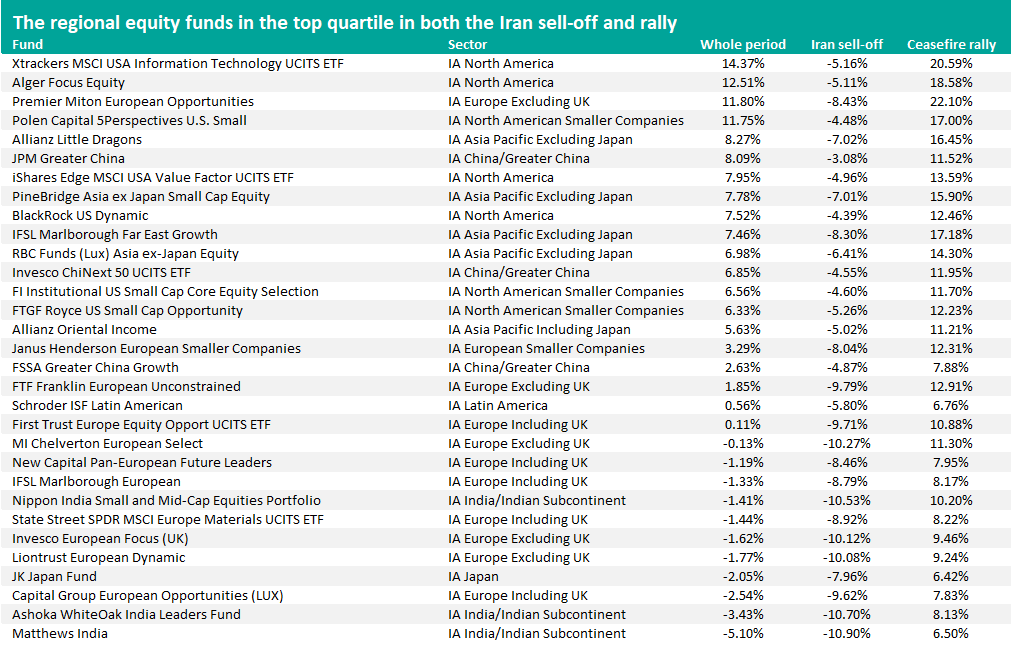
Another 31 funds from the various regional equity fund sectors in the Investment Association universe have top-quartile returns for the Iran war sell-off and rebound.
Again, there are few clear trends in this list, reflecting the broad range of markets involved. Four of the funds are on FE Investments’ Approved List: Janus Henderson European Smaller Companies, Liontrust European Dynamic, Premier Miton European Opportunities and Schroder ISF Latin American.
FE Investments analysts have insights into the three European funds’ ability to navigate varying market conditions.
On Janus Henderson European Smaller Companies, they said: “Long-term relative performance has been strong thanks to a combination of superior stock selection and a strict sell discipline. Due to the balanced approach, the fund has successfully navigated most market environments.”
They said Liontrust European Dynamic’s “ability to call market inflections through use of its market regime indicators on momentum, investor anxiety and corporate confidence has led to remarkably consistent performance through the cycle”.
Premier Miton European Opportunities, meanwhile, has significantly outperformed the benchmark due to its managers’ stockpicking skills in small companies with a strong competitive position and good long-term potential.
When it comes to funds that focus on a particular sector, only GS Global Future Technology Leaders Equity Portfolio and Polar Capital Healthcare Discovery are in the top quartile in both periods examined in this research.