






Asia's rally over the past year has had one driver: AI. Under these circumstances, it might be surprising that an income trust such as Schroder Oriental Income has been doing as well as it has.
The £1bn trust has topped the IT Asia Pacific Equity Income sector over one, three and five years, returning 52.8% against 40.7% for the sector and 38.9% for the MSCI AC Pacific ex Japan index over the past 12 months.
It has also been popular among investors and was among the best-selling investment trusts on Fidelity Personal Investing in July.
Their enthusiasm is matched by the trust’s manager, Richard Sennitt, who said there is “a huge opportunity if the market starts to broaden beyond AI names”.
“We could be wrong and we could lag the overall market if AI continues to do very well,” he said. But his bet is that a consistent, longer-term approach to valuation wins out once the theme fades, even if it means short periods of underperformance along the way.
Below, he explains why he's positioning for a broadening beyond AI and how that's reshaping the trust's exposure to China, Hong Kong and India.
Performance of fund against index and sector over 1yr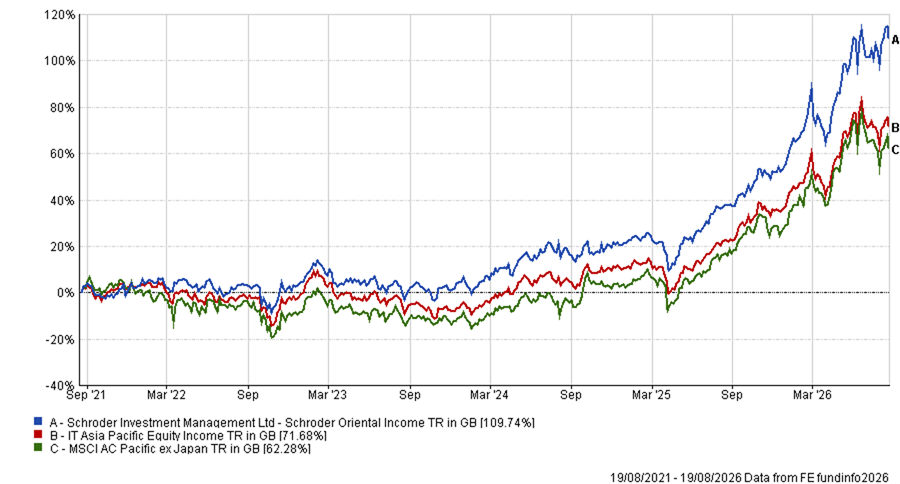
Source: FE Analytics
What is the philosophy behind Schroder Oriental Income?
The approach to managing the trust is very much based on the belief that markets are inefficient, especially in Asia.
We buy quality businesses that have got attractive dividend prospects, but also the potential for upside to capital growth.
Even though it's an income trust, I’m not screening the universe for the highest yielding stocks and backfilling the portfolio with those names.
How do you select your holdings?
We have a team of analysts based across Asia going out visiting the companies, writing the research, setting fair values and I'm drawing on their best ideas from an income perspective to create a portfolio of around 60-odd names.
It’s a bottom-up fundamental process and we tend to have a bit of a value bias.
We'll have companies that generate a higher yield – and they tend to be slow growing but with very solid cashflows – and then those that don't yield as much but have underlying earnings growth, so the income is growing over time.
Then there will be some room within the portfolio for putting in names where perhaps they don't pay an income at the moment, but we can see a clear path to that income being realised. That is relatively rare within the portfolio.
What is your allocation to India?
India is only roughly a couple of percent of the portfolio. Historically it has been quite expensive and therefore relatively low yielding.
The market more latterly has started to come back and lag the rest of the region, so it is a potential market for looking to new opportunities, but I suspect it'll be a while before you see a sizeable increase in the weight in India within the portfolio.
But as that market comes back, there's room for opportunities there.
And China?
We've generally been quite overweight Hong Kong and very underweight in China.
Notwithstanding the internet platform companies not being particularly attractive, there are increasingly more opportunities in that market. Over the course of the last year we have gone from being heavily underweight to only slightly underweight.
It has been in a lot of stocks that have been relative laggards, but with reasonable valuations and less directly impacted by the macroeconomic backdrop in China.
How have you navigated the semiconductor rally in Asia?
Roughly two thirds of the market has underperformed the index by more than 20 percentage points over the course of the past 12 months, so there are a lot of names that have been left behind that are starting to look more attractive from a valuation standpoint.
And what that has meant within the portfolio over the course of the past 12 months is that I have been taking some money out of IT names, which is now the biggest underweight segment within the portfolio, and rotating that into other areas, which has included names in Hong Kong and China.
I'm underweight both Taiwan and Korea, but there's a reasonable exposure to those markets. Taiwan, in particular, until about 12 months ago, was actually a pretty good yielding market, because corporate governance has historically been good and shareholder return focus has been good, and yields were in an absolute sense relatively attractive.
Of course, over the past 12 months, some of those names have done very well, given what I've just said about AI, and so those absolute yields available in Taiwan have come down.
How much have the allocations changed in the past year?
In IT I would have been slightly overweight and am about 6% underweight now as a total portfolio level. In Hong Kong and China I am about 2% underweight – a year ago it would have been about 7% underweight.
I think there's still opportunities on a stock-by-stock basis and so I am continuing to look for ideas there but it's a slow move rather than a wholesale shift.
What were the best and worst calls of the past year?
One of the top contributors has been a Taiwanese tech company called ASE, which is a semiconductor packaging company that has obviously been benefiting from the increase in spend around AI capex. That was up something like 230% over the past year. But there's a number of other IT names that have done pretty well as well.
At the other end of the spectrum, most countries in Asia are importers of oil and energy and gas, and therefore a higher energy price due to what’s been going on in the Middle East is a headwind.
Indonesia was the worst performing market over the course of the last year and one of our holdings there, Telecom Indonesia, was the weakest in absolute-return terms. That's down more than 19% over the period.
Why should investors pick this fund?
People are often surprised how much of the total return of Asia has come from reinvestment of dividends rather than pure growth.
Just because it's an area of high growth from an economic standpoint doesn't necessarily mean that you always want to own growth stocks to generate the highest longer-term returns.
What do you do when you are not working?
I enjoy sports, but it's more watching than participating these days.
And I do like to ride my bike. I find it a really good way to get out into the open spaces, clear the mind.