






Long-term gilt yields would need to hit around 7% for the UK economy to start to feel “real pain”, according to BNY Mellon UK Income manager David Cumming.
While the current spike in yields is “not helpful”, he said there is no concern of recession in the UK and that markets are “a bit too bearish” on the potential for economic slowdown.
One reason yields are rising (and therefore pricing in rate hikes) is because there is uncertainty with the change in prime minister. Rate hikes tend to bring down inflation but also stymie growth, hence the link with recession.
However, Cumming noted that inflation has been caused by non-UK-related factors such as the war in the Middle East. “It's really a global thing,” he said, with the latest bond market reaction over the summer focusing more on the worldwide political environment than the domestic one.
If US treasury yields hit 5%, this would be enough to fast-track negotiations between America and Iran, he argued, bringing an end to the current conflict. When the conflict ends, that should bring inflation back down as energy prices soften.
“Thinking 12 months from now: rates will be being cut in the UK and things will get better, assuming the war isn't still going on in the Gulf,” he said.
This is creating opportunity, as the market can get “out of sync” when strong long-term fundamentals are coupled with weak near-term trading.
“Consumer discretionary has been hit quite hard because people are worried about the near term,” he noted, as have some building materials companies and housebuilders.
“Quite a lot of the opportunities I see at the moment are in stocks that are mispriced if things get a bit better,” said Cumming.
Below, the co-manager of the £2bn BNY Mellon UK Income fund outlines why he has the full 20% allowance invested in overseas stocks, how Volkswagen has been one of his biggest disappointments and why he is happy swimming against the tide.
What is your process?
I spend as much time as possible seeing companies on a one-to-one basis and asking them questions. The second part is we've got a lot of resources here – global managers and analysts – and I try to get them to help me in terms of ideas, seeding companies and supporting me in that process.
Thirdly, my clear objective is to beat the index and the competition, so the portfolio construction is geared to deliver clear targets in terms of outperformance and risk.
In terms of income, the fund is run to a minimum of 10% above the market yield. The yield's about 4%; it's usually a bit above that.
We tend not to go below a billion in market cap, and another slight differential with this fund is we can invest up to 20% outside the UK, which we do. At the moment we've got about 19% of the fund in Europe and 1% in Hong Kong, actually.
Why do you have so much overseas?
If we're buying, say, a farming company, there might be a better one outside of the UK, which is quite a narrow sector here. So it's really best-in-class, themes or opportunities we can't get in the UK.
The UK is quite a narrow market these days. The mid-cap space isn't that liquid and the mix of companies in there is quite tight. So having that opportunity to go global and still hit the yield threshold gives you better optionality, better liquidity and better performance options.
BNY Mellon UK Income has topped the IA UK Equity Income sector since you took charge. What has worked?
It's mainly alpha generation. Obviously mid-cap in the UK has been quite [challenged], so having the option to be more large-cap has not been bad over that period.
I suppose the two big themes that helped me, if I take the five-year period, have been being long financials and short staples. Everyone hated banks four or five years ago and there was a big underweight of staples, which everyone loved at that point.
Performance of fund since manager start
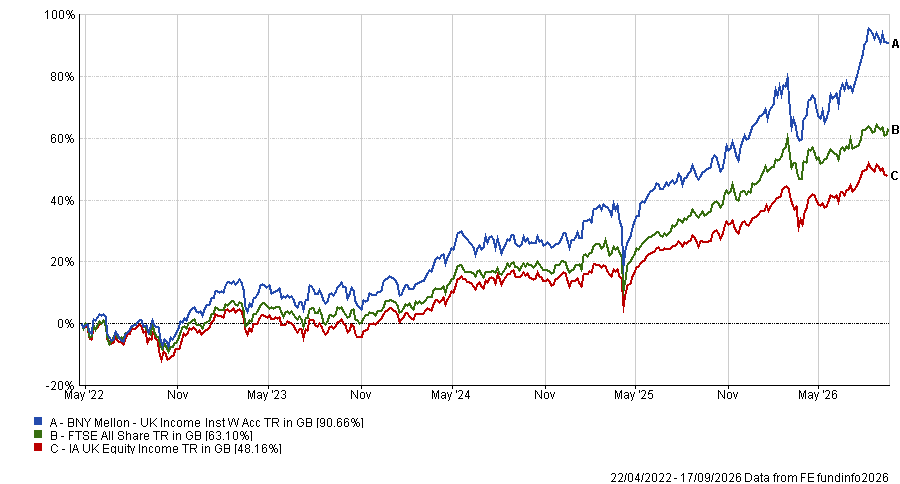
Source: FE Analytics
Philosophically, I don't care where I make money. I don't have this fixed idea that it's got to be quality [or value]. I'm eclectic in that sense. If you went back four or five years, banks were quoted as uninvestable and I'm not fazed by that sort of thing. I'm quite happy to go against the flow.
One of my mantras is a quote: ‘Only dead fish swim with the stream.’ I'm quite happy to do what other people are not doing and that's been helpful.
What have been your best and worst holdings?
The best has to be banks, because that's added the most value. Banks that were trading at half book value have all tripled, so you've made a few hundred percent on some of those trades. That's been the best thematic and stock-specific area.
The worst I'd probably say – and this is a live worst, because I've still got the position – would be autos. I've been buying autos for the past 12 months or so and that definitely hasn't worked.
Volkswagen and Renault are the two stocks we've got in there. The market hates autos and they've struggled against China. But the reason we still hold them is they're breathtakingly cheap.
Volkswagen is the largest company in Europe by revenue and its market cap is about €40bn. It's got about €20bn of cash, so it's on a P/E [price-to-earnings ratio] of 4x. If it turns thing round, it doubles.
What do you do outside fund management?
My family are all musicians. I play piano, my son plays as well and my brothers are both musicians – one of them won a Grammy a couple of years ago, so he's quite good. We play jazz together.