






US treasury yields have risen to their highest levels since the global financial crisis but strategists at Nuveen and BlackRock Investment Institute say the cause behind the move matters more than the level reached.
The 10-year US treasury yield reached 5.25% on 28 September, a level last seen in 2007, as investors continue to react to stronger-than-expected purchasing managers' index (PMI) data and a robust labour market. The 30-year yield rose to 5.57%, its highest since 2004, and the two-year yield touched 4.93%.
Mauro Valle, head of fixed income at Generali Asset Management, pointed out that real US interest rates – or nominal rates minus inflation – climbed to 2.9%, the highest since 2008, while inflation expectations held broadly steady at 2.35%, suggesting growth expectations are driving the rise.
"Strong economic data, a resilient labour market, robust AI capex, easier fiscal policy and persistent energy inflation are forcing markets to reconsider the level at which rates could find an equilibrium," Valle added.
"If the US and Iran start to negotiate again, reducing uncertainty over oil flows and leading to lower energy prices, we continue to believe that 5% could be a neutral level for the next few weeks."
US 10yr treasury yield rise driven by real yields
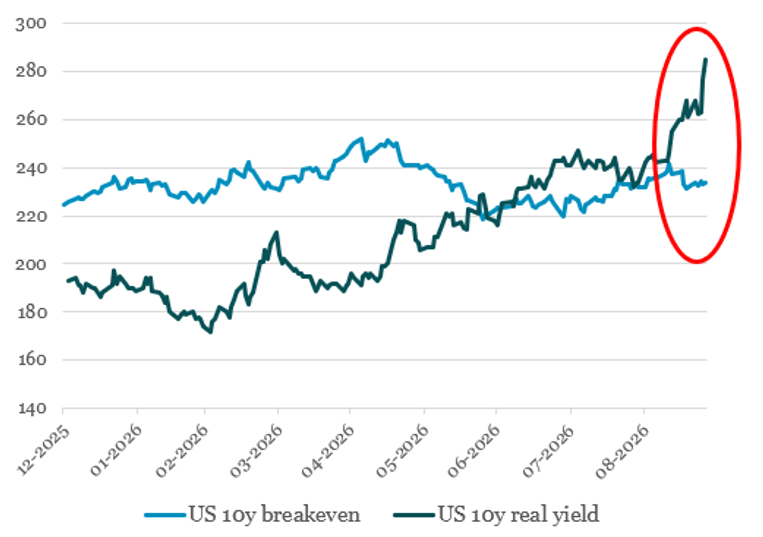
Source: Nuveen, Bloomberg. As at 25 Sep 2026
The Federal Reserve raised interest rates on 16 September, lifting its target range to 3.75%-4% from 3.5%-3.75% in a unanimous vote. It was the Fed's first increase in three years and the projections released alongside the decision pointed to at least one further quarter-point rise before the year ends.
"The macroeconomic data remains robust," Valle said. "Stronger-than-expected PMI readings heightened concerns over demand-driven inflation, leading markets to significantly increase the probability of an October rate hike. Hawkish remarks from FOMC members further reinforced this view. The market is pricing a 70% probability of an October hike."
Laura Cooper, global investment strategist and head of macro credit at Nuveen, said investors spent most of the summer seeing a 5% yield on 10-year US treasuries as "the line markets could not cross without something breaking".
However, she noted that equities and credit have avoided serious damage despite US government debt yields breaching this level. That resilience challenges the assumption that 5% itself was the danger, so Cooper instead pointed to the pace of the climb as the greater risk.
"Markets can make their peace with a yield above 5% if it arrives slowly. Investors get time to rebalance, and companies and equity valuations can adjust to a higher cost of money at their own pace," Cooper explained.
"A fast repricing is a different animal. Bondholders are left nursing mark-to-market losses and some are forced to cut positions or reduce leverage at the worst moment, tightening financial conditions in the process."
In a note last week, strategists at BlackRock Investment Institute said the rise in borrowing costs has mostly reflected higher real rates and expectations of tighter Fed policy. That differs from a jump in the term premium, the extra compensation investors demand for holding long-term debt.
The strategists said the Fed's rate increase helped restore some of the credibility needed to keep that term premium contained.
"A rise in yields driven by resilient growth, investment demand and central-bank efforts to maintain credibility can coexist with our pro-risk stance," they said. "A rise increasingly driven by inflation or concerns about policy credibility would be more concerning."
Equity prices and bond yields have moved differently on the same data through September. The VIX – often called Wall Street's 'fear gauge' – has stayed at historic lows even as a measure of implied rate volatility jumped to its highest level since March, which Cooper attributed to "solid" earnings momentum.
"The bigger risk for equities is a change in what is driving yields higher. Stocks can live with yields rising on strong growth expectations because robust earnings provide an offset to the higher discount rate," Cooper said.
"There is much less of an offset when inflation or a higher term premium is doing the work. For now, earnings are winning the argument, and we remain constructive on risk. Third-quarter reporting season will show whether that can last."
The war in Iran remains another risk, however. The Strait of Hormuz remains effectively closed, with Brent crude trading above $100 a barrel and adding to already elevated inflation pressures.
If those higher energy costs spread into wages and other prices, the BlackRock strategists argued core inflation could become more persistent and keep monetary policy tighter for longer.
This week's US data will be closely watched as a result. Core PCE, the Fed's preferred inflation gauge, is expected to hold at 3.3%, and the September jobs report is due on Friday, with the consensus tipping a 90,000 increase in payrolls, Valle said.
Markets are also watching the ISM Manufacturing Index, particularly its prices paid component, and consumer confidence data this week, he added.
Nuveen's Cooper said relatively benign prints in the US economic reports would not add to the hawkish narrative, though an extension of sticky inflation and steady employment would keep pressure on yields. BlackRock strategists are watching flash PMIs for signs that business activity is holding up as borrowing costs rise.
With yields at multi-year highs, Cooper said investors are being paid to wait and volatility is creating more opportunities to be selective across duration and credit. Nuveen has trimmed its underweight to US duration as valuations have improved, though it still sees upside risk to long-end yields, particularly if higher diesel prices feed into core inflation.
In credit, Cooper said that earning carry in higher-quality names is preferable to reaching down the rating spectrum for extra yield, with floating-rate senior loans, which yield above 9% in the broadly syndicated loan market, offering income without adding duration.
She added that selective emerging-market debt offers a further source of diversification, since several central banks in that asset class entered this period with higher real rates and more orthodox policy than their developed-market peers.
"Markets have cleared 5% intact, though the speed of the climb has raised the stakes. We remain patient on duration awaiting inflation clarity and stay selective on credit," Cooper finished.
"The income is back and this autumn's volatility is creating opportunities to put it to work."