






Many global investors have stepped back from China in recent years.
Scottish Mortgage, which has been investing in the country for almost 20 years, utilising in-house research from a Baillie Gifford team based in Shanghai, trimmed its own China weighting from 24% of the portfolio at the end of 2020 to 11% in September.
But it would be a mistake to think that steering clear of Chinese shares removes China risk from a portfolio, according to Lawrence Burns, co-manager of Scottish Mortgage.
“If you don't own any Chinese companies, it doesn't mean you don't have China risk in your portfolio,” he said.
For example, China is “incredibly important” to both Tesla and Apple as a consumer market and as a manufacturing hub. The same applies to Western retailers, said Tom Slater, FE fundinfo Alpha Manager on the trust.
“If you look at commerce, I don't think there's a Western commerce market that you can analyse without understanding the effects of Temu or Shein,” he said. “These are business models which have been created in China and then brought to these markets and completely changed the dynamics in them.”
Performance of fund against benchmark and sector YTD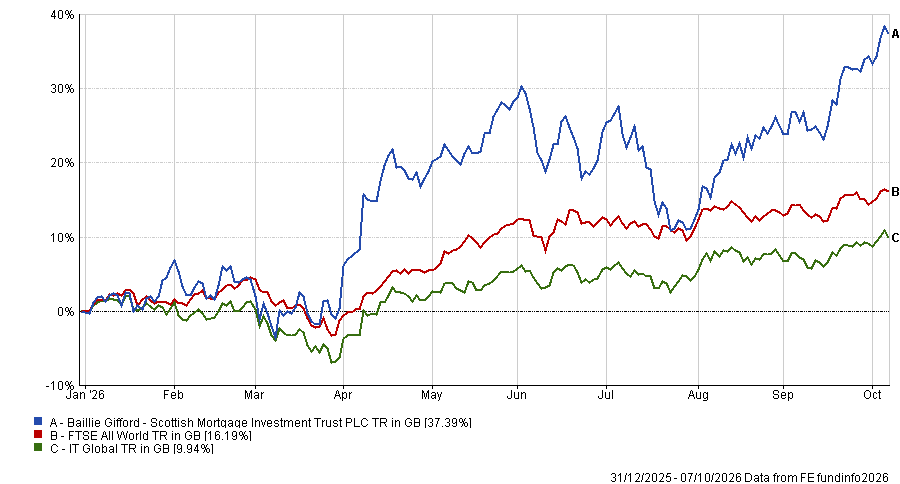
Source: FE Analytics
This doesn’t mean that investing in China or Apple and Tesla carries equal levels of risk. Burns and Slater build geopolitical risk and China's domestic regulation into scenarios for each Chinese company they own.
For electric vehicle manufacturer BYD, for example, one of their scenarios assumes it never sells passenger cars in the US and allows for tariffs and political resistance limiting its share in Europe.
“Even with these headwinds, is there a good risk-reward available?” Burns said. “In some cases, there isn't and in some cases, like BYD and our other holdings, we think there is.”
The scenarios also have to cope with a risk shared across the China holdings: that America tries to limit the amount of US money that can be invested in Chinese companies. This can have impacts on valuations, Burns said.
He also noted the market treats the same risk differently depending on where a company is listed: “I'm not sure there's really much discount built in for the China risk. Whereas when you're investing in China, the market is very pessimistic. And you can see that in very low valuations applied to very fast-growing, capable companies,” he said.
“And so for us, it's the ability to get access to these innovative businesses in a moderate way and do so at a risk-reward that we think makes a lot of sense.”
Cheap valuations have not lifted Chinese shares this year, with the MSCI China losing 11.3% over the year to date, as shown in the chart below.
Performance of index YTD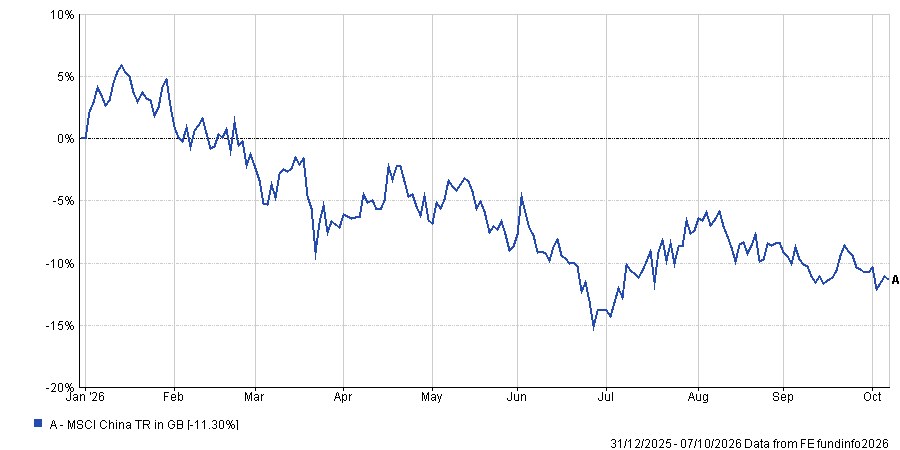
Source: FE Analytics
The Chinese companies the managers hold and are most bullish on include BYD, CATL and ByteDance.
BYD's appeal goes beyond price, according to Burns. Its cheapest model in China, the Seagull, sells for about £8,000 and is “a very decent car”, he said, but the company's edge is in the supply chain.
“What's impressive about BYD in terms of sophistication is it does its own chips, motors and batteries. That is very rare in the automotive world,” Burns said.
“In China, BYD is building out their fast-charging technology, where you can charge in five minutes for a 400-kilometre range. Europe's at a fraction of that. And it’s planning to bring that technology to Europe. My experiences of Chinese EVs make me very worried about the future of the European mass auto market and how it responds in the long run to them.”
Meanwhile, CATL supplied almost 40% of the world's electric vehicle battery market last year and its batteries are in more than 24 million cars.
Slater said CATL is also moving into grid-scale storage, which involves large battery installations that store electricity from the grid or renewable generation and release it when demand is high, describing it as a market that is “growing very rapidly”.
He added: “There's something in there about the culture, about being prepared to walk away from what worked last year if you think there's a better solution this year, to make sure you're progressing all the different technologies so you're in a position to pick the winner.”
TikTok owner ByteDance is the trust's largest Chinese holding and makes up 2.3% of the whole portfolio.
Linda Lin, head of China equities at Baillie Gifford, said: “When people are talking about AI, fewer people think ByteDance is the strongest AI player in China. It has its own model and the most powerful distribution platform both in China and globally.”
Finally, Lin considered another underestimated risk China poses to global portfolios. Her example was semiconductors, as the US has restricted the export of advanced chips and chipmaking equipment to China to slow its progress in the technology.
“Imagine if China can produce its own alternatives, even with those big restrictions. What does that mean for our other global holdings?” she asked.