


Semiconductor stocks – one of 2026’s market darlings – crashed last week after inflation data, interest rate expectations and doubts over artificial intelligence spending weighed on sentiment.
The Philadelphia Semiconductor index fell 11.4% in US dollar terms in the week ending Friday 16 October, FE fundinfo data shows, compared with a 1.6% fall in the broader MSCI AC World.
The semiconductor index has had a strong run in 2026 and remains up 57.2% for 2026 despite last week’s fall, against a gain of 12.5% for the MSCI AC World.
Performance of Philadelphia Semiconductor index vs ACWI over 2026 to date
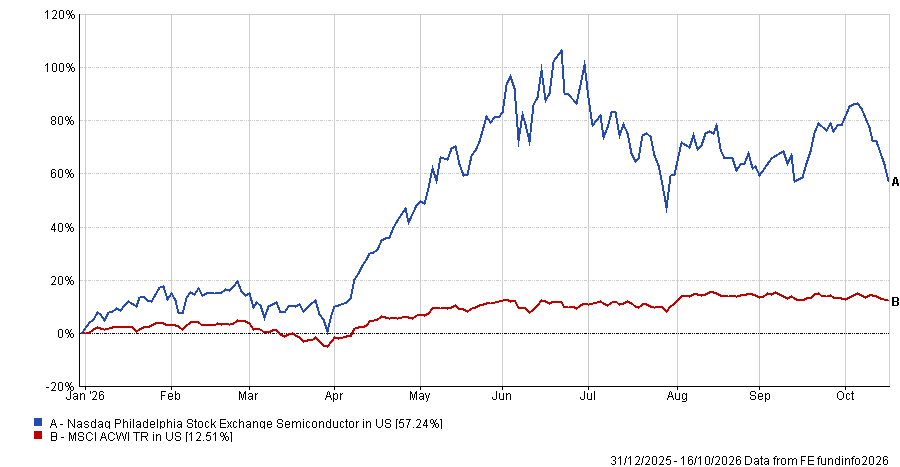
Source: FE Analytics. Total return in US dollars between 1 Jan and 16 Oct 2026
US consumer prices rose 3.7% year-on-year in September, up from 3.4% in August, the latest data from the Bureau of Labor Statistics shows. Producer prices rose 6.3%, up from 5.4%, the fastest increase in more than four years, raising expectations of a further Federal Reserve interest rate rise.
Higher interest rates tend to be bad for growth stocks because they lower the present value of profits due in the distant future and growth companies get most of their value from those profits.
Chip stocks SK Hynix, Samsung and Micron also fell during the week, with Micron down 4.3%. Western Digital, SanDisk and Seagate Technology also fell more than 5% in a single session, according to global advisory firm Norman K.
Dell dropped 19.2% after Barclays downgraded the stock, citing concerns over slowing growth in AI infrastructure spending, Edmond de Rothschild Asset Management noted. TSMC fell 1.8%, despite reporting record quarterly results of NT$763bn, 2% ahead of consensus estimates.
The falls followed an announcement from Chinese manufacturer CXMT of a memory chip positioned to compete with SK Hynix, Samsung and Micron. Grégoire Kounowski, head of advisory at Norman K, said: “Behind the scenes, speculation is rife regarding the date by which this AI sub-segment might reach saturation.
“Major manufacturers have invested heavily to build new factories within the next three to five years. Industry insiders therefore anticipate an overproduction crisis by 2029, coupled with the rise of Chinese players like CXMT.”
Doubts over the profitability of AI companies have added to the pressure. Anthropic's third-quarter revenue grew by close to 50% to $17bn, but at a slower rate than expected, and it now looks likely to miss its $110bn annualised revenue target for 2026.
OpenAI's annualised revenue estimate has been cut from $70bn to $50bn, according to Norman K.
Kounowski added: “After having long been driven by growth prospects, the AI market is now entering a new phase: that of demonstrating its profitability.
“The real challenge, therefore, is no longer whether AI will transform the economy, but determining to what extent the markets can value this transformation before financing and profitability constraints become a hindrance.”
Nina Stanojevic, senior investment specialist at St James's Place, agreed that the sell-off reflects a combination of macroeconomic pressure and growing scrutiny of valuations and earnings growth.
She added: “While AI remains a potentially transformative technology, the optimism surrounding the sector has left parts of the market vulnerable to even relatively modest disappointments.
“A compelling long-term growth story does not necessarily translate into an attractive investment at any price. The key question for investors is whether future earnings can justify current valuations, rather than simply whether the recent sell-off represents a short-term correction.”
South Korean chipmakers SK Hynix and Samsung are central to the global AI memory chip supply chain. Stanojevic said this creates a concentration risk, as investors trying to diversify away from US technology stocks through buying emerging markets could still end up exposed to many of the same underlying drivers.
Some investors saw opportunity in the sell-off, however. Edmond de Rothschild Asset Management has “reinforced” equity exposure following the market declines, as it expects the upcoming earnings season to show how well companies are performing.
Despite the declines, tech funds took in $10.7bn over the week, with 2026 global inflows annualising to a record $196bn, according to Bank of America. BofA's Bull & Bear Indicator dropped from 8.1 to 7.4, ending a “sell signal” for risk assets that had been in place since 26 May, driven by the bank’s indicators suggesting a net 52% of global equity market indices are oversold.
However, BofA said investors are most overweight tech since August 2020 and that an AI bubble forming in 2027 is “now consensus” among the investors it surveys. The firm said it is not adding to its own tech exposure as a result.
US semiconductors producer price index
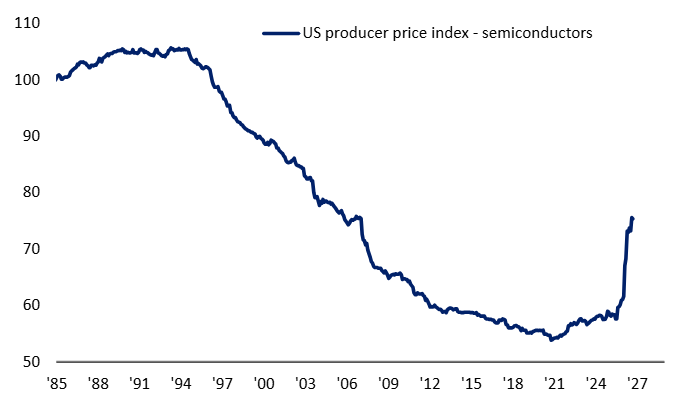
Source: Bank of America, Silicon Data, Bloomberg
BofA pointed to US semiconductor producer prices as a signal to watch going forward. Rising prices would support a positive outlook for the sector, while a reversal would point to tighter AI financing conditions and weaker economic growth in 2027.