


Investment trusts have outperformed their open-ended ‘sister’ funds in almost nine in 10 cases, according to data from the Association of Investment Companies (AIC).
In 28 out of 32 cases (88%) where an investment trust and an open-ended fund have had the same fund manager for the past 10 years, the investment trust has outperformed.
On average, investment companies with a sister fund added an extra £37 per £100 invested to the total return over a decade, or an additional 1.7 percentage points per year, based on figures to the end of September.
Over five years the figures dropped, with 29 out of 40 trusts beating their broadly identical open-ended alternative with an average gain of £8 (or 1.3 percentage points per year).
This rose over shorter timeframes, however, with 33 out of 40 winning over three years and 34 out of 41 over 12 months.
Nick Britton, research director of the AIC, said: “It’s good to see investment trusts’ natural advantages help managers to generate strong performance over the past decade.
“Being able to gear is clearly helpful, as is the flexibility to invest in less liquid assets. With investment trusts, managers can also pick their moment to buy and sell investments, which isn’t always possible with funds that have to follow investment flows.”
Trusts that beat their funds
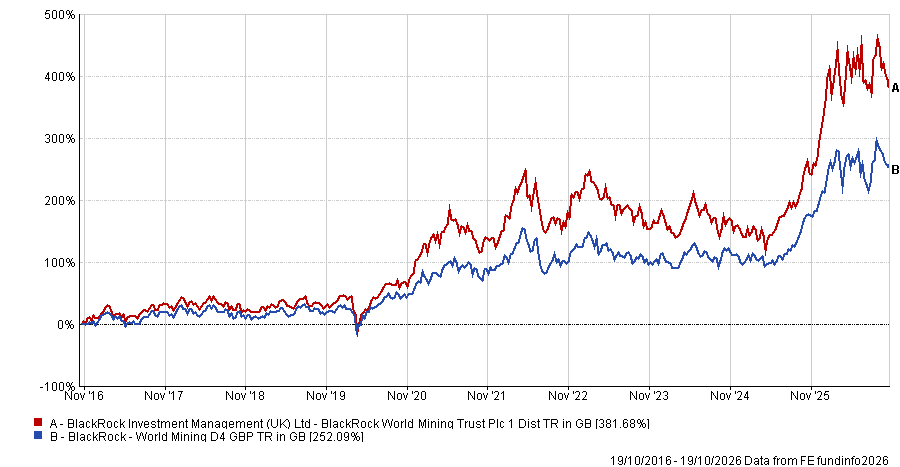
Looking at the performance of individual fund pairings, perhaps the clearest example of this is the BlackRock World Mining fund and investment trust.
Both are managed by Evy Hambro and Olivia Markham and invest in the shares of mining stocks from around the world. They have performed phenomenally well over the past decade, both sitting in second place of their respective Investment Association (IA) and AIC sectors.
However, the trust has eclipsed its fund partner, up 381.7% versus a 252.1% gain for the open-ended option, a gap of almost 130 percentage points, as the below chart shows.
Performance of trust vs fund over 10yrs
Source: FE Analytics
Two more examples come from the Baillie Gifford suite. Roderick Snell manages both the closed-ended Pacific Horizon trust and open-ended Baillie Gifford Pacific fund. Both are the top performers in the IT Asia Pacific and IA Asia Pacific Excluding Japan sectors, with the trust up 351.5%, compared with the fund’s 258.8% rise.
Meanwhile, Edinburgh Worldwide and Baillie Gifford Global Discovery are both global small-cap portfolios run by a team including Douglas Brodie, although he is joined by different co-managers on the two. The former is up around 167%, while the latter has made just 55.9% over the past decade.
Several trusts run by FE fundinfo Alpha Managers beat their open-ended counterparts including those managed by Fidelity’s Alex Wright, Invesco’s Stephen Anness and Schroders’ Robin Parbrook.
The funds bucking the trend
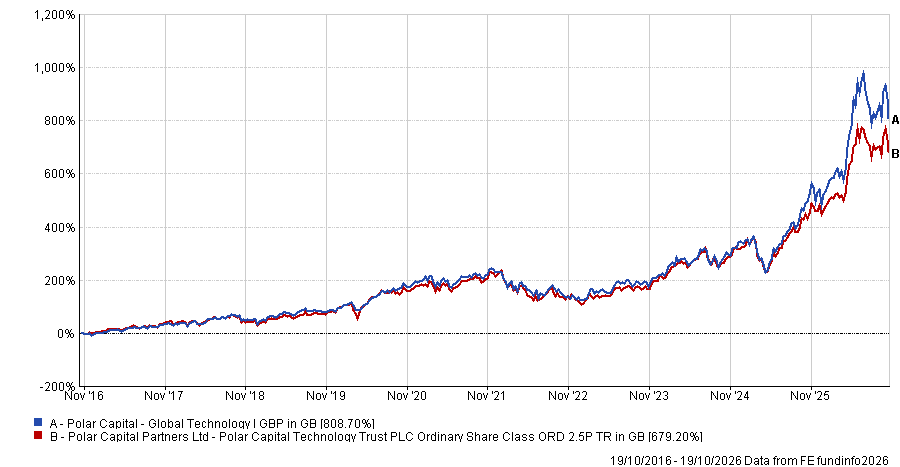
While trusts were broadly better performers, there were some exceptions. The largest differential came from the tech space, where Polar Capital Technology couldn’t keep pace with the open-ended Polar Capital Global Technology.
Both are run by Ben Rogoff and his team and have been hugely successful for investors over the past decade, benefiting from a tech rise during the Covid pandemic and more recently the AI boom of the past few years.
However, while the trust has made investors some 679% over 10 years, the fund is up even more – 798.4%.
Performance of trust vs fund over 10yrs
Source: FE Analytics
There were only three other instances where the fund beat the trust. Janus Henderson Asian Dividend Income beat Henderson Far East Income by 22 percentage points over the decade, while BlackRock UK Income was 16.7 percentage points ahead of the BlackRock Income And Growth Investment Trust.
WS Lindsell Train UK Equity was also ahead of the Finsbury Growth & Income Trust, although there was less than 2 percentage points in it.