


Investors have sorted the stock market into AI winners and AI losers, and priced the two groups at opposite extremes, according to Ian Lance, co-head of the value team at Redwheel and co-manager of the Temple Bar investment trust.
“The market has done this amazing thing where it has basically gone, ‘Right, all the US tech companies are the AI winners’ and it has put those on absolutely stratospheric ratings,” he said.
“Then it has taken this other subset of companies that it thinks are going to be AI losers and it has crushed those.”
Lance and fellow Temple Bar co-manager Nick Purves have warned for some years that the US market looks expensive. The 10 largest US stocks, all technology companies, now make up 40% of US indices, a level of concentration Lance said has been a warning sign of previous bubbles.
That concentration, along with the scale of the bet on AI within the US market, meant an investor could now get “better diversification, measured statistically, from a 30-stock portfolio than you can from buying the S&P 500”, he said.
A gauge of total US market value against the size of the economy, as used by Warren Buffett, is above its level on the eve of the 1929 Wall Street crash, he said.
Performance of fund against index and sector over 1yr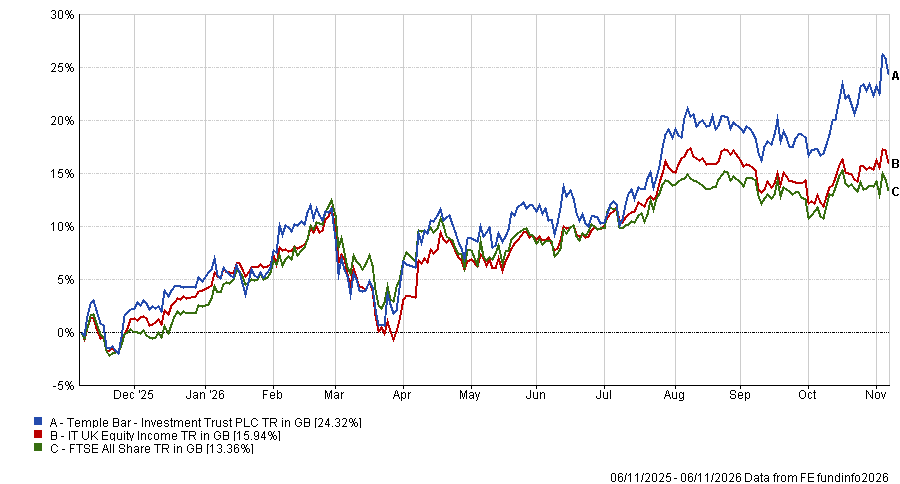
Source: FE Analytics
The damage on the other side of the trade has been showing in company valuations. Global IT consultancy Accenture traded on about 8x earnings a few months ago, meaning investors valued it at roughly eight years of its annual profit. Capgemini was on about the same multiple.
For many such names, the low valuations have given Temple Bar opportunities to buy. Advertising group WPP was the main example of a story the market missed out on by labelling it an ‘AI loser’. Lance and Purves looked at its closest rivals, France’s Publicis and US-based Omnicom (which has merged with Interpublic) for red flags.
Lance said: “You look at them, and there’s no sign at all that they are being disrupted. Their top lines are still growing at 5% or so, and so therefore we thought maybe this is a WPP issue, not an industry issue.”
A meeting with Cindy Rose, WPP’s new chief executive, supported that view. Rose described a company that had never been pulled together, Lance said.
“It was still run as a bunch of fiefdoms,” he said. “It hadn’t been consolidated at all, to the point where they’d be pitching for a new account, and different bits of WPP would be pitching against one another.”
Rose’s plan was to merge those businesses and take costs out, he said. This is a problem the management team can fix, compared with issues that businesses face when there is a collapse in demand.
WPP is heading for earnings of about 50p a share this year, which Lance called “a really bad year”, against about 70p a couple of years ago. The shares bottomed at 250p, putting them on 5x what the managers regarded as trough earnings, the lowest point of the profit cycle.
“We took the view that at that price the market has given her literally zero chance that she can improve the business and, actually, we think she can improve the business,” he said.
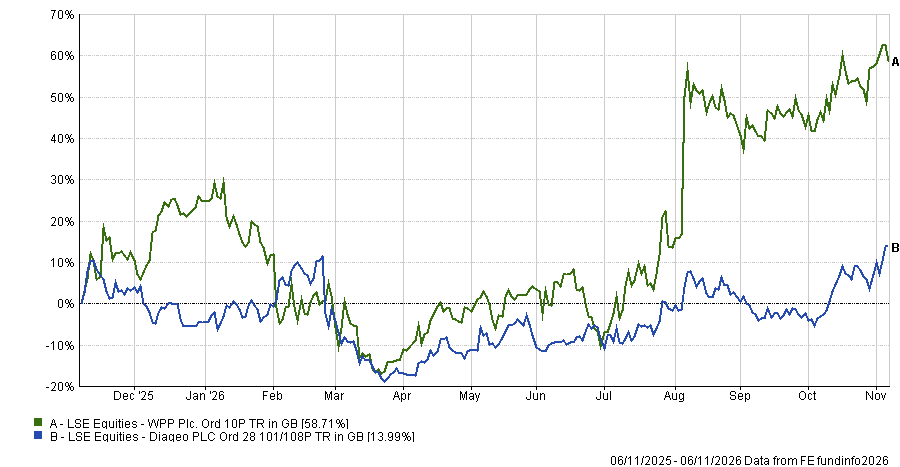
A return to 70p of earnings, valued at 10x, would give a share price of 700p, a multiple Lance called “pretty miserly”. The shares trade at 412.2p at the time of writing, having rallied hard from the lows.
Another sector being written off by the market is consumer staples, Lance said, as the makers of everyday branded goods like drinks and food have gone through a similar reset. Over the past six months, Temple Bar has bought domestic names such as Diageo, as well as US giants Kraft Heinz and JM Smucker, as share prices have fallen by 50% to 60%.
Price of UK shares Diageo and WPP over 1yr
Source: FE Analytics
Quality-growth investors once treated them as shares to own forever, said Lance.
“People used to say, it’s such a fabulous company. You just buy it and hold it forever. Of course, subsequently, it turned out actually it wasn’t a growth company at all. And secondly, people were overpaying for it,” he noted.
But buying a growth story everyone already knows risks paying for it upfront and leaving little room for mistakes.
“If you bought Microsoft in 2000, it was a great company. It really was a great company. You didn’t get back to your start point until 2016. It took you 16 years to get back to your starting point. Why? Because you just paid too much for it at the start,” he concluded.