


Investors who treat Europe as a single market risk missing out on where its growth is coming from, according to Joe Faraday, lead manager of the Baillie Gifford European Growth investment trust.
“To me, Europe looks more like [the] emerging market – it’s diverse, an eclectic mix,” said Faraday.
“But you can really lose your shirt if you’re too narrow, or too myopic, or you’re just a thematic investor. It’s worth tuning into the full opportunity set.”
In particular, he emphasised the importance of looking beyond the European countries that dominate indices, such as France and Germany, which make up more than 30% of the FTSE Europe ex UK index.
“There are big structural challenges ahead for France [as it deals with political and civil unrest], while Germany is trying to put through this huge stimulus in defence and infrastructure spending but, if it weren’t for that, Germany would also be very fragile.”
Although markets are ultimately not the same as economies, Faraday said it can make things difficult and cause headwinds for Europe as an asset class.
He argued there is a “shifting dynamism” in Europe and “grounds for optimism” in several countries.
Faraday said: “I’m seeing a big return of southern Europe after 15 to 20 years of pain. Spain is enjoying growth and productivity and Greece is focused on attracting high net-worth individuals and financiers.”
He also expects the broader rise of eastern European countries to be a trend “for the next decade or two”. In particular, Poland is enjoying “a formidable rise”, he said.
Faraday acknowledged that the trust was previously “very skewed” away from these regions, broadly favouring Scandinavia and companies in the Benelux.
He took over as manager of Baillie Gifford European Growth on 1 April 2026, replacing Stephen Paice and Chris Davies.
The £341m trust has logged a fourth-quartile return in its sector in every year between 2021 and 2024; 2022 was a notably difficult year with the trust down 41.4%.
Baillie Gifford European Growth has promised a 100% tender offer if it does not beat the FTSE Europe ex UK index in the four years to mid-2028.
Faraday was keen to “put my imprint on it” when he took over, changing around a third of portfolio holdings within the first few months.
“If all you’re going to do is focus on Scandinavia and semiconductors, then you are missing what Europe really stands for,” Faraday said.
“You need a broader perspective on what growth you should go after, a willingness to open your mind to a wider set of company types and, importantly, blend that with portfolio construction, rather than holding it too sacred that Europe is only home to a very specific and narrow set of industries or company types.”
That broader perspective led Faraday to a sector rarely associated with growth investing: banks. UBS and CaixaBank are two of six banks in the portfolio.
“I am a believer that you can get growth from banks – after all, they are intertwined with European economies so, if they aren’t growing, then the economies probably aren’t growing,” he said.
“My perspective comes from a lot of years looking at emerging markets and macro measures like credit-to-GDP, or the structural growth in economies and what could be a driver of that.”
However, he acknowledged that European banks need more consolidation “to be able to compete with the North American banks” and that there is “a lot of inefficiency baked into Europe”.
“I think Europe almost has one arm behind its back because of that complexity,” he said. “In spite of that, I still think there are excellent companies, including the banks.”
Faraday also turned to Europe’s defence stocks, such as stalwart Rheinmetall and IT, aerospace, defence and security technologies company Tekever.
“While this [play on defence] hasn’t quite worked out over the past six or so months, it remains important to be plugged in and making sure you are exposed to what could be the growth drivers,” he said.
Defence is therefore just one of several long-term themes Faraday is keeping on his radar. Others include electrification, labour versus productivity, semiconductors and healthcare.
Yet for all the changes, much of the portfolio remains anchored in Europe’s long-standing heavyweights that have an established global presence, with Faraday pointing to ASML, Airbus and Roche.
He also looks beyond the listed market for growth, with the trust able to hold up to 20% in private companies.
This includes the Italian technology company Bending Spoons, which went public on the Nasdaq in July. Since then, the share price has increased by 50.8%.
Bending Spoons was founded in 2013 and buys established but underperforming digital products – such as Eventbrite and Vimeo. It then reworks their pricing and operations to run them more profitably.
Faraday said it has been a “slam dunk” for the portfolio, going from a 4% private position when he took over the trust earlier this year to the biggest holding in the portfolio today at 16.5%.
“It has been an absolutely fantastic investment. The lock-up expires in a few weeks and it will be right-sized accordingly,” Faraday said.
Performance of the trust under Faraday vs sector and benchmark
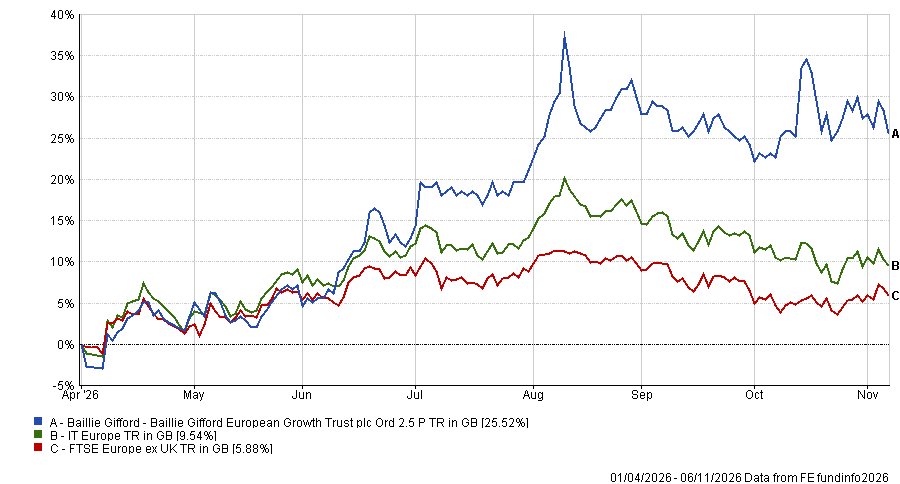
Source: FE Analytics
Being willing to trim a winner like Bending Spoons is exactly the kind of decision Faraday believes many managers struggle with.
“Long-termism must not be an excuse – you have to get a wriggle on,” he said.
“I reckon every portfolio manager has a weakness when it comes to selling and letting go, [so it’s important to understand] what makes you let go and where your blind spots are. Fall in love with a company, but don’t fall in love with a stock.”
Half the time he sells a stock because of growth, a quarter of the time because of management and a quarter of the time because of valuation.