


Markets, economies and investment trends can change dramatically over the course of a lifetime. Fund managers come and go, entire sectors can be reshaped by innovation or disaster, and today’s market leaders can lose their dominance.
For investors who would rather not spend years constantly reassessing their holdings, however, there is obvious appeal in finding investments capable of enduring changing market conditions and continuing to compound returns over multiple decades.
With that in mind, Trustnet asked fund selectors for one fund or investment trust they would hold for the rest of their investing life.
Although challenging the concept of holding a fund or investment trust ‘forever’, Rob Morgan, chief analyst at Charles Stanley, noted that Baillie Gifford’s Scottish Mortgage investment trust is a “buy and lock away investment that I would look to maintain a position in for an indefinite period, perhaps topping up and taking profits to rebalance along the way”.
Fund selectors also recommended the trust to hold for a five-year period.
The £15bn trust is managed by FE fundinfo Alpha Manager Tom Slater and deputy manager Lawrence Burns, investing in a combination of global public and private companies it considers innovators within their respective industries.
Given this ability, Morgan said it “offers opportunities to investors that are hard to reach any other way”, including Anthropic, TikTok owner ByteDance and payments provider Stripe.
“The very long-term, patient approach of Baillie Gifford and its superior access to entrepreneurs and private deal flow makes the trust a true standout that others find difficult to replicate,” Morgan said.
“It also has exceptionally competitive charges for such a differentiated, actively managed investment.”
The trust has an ongoing charges figure (OCF) of 0.33% and is currently trading at an almost 7% discount to net asset value (NAV).
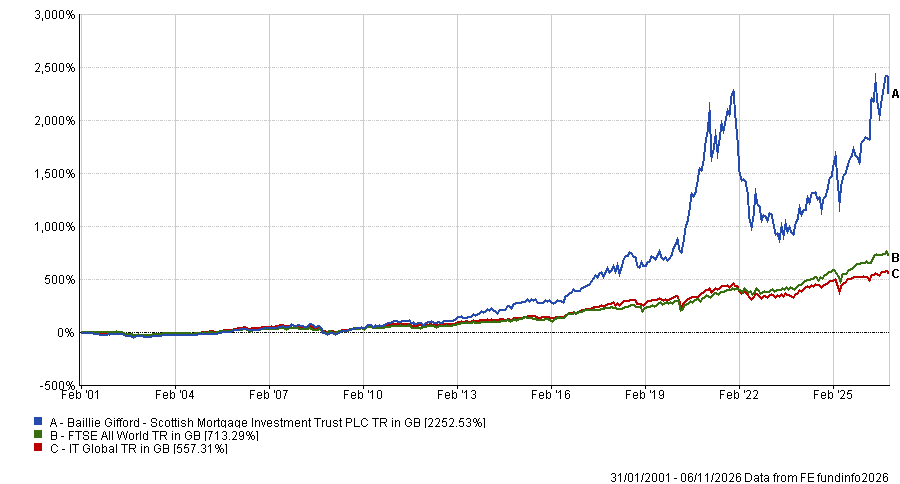
Since the beginning of 2001, the trust has returned 2,252.5%, outperforming both its benchmark and sector average return.
Performance of the trust vs sector and benchmark since January 2001
Source: FE Analytics
Meanwhile, Emma Bird, head of investment trusts research at Winterflood, highlighted the £3.2bn JPMorgan Global Growth & Income trust as a hold forever investment. It currently sits in Winterflood’s recommended trusts list for this year.
“The managers [Alpha Manager Helge Skibeli, James Cook and Sam Witherow] follow a style-agnostic, research-driven investment approach, supported by the significant analyst resources at JPMorgan Asset Management, which has enabled the trust to outperform the MSCI ACWI index in a range of market conditions,” Bird said.
While the momentum-driven markets over the past few years have proven a more challenging environment for the trust, Bird is confident that the managers’ “commitment to the disciplined approach, while aiming to learn lessons from periods of underperformance” stands them in good stead to outperform over the long term.
“In addition, the enhanced dividend provides shareholders with a regular and predictable source of income,” she said.
The trust operates a dividend policy that aims to pay quarterly distributions totalling 4% of NAV each year. Shares are also currently trading at a narrow 0.84% discount.
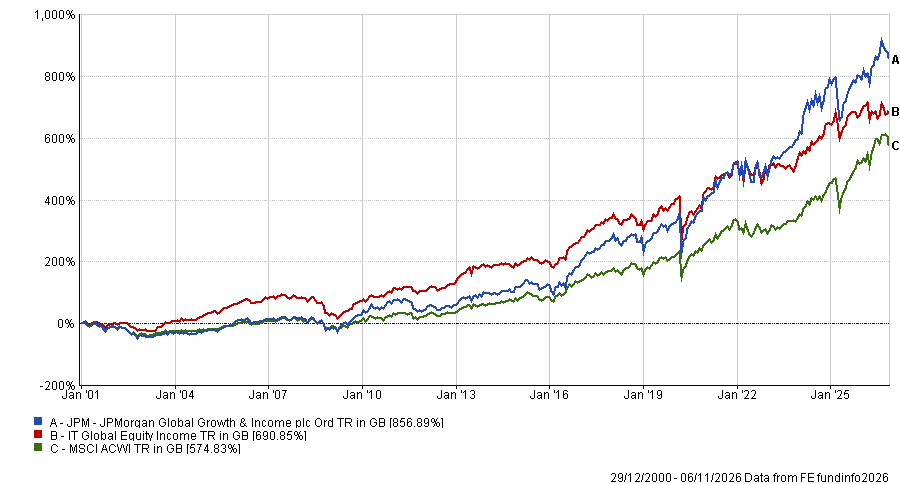
Since January 2001, it has returned 856.9%, beating both the MSCI ACWI and IT Global Equity Income sector average return.
Performance of the trust vs sector and benchmark since January 2001
Source: FE Analytics
Paul Angell, head of investment research at AJ Bell, also turned to investment trusts when asked for a fund pick he could hold forever.
“The emphasis here isn’t about trying to identify the next decade’s big investment theme but owning a dependable, diversified core of companies capable of quietly compounding returns and income over long periods,” he said.
As such, Angell suggested the £3bn City of London Investment Trust, which aims to achieve long-term growth in both income and capital and has been managed by Job Curtis since 1991, with David Smith joining as deputy manager in 2021.
Trading on a 0.70% premium to NAV, it follows a bottom-up, valuation-focused approach, favouring financially robust companies with strong cashflows and the ability to sustain and grow their dividends.
Angell noted that its “extraordinary dividend record” illustrates that consistency, having now increased its dividend for 60 consecutive years.
“Its investment trust structure is also helpful for an income strategy because revenue reserves can be used to smooth distributions during more difficult periods,” he added.
“For me, the combination of sensible valuation discipline, durable businesses and a deeply embedded income philosophy makes City of London investment trust the sort of holding unlikely to need rethinking on a regular basis.”
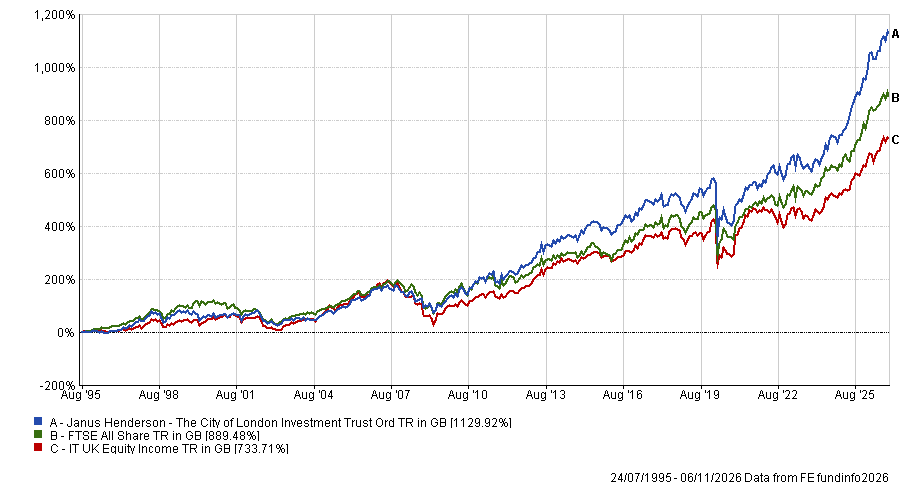
He suggested it could provide the steady core around which more adventurous regional, small-cap or growth investments can be added. Since August 1995, the trust has returned 1,129.9%.
Performance of the trust vs sector and benchmark since August 1995
Source: FE Analytics
Michael Heapy, senior investment analyst at IBOSS, was the only one of the four fund selectors who picked an open-ended fund, selecting Lazard Emerging Markets.
“With an indefinite investment horizon, I can afford to look through periods of market weakness and focus on structural opportunities that may take years, or even decades, to play out. For that reason, I would allocate to emerging markets,” he said.
He particularly likes the constantly evolving nature of the opportunity set, noting that emerging markets today look very different from 20 years ago and are likely to look very different 20 years from now.
“Lazard Emerging Markets has built an impressive long-term track record, consistently demonstrating its ability to navigate what can often be a highly volatile asset class,” Heapy said.
“While periods of underperformance are inevitable, the fund’s ability to generate attractive long-term returns through a variety of market environments gives me confidence it can continue to reward patient investors.”
He also pointed to the “remarkable tenure and stability” of the investment team, with such continuity giving him confidence that the investment process is “deeply embedded and capable of standing the test of time”.
It is co-managed by James Donald – in place since 1999 – alongside Rohit Chopra, Monika Shrestha and Ganesh Ramachandran.
Heapy also noted that emerging markets typically create more fertile ground for active managers to add value through stock selection, given they remain less efficient than their developed market counterparts.
“The management team has also been highly active in adjusting geographic exposures over time – in recent years they have been willing to remain underweight more expensive markets, such as India, relative to the benchmark, while maintaining higher conviction positions in countries such as Mexico, Brazil and South Korea when valuations have appeared more attractive,” Heapy said.