


M&A activity in the UK has freed up money for Merchants Trust manager Simon Gergel, who decided to recycle this newly unlocked dry powder to buy other names that are usually out of his reach.
This has pushed turnover on the trust to 35%, a level he called “very high for us”. The trust is now replacing about a third of its holdings annually, against a typical 20% to 25%. At 25%, a share is held for around four years.
Takeovers included food ingredients company Tate & Lyle and energy distributor DCC. Gergel funnelled profits into names that had fallen, such as software company Sage, information provider Wolters Kluwer, medical devices company Coloplast, online marketplace AutoTrader and publisher Bloomsbury.
Sage and Wolters Kluwer were sold off on fears of disruption from artificial intelligence, and both then rose 50% within six months.
“While the overall market still looks quite cheap, particularly the mid-cap sector, there are opportunities to buy companies when they’re materially undervalued and see them recover,” Gergel said.
Performance of Merchants Trust vs sector and benchmark over 1yr
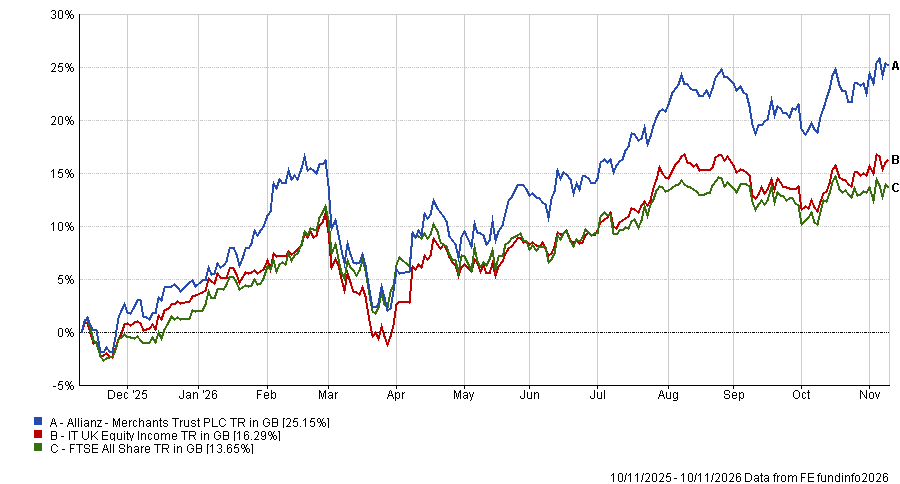
Source: FinXL
Below, he explains why the trust is trading more, why trading costs do not worry him and how he responds to takeover bids.
What is your process?
We are trying to buy materially undervalued companies and benefit from a re-rating as their value is recognised.
We try to build in a margin of safety so that we’re buying companies significantly below what they’re really worth. As long as we’ve got our analysis right and these are strong businesses that can hopefully generate profits, growth and cash, then we can afford to wait.
We have a thesis in our mind, but we don’t put a time limit on it. We don’t have a stop-loss policy, for example. It’s about the fundamentals of the business. If the fundamentals are improving and the share price has gone down, we’ll often buy more.
It’s very common for us to buy a company a bit too early, see the shares go down and buy more of it before it starts to recover.
Why has turnover risen and does the trading cost investors?
It’s typically been 20 to 25%. We typically own shares for three to five years and 25% would be four years, for example.
The reason it’s gone up is that we’ve just seen so many opportunities in the past 12 months to buy companies that are typically not in our universe, as they are not cheap enough. The market’s been really polarised and really volatile.
RS Group is a share we bought. We then reduced it when it had a rally and we bought some more when it came back again. Now it’s had another rally.
If we get it right, it increases returns significantly. If we were buying a share at £6 and then selling some at £7.20, the fact that you may pay 0.5% stamp duty or some trading costs doesn’t really matter. Then we’re buying back at £6 again and selling again at £7.20, £7.50.
You’re buying and selling a third of the portfolio a year. On that basis, the trading costs you incur are pretty small compared with the return you’re making on the portfolio and even compared to the dividend yield.
How do you handle takeover bids?
In some cases, we have sold out, like Tate & Lyle or DCC, when there’s been a takeover bid on the table.
What we’re concerned about is companies being taken over for too low a price. We don’t mind a board of management deciding that a price for a business is fair and selling. But if companies are very depressed, you sometimes see cheeky buyers coming in at a small premium, trying to take advantage of that and not offering a fair value. If a takeover is done at a price which is too low, we will try to push against that.
One example last year was Assura, which has GP surgeries, hundreds of them around the country. They were bid for initially by private equity and we weren’t particularly happy with that.
Then a competitor, Primary Health Properties, came along and launched a bid and we accepted it and held onto our shares. We ended up in a bigger consolidated company with an even bigger portfolio of healthcare assets.
Why should investors pick Merchants over a tracker?
Merchants has delivered 44 years of progressive dividend growth, so every single year for 44 years, which you won’t get in a tracker necessarily. That’s all been paid out of revenues and reserves that have been built up over the years.
We’ve delivered outperformance over the long term through a highly active portfolio. Our portfolio is about three-quarters different from the benchmark.
The yield is never a reason to buy or sell a share. We only buy shares when we think we can make money, a good total return and we’ll sell them if we think they’re expensive or fully valued.
What were your best and worst calls over the past 12 months?
The biggest contributor would be Tate & Lyle, which is an ingredients company with a very long heritage in the market.
It’s been on a long journey, moving from being a manufacturer of sugars and then sweeteners, towards speciality ingredients. Eventually, that transformation was recognised by one of its competitors, who bid for it in the past year. So those shares were up in the past 12 months. We’ve made about 50% on the shares, and they’ve added 1.2% to our performance.
The worst contributor was Entain, which you’ll know in the UK through Ladbrokes and Coral Bookmakers, but it also owns a big online gambling business.
Tax changes have impacted its UK and Brazilian businesses, and in America the emergence of prediction markets [has impacted too]. The shares are down 39% over 12 months, which cost us 0.7%.
It’s still a business with structural growth and some very strong market positions – it’s the clear market leader in the UK by a long way and is very strong in America.
What do you do outside of fund management?
I play five-a-side football. I like to play golf. I like walking out in the countryside. Fairly simple things.