






Federal Reserve chair Kevin Warsh is set to speak at the Jackson Hole symposium this Friday, the annual central banking conference where the direction of US monetary policy is traditionally traced. However, he has spent his tenure refusing to do just that, and markets are jittery.
What he says and how much of his own decision-making he is willing to show will set the tone for the long end of the US government bond market for the rest of the year.
Kish Pathak, fixed income research analyst, and Erik Weisman, chief economist and portfolio manager at MFS Investment Management, said the speech assumes “great significance” because “historically, Jackson Hole has been a venue where the future course of monetary policy will be signalled”.
“But chair Warsh is dead set against forward guidance,” they said.
Thirty-year treasury yields briefly touched 5.3% last week, their highest since 2007. Investors are still buying US treasuries. They are charging more for it, with almost all the increase being in those with maturities beyond 20 years.
For Harvey Bradley, head of global rates at BNY Insight Investment, the problem was fiscal sustainability in the US and in several other developed markets.
“In that context, it's hard to justify lending to the US government for 30 years when deficits are expected to remain elevated into the future.”
What brought us here
The treasury has already moved to take pressure off the long end of the curve. Last Wednesday it said it would at least double the maximum size of its liquidity-support buybacks in the 10-to-20-year and 20-to-30-year parts of the curve, from $2bn to at least $4bn per operation.
The Treasury buys its own outstanding bonds back off investors, in this case the older, less liquid long-dated issues where trading has thinned.
US gross federal debt passed $40trn last week, roughly double where it stood in 2017, against a statutory borrowing limit of $41.1trn. Federal interest payments came to about $970bn in the 2025 fiscal year, or 3.15% of GDP, more than the US spent on national defence, according to Elliot Farley, chief executive and fund manager at T. Bailey Asset Management.
"The post-GFC [global financial crisis] era of near-zero policy rates and subdued inflation is over, yet fiscal policy has barely acknowledged the shift, leaving the interest burden at levels last seen in the 1980s and 1990s, and with potential to rise further."
30-Year Government Bond Yields
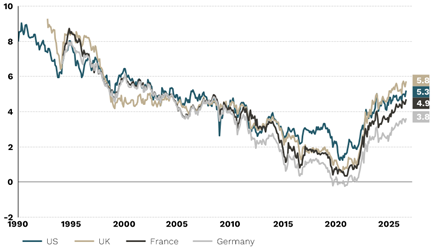
Source: T. Bailey Asset Management, LSEG Workspace.
Long-dated yields fell on the announcement, then rebounded back within hours. Nothing about the size of the government's borrowing requirement had changed, while the competition for the money to fund it keeps growing.
Hyperscalers issued nearly $200bn of bonds through July, bidding for the same capital as the Treasury, according to Van Luu, global head of solutions strategy at Russell Investments.
Long-dated yields have climbed in Japan, Germany, France and the UK as well, which makes deficits and supply a shared developed-market problem. Ross Pamphilon, chief investment officer for fixed income at Impax Asset Management, separated the American drivers into the fiscal and the cyclical.
“There is ongoing treasury issuance which markets have struggled to absorb, combined with questions around fiscal credibility. Cyclically, there are also questions around the rhetoric coming from the Fed chair, who has indicated that there will be less forward guidance as to the direction of interest rates. This has injected an uncertainty premium into long-term yields.”
What experts make of this
The US Treasury publishes its borrowing needs well in advance through the quarterly refunding process, so elevated issuance is already in the price, according to Michal Stanczyk, portfolio manager of the Income Plus strategy at Allspring Global Investments.
"The real question is not whether the Treasury can sell the debt, but what yield investors require to absorb a growing stock of duration over time,” he said.
At Carmignac, co-head of fixed income Guillaume Rigeade said the premium is now covering a risk it did not use to.
"Investors are being asked to absorb more duration precisely when they require greater compensation for holding it. The bond market is increasingly demanding compensation not only for inflation risk, but also for fiscal risk."
Bradley did not expect buybacks to turn long yields around – their achievement however is to send “a clear signal that policymakers are increasingly uncomfortable with the persistent upward pressure on borrowing costs”.
Two things would bring long yields down and keep them there: fiscal consolidation or a stretch of weaker growth and inflation.
In practice, they are one and the same, since cutting government spending drags on activity and takes inflation with it. Neither looks imminent, and if neither arrives the burden has to come down some other way.
He added: “Looking further ahead, talk of financial repression could well become a market theme. This would be a scenario where policymakers face pressure to keep interest rates below what would otherwise be justified by economic fundamentals, gradually eroding the real value of outstanding debt.”
That leaves Friday. Pathak and Weisman wished Warsh published his method, outlining which data encouraged him to act and in which direction.
“The big issue is not the absence of forward guidance but the lack of specification of a reaction function. Specifically, chair Warsh needs to highlight the factors he considers when he decides the course of policy. Without a credible set of potential responses to incoming information, the promise of price stability rings hollow,” they said.
“It is going to be a tightrope for Warsh. However, he is a seasoned operator. It is indeed possible that he pulls something out of the hat that calms the market's nerves, but it will not be easy.”