






Chelverton UK Equity Growth, Jupiter UK Dynamic Equity and Man Undervalued Assets have all made strong returns over the past decade and all have struggled so far in 2026, dropping to the bottom quartile of the IA UK All Companies sector over the first six months.
As such, their trajectory has been the opposite to that of the long-term UK laggards that have been turning things around in 2026.
But for investors looking at the UK with renewed interest, are these names worth considering? We asked three fund pickers in which of the three they would put money today, and two landed on the same answer.
Performance of fund against index and sector over the first half of 2026
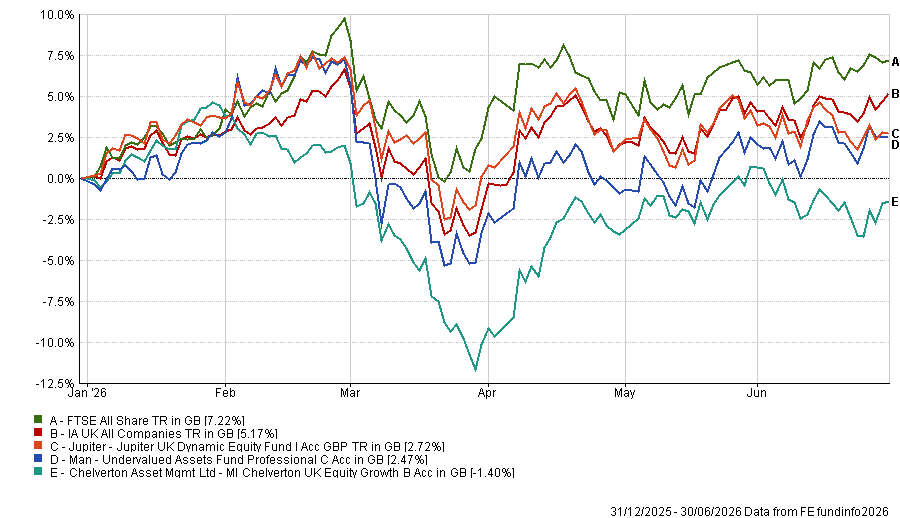
Source: FE Analytics
The three approaches
Chelverton UK Equity Growth is run by James Baker, who has specialised in UK small and micro-caps for more than 30 years, and co-manager Edward Booth, who was appointed in 2017.
The fund holds companies below the top 100 by market cap, roughly 40% of it in AIM-listed stocks, and looks for cash-generative, founder-led businesses with room to compound earnings over time.
Jupiter UK Dynamic Equity is built around business transformation. Alex Savvides developed the approach at JOHCM from 2008, where he ran the UK Dynamic Fund for 21 years before joining Jupiter with colleagues Stephanie Geary and Siddharth Sukumar.
The fund looks for companies where management change or operational improvement can unlock value that the market hasn't yet recognised and typically holds 25 to 40 stocks with a bias towards mid and larger companies.
Man Undervalued Assets, run by Henry Dixon with co-manager Jack Barrat since November 2013, takes a balance sheet and cash flow led approach.
The team looks for companies trading below their estimated replacement cost or below the value implied by their returns on invested capital, often in unfashionable areas such as financials, materials and energy.
The different drivers behind each fund
Benjamin Newton, investment manager at Credo, put the recent performance down to growing recognition that UK equities remain cheap, reinforced by a steady run of takeover approaches and strategic investments over the past year.
“Valuations remain supportive, private equity still has significant dry powder available, and UK equities continue to trade at a discount to many international markets,” he said.
But while the sector tailwind is common to all three funds, Rob Morgan, chief equity analyst at Charles Stanley, noted that the underlying drivers differ.
Chelverton's fortunes are tied to sentiment towards UK small-caps, which has “been found wanting in recent years” before a recent turn helped by a pick-up in M&A activity.
Man's improvement reflects its heavier weighting to “old economy” areas such as materials, industrials and energy, which have been in favour.
Jupiter's case is different again: Morgan saw genuine stock picking behind the fund's form, alongside a stylistic lift from its value tilt.
Sheridan Admans, chief investment strategist at Infundly, didn’t necessarily see a turnaround, describing Man and Jupiter instead as established approaches working through “a period of style and stock-specific headwinds”.
Man's outperformance of the sector runs back to 2022, which he read as the continuation of an existing record rather than a new trend.
Which fund would each picker buy today
Newton's pick was Chelverton, held as a relatively modest position given its risk profile. “It also offers the greatest sensitivity to any continued revival in UK smaller companies,” he said, pointing to improved momentum and valuations that remain attractive in a part of the market he considers under-owned.
Morgan chose Man Undervalued Assets, citing manager longevity and consistency of process. He described the fund's approach to value as “disciplined but pragmatic”, with an emphasis on financial strength that should filter out companies at risk of a shaky balance sheet.
Agreeing with him, Admans leaned towards Man, as it has the “cleaner established proof base in its current setup” given Dixon and Barrat's longer track record in the strategy.
He said Jupiter UK Dynamic Equity should be viewed as an established approach being applied on a new platform rather than an untested one, since Savvides ran the same process at JOHCM for 21 years. Newton didn’t think the arrival of Savvides, which happened less than three years ago, would have made a noticeable impact already.
“Savvides has clearly begun to put his stamp on the portfolio and there have been some noticeable changes to positioning. That said, I would attribute the majority of the recent performance to the broader recovery in UK value and recovery stocks, as well as the fund's underlying exposures, rather than manager impact alone,” he said.
“Given that he only took over responsibility in late 2024, it is still very early in the journey. It generally takes at least three years before investors can make a meaningful assessment of a manager's skill through stock selection and portfolio construction rather than market conditions.”
Morgan gave Savvides more credit, pointing to the fund's stock picking as a genuine driver alongside the value tailwind.
Who each fund suits
Chelverton is suited to investors who can tolerate volatility and want maximum exposure to a UK small-cap recovery, said Newton, while Jupiter works better as a complementary holding alongside a portfolio that already leans towards growth. Man should appeal more to investors who want a disciplined, balance sheet led approach with some downside support.
Morgan broadly agreed, describing Jupiter as the more core UK equity holding of the three given its multi-cap approach, sitting stylistically closest to the middle of the pack. Man, he said, suits investors looking to balance out more growth-orientated funds held elsewhere.