






Mercantile Investment Trust has cut its borrowing by one to two percentage points over the past month to leave itself room to act on the Budget.
The move brings gearing down to about 15% of assets under management, against a record of 17% and a high of 16.5% over the past year.
FE fundinfo Alpha Manager Guy Anderson, who manages the trust together with Anthony Lynch (also an Alpha Manager), said the move was “sensible” as chancellor John Healey is preparing to deliver his Budget at the end of the month.
“It’s just sensible for us to have a little bit of dry powder in case [the Budget] throws up opportunities, [even if] we don’t know where those opportunities might be,” he said.
“Inevitably, there will be some companies that come out of the Budget as relative winners and there could be some relative losers. And we want just to have a little bit of capacity so that we can act on that if we see some opportunity.”
Mercantile invests mainly in UK mid and small-sized companies and its rules allow it to run anywhere from 10% in cash to 20% geared.
Its current financing could cover gearing of circa 18%, Anderson said, so at the current level, it has spare borrowing capacity of about 3% of its assets. On a portfolio of about £1.7bn, that 3% buffer equates to £60m, which “gives us some dry powder, should we want to deploy it”.
Anderson said the government had been “making reassuring noises” to avoid a repeat of the Truss mini-Budget, which sent gilt yields soaring in 2022. The government, he said, had been “very clear” that it would “stick to the financial framework”.
But where the Budget winners might come from is still a question mark. The one policy that has already briefly kindled enthusiasm was the revival of Help to Buy, the government scheme that backed first-time buyers’ deposits, rebranded as First Home.
Housebuilder shares jumped by roughly 11% to 12% when the government announced the scheme in late September, but they gave all of that early returns back. While they could “easily be a beneficiary”, it won’t be a broad-based, straight trajectory upwards, according to Anderson.
“Mortgage rates have been marching steadily higher, so I expect near-term trading for the house builders will be really difficult,” he said. “While there’s potential light at the end of the tunnel there, it’ll all be in the detail.”
Separate from the gearing cut, the trust’s allocations have also shifted recently, including some holdings. Over the past 12 months, Anderson has reduced consumer-facing holdings by about 5.5% of the portfolio and raised financials by about 5%, as well as moving money into industrial businesses.
The names that he added to included Renishaw, a precision engineer based in the west of England that sells equipment used in semiconductor manufacturing, and Softcat, a technology reseller that Mercantile has held since its 2015 flotation.
The stock sharply early this year as investors worried that AI would make resellers redundant, which Anderson saw that as an opportunity to top up.
“It’s very hard to disprove a narrative but having become fairly well convinced that it was not in fact an AI loser, we took advantage of the share price weakness and added to the position quite significantly,” he said. “So, it’s been quite pleasing to see them deliver pretty strong growth through this year.”
Softcat is now one of the trust’s top contributors this year and the trust’s largest holdings (4.3%).
Performance of stock over 1yr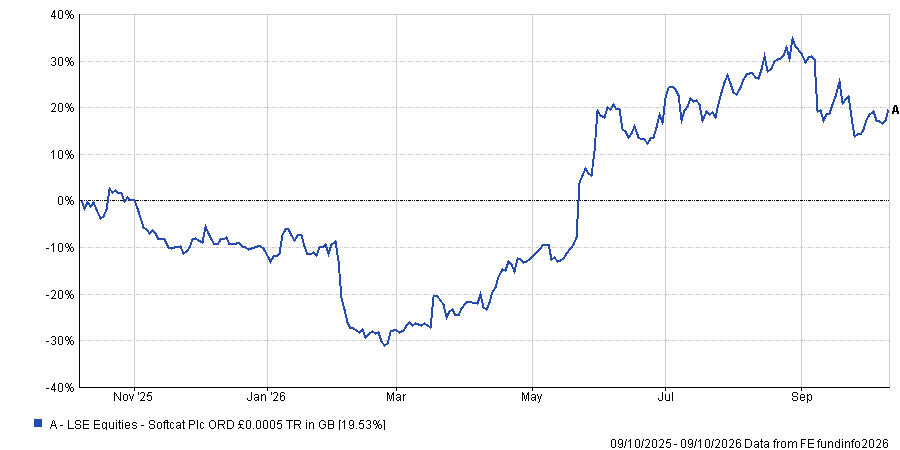
Source: FE Analytics
Other existing holdings that are also benefiting from the AI build-out, said Anderson, include Computacenter (2.7%), a technology reseller that sells to large businesses and counts several of the big cloud-computing companies among its customers, whose profits also roughly doubled in the first half of the year.
As for the reductions, the decrease in consumer exposure included two retailer exits. WH Smith was sold last year after an accounting issue at its North American retail arm, and Dunelm a few months ago on weak sales growth and doubts over strategy under new leadership.
Behind the stock-specific cutbacks, Anderson said, was a consumer showing signs of strain and a rate outlook that had flipped, with the trust now expecting rates to go up rather than down.
“The consumer has been pretty resilient despite everything the world has thrown at them over the last few years. But there are recent signs of weakening, and of course recent inflation is going to be pretty unhelpful on that front,” he said.
“Having been in a position where we were expecting rates to come down, we’re now expecting the reverse.”
Anderson also sold Telecom Plus after a profit warning, when stiffer competition from Octopus Energy slowed its customer growth.
“If a pre-existing hypothesis has been invalidated by a new piece of information, our default should naturally be to cut the position and recycle the capital,” he said.
After these moves, financials has become the largest overweight in the trust, currently at 26.4%.
Here, an interesting name has been IG Group. It was the trust’s biggest holding in 2025 –it was bought in March and briefly accounted for more than 3% of the portfolio.
Mercantile has since sold most of it after the shares were promoted to the FTSE 100. Anderson said it still has a place in the portfolio despite a rough few months since IG announced a US acquisition, and that new customer numbers were still growing.
Not every call has paid off, and the trust lagged its peers last year, returning 11.3% in 2025 against a sector average of about 20%.
“I’m never really happy, to be honest,” he said. “If you can get 55% of things correct consistently, you probably end up having a very strong track record. But that means inevitably there are lots of things that are going wrong.”
After last year’s fourth-quartile performance, things have started to look brighter over the year to date, with a second-quartile 8.6% return, as the chart below shows.
Performance of trust sector over YTD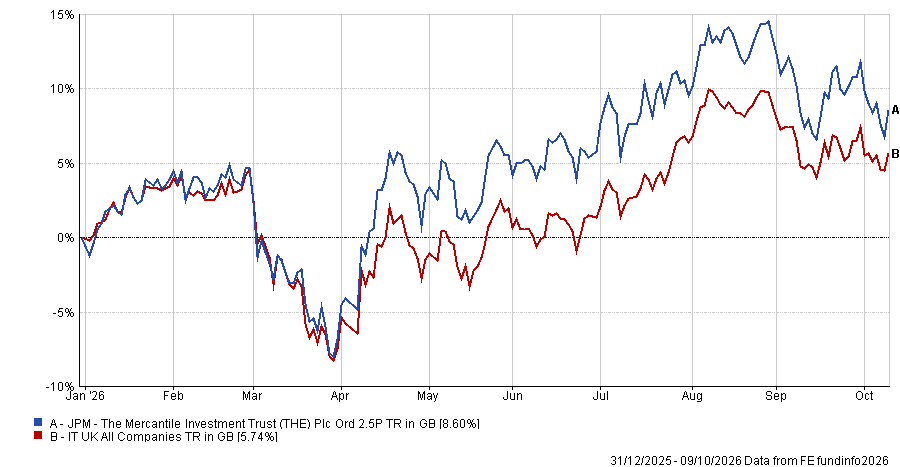
Source: FE Analytics