






Shares in Barratt Redrow, Taylor Wimpey, Persimmon and Bellway have risen by roughly 11% to 12% this morning, after the government announced an equity loan scheme for first-time buyers of new-build homes.
The Ministry of Housing, Communities and Local Government said on Saturday that a new Your First Home initiative, open to buyers in England, will be confirmed at the Budget on 28 October. Buyers would need a 2.5% deposit and the government would lend 20% of the price through an equity loan, a loan sized as a share of the home's value. That leaves a mortgage of 77.5% of the price. Loans under the previous scheme, Help to Buy, were interest-free for five years; the new ones will be interest-free for an initial period yet to be set.
Oli Creasey, head of property research at Quilter Cheviot, said: "The interest-free nature of the loan is likely to be of particular value given current mortgage rates, compared to the previous version of the scheme that was launched during a much lower interest rate environment."
The former Help to Buy scheme backed more than 387,000 purchases between 2013 and 2023, but Land Registry data shows prices rising 33% in the five years after it was announced, Creasey noted. Peel Hunt analysts found that new-build prices rose 64% over the scheme's life against 67% for existing homes, with no link between take-up in an area and its price growth.
Creasey expects the new scheme to push prices up anyway. "The announcement is likely to have a positive effect on house prices, boosting demand and injecting capital into the system," he said.
For James Lowen, fund manager at JO Hambro, the policy is a game changer, as many stocks linked to housing, from housebuilders to brick makers and repair, maintenance and improvement retailers, trade on trough multiples on trough earnings, meaning low valuations on depressed profits.
Most of the housing-related stocks in the JOHCM UK Equity Income portfolio have 100% to 300% upside to his target prices, Lowen said. Those targets assume only 200,000 new homes a year, which he thinks the scheme will make "readily achievable". He anticipated "some sharp moves" today in the market and "a positive tailwind for months to come".
Peel Hunt modelled a scenario for 2028. It assumed volumes were 10% higher and gross margins two percentage points wider as builders cut sales incentives. That would lift earnings per share by about 70% on average at six national housebuilders. It would cut the sector's price-to-earnings ratio from 11.2x to 6.7x. The analysts said Crest Nicholson and Gleeson would gain most and Persimmon least, because Persimmon has already held up better.
Persimmon fares better in a different analysis. Aarin Chiekrie, equity analyst at Hargreaves Lansdown, called it the clearest beneficiary of the new government initiative, given its low average selling prices and high share of first-time buyers. He said Berkeley's higher prices and Vistry's greater partner-funded exposure mean fewer of their homes will qualify.
Share price jump in UK house builders
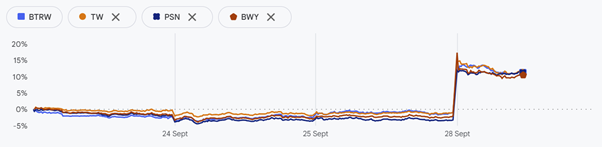
Source: Google Finance
Chiekrie flagged a delay risk.
"With the fine print and implementation still at least a month away, some buyers may simply choose to wait for more details, so sales are likely to remain subdued in the meantime," he said.
The government said developers will be expected to contribute to the scheme's costs. Peel Hunt's scenario assumes 1% of the selling price, in line with an August proposal from the industry body HBF. The final figure is not known.
Creasey also noted that there is "no mention of whether buyers' savings will be measured," he said.
"The prime minister has indicated that this scheme is not intended for buyers with wealthy families, those who can rely on the so-called 'Bank of Mum and Dad', but the exact design of the scheme will need to be carefully balanced to avoid claims of unfairness, with some first-time buyers having put aside savings into the Government's LISA to put towards their first purchase. Any scheme that penalises those savers would risk widespread criticism."
Caps and income limits could restrict demand for the more expensive homes built by Redrow, Peel Hunt concluded.