


The number of active emerging market funds whose three largest holdings match the MSCI Emerging Markets index’s top three has doubled in a year, Trustnet research has found, after a rally in Asian memory chip makers boosted concentration risk.
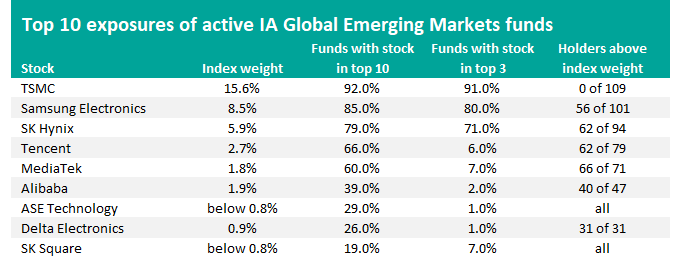
The index’s top three stocks are now Taiwan Semiconductor Manufacturing Company (TSMC), Samsung Electronics and SK Hynix after investors poured cash into AI ‘picks and shovels’ plays. In the IA Global Emerging Markets sector, 71 of 119 active funds – around 60% – hold some combination of these three stocks as their top three holdings.
What’s more, 59 of the 71 funds currently own the three stocks in the index’s exact order (TSMC first, Samsung second, SK Hynix third). The other 12 have the same three stocks but rank them differently: eight funds put SK Hynix ahead of Samsung and four put Samsung ahead of TSMC.
Simon Evan-Cook, multi-asset manager at MGTS Downing Fox, said: “It’s tempting to suggest that, if the index funds have been compromised by heavy AI concentration, then active funds are an antidote to that.
“But the truth is that this has become such an extreme market trend that the average active fund manager is unlikely to be much help and might even be worse. This is because of Darwinism – many fund managers that have resisted following the herd have either given up or been sacked and now, on average, they’re just positioning their funds against the benchmark.”
Source: FinXL, MSCI
The same pattern is evident in the IA Asia Pacific Excluding Japan sector, where 59% of active funds now match their index’s top three, up from 32% a year earlier.
One year earlier, just 35 of 117 global emerging market funds (or 30%) held the index’s top three stocks (TSMC, Tencent and Alibaba) as their largest holdings. The share held broadly steady the year before that, as 32% had TSMC, Tencent and Samsung as their biggest stocks in September 2024.
The shift follows a rapid rise in the index weight of Samsung and SK Hynix, both large manufacturers of memory chips used in AI hardware. Samsung’s weight in the MSCI Emerging Markets index rose from 2.9% to 8.5% over the year, including its preference shares, while SK Hynix’s rose from 1.4% to 5.9%.
Combined with TSMC’s 15.6% weighting, the three stocks now make up 30% of the index, against just 15.2% a year ago. Tencent and Alibaba, which made up two of the index’s three largest holdings in 2025, dropped to fourth and fifth places respectively.
UCITS diversification rules, applied to most funds sold to UK retail investors, limit any single holding to 10% of a portfolio, meaning funds cannot fully replicate the index’s weights for some large constituents.
Of 109 active funds holding TSMC in their top 10, 94 allocate more than 9% but none holds it at its 15.6% index weight because of this rule. Across the three stocks combined, the median active fund holds 23.6% against 30% for the index.
Leon Eidelman, manager of JPM Emerging Markets, said UCITS funds are “forced to underweight TSMC by the regulator”, even if they hold the maximum 10%. He would be “quite shocked to find funds that aren’t near that 10% limit for TSMC”, arguing that an underweight of that size was probably a bigger bet than any position most managers took on the long side.
JPM Emerging Markets holds all three stocks as its top three holdings, in the same order as the index.
A related rule caps holdings above 5% at 40% of a fund in total. The number of active funds in the sector with 35% or more in such holdings rose from one in 2025 to nine in 2026, leaving these funds little room to add further to their largest positions.
Eidelman said managers were left with “the uncomfortable reality of a much more concentrated benchmark than used to be the case for the asset class”.
“But you’re going to have to deliver more juice from the orange of stock selection, so to speak, because you’ve got more money tied up in active share, given the industry concentration,” he added.
Eidelman said JPM Emerging Markets had added value through stock selection within technology despite its TSMC underweight, by picking other Taiwanese stocks.
FE fundinfo data shows some of that shift into smaller Taiwanese and South Korean hardware makers. MediaTek appeared in the top 10 of 71 funds in September 2026, up from just 21 a year earlier, and ASE Technology went from being in five funds to 34.
SK Square, whose main asset is a stake in SK Hynix, is now held in the top 10 of 23 funds, meaning some funds’ real exposure to SK Hynix is higher than the headline holdings might suggest.
Across the IA Global Emerging Markets sector, AI and semiconductor hardware stocks now make up 70% of the typical active fund’s top 10 weight, against 41% a year ago.
The increase in Asian hardware holdings came alongside a reduction in Chinese and Indian positions. Alibaba appeared in the top 10 of 47 funds, down from 77, mostly as its share price fell relative to the rest of the index. HDFC Bank, an Indian lender, fell from the top 10 of 50 funds to 15.
As would be expected, the funds that were early to the Asian AI trade tend to have been rewarded over the two years since 30 September 2024.
The quarter of funds with the highest exposure to TSMC, Samsung Electronics and SK Hynix in September 2024 returned an average 63.9% over the following two years, against 39.4% for the quarter with the least exposure.
The average active fund in the sector returned 51.6% over the period but 89% of the highest-exposure quarter beat a basket of MSCI Emerging Markets tracker funds, which returned an average 53.5% over the same period. Just 26% of the lowest-exposure quarter beat the trackers.
The best performers of the high-exposure funds are Nomura Emerging Markets (up 138.6% over the two-year period), FTF Templeton Global Emerging Markets (up 78.6%) and Invesco Emerging Markets ex China (up 77.1%).
But avoiding the consensus did not guarantee underperformance: Carmignac Portfolio Asia Discovery, which also held none of the three stocks in its top 10 in September 2024, returned 81.2%. It now holds 24% in the three combined.
Evan-Cook added: “You have to work a little harder to find an active emerging markets fund that won’t get dragged down by this. We own four – Merlin, Neuberger, Skerryvore and Chikara India – and they all went up in July while the market and the average fund was getting walloped by the AI reversal.”
The analysis covers the top 10 holdings of active funds in the IA Global Emerging Markets and IA Asia Pacific Excluding Japan sectors, dated 30 September in 2024, 2025 and 2026. Index weights for 2026 are taken from MSCI factsheets; earlier weights are estimated from MSCI Emerging Markets tracker funds. Index-tracking products and funds of funds are excluded from the active fund counts.