


Some 18 US funds have tended to rise when the tech-heavy Nasdaq index falls, according to a Trustnet study, with specific sector specialists and income-focused funds offering investors a different way to approach American stocks.
Tech stocks have taken a beating over the past few months. Between 23 June and 2 November, the Philadelphia Stock Exchange Semiconductor index dropped 21.3%.
Things took a turn for the worse last week, with the index plunging 12.3% on Thursday 5 November, and there could be further trouble ahead. In recent days Nvidia announced it had launched an investigation into reports that chief executive Jensen Huang was the target of a Chinese espionage operation.
The company is the bellwether of the AI trade, and therefore a big forward indicator of the continued success of the giant technology stocks that have propelled markets in recent years. Nvidia’s share price fell at the start of Monday's session as investors digested the news.
As such, investors have been looking to diversify away from tech in recent months, with experts pointing to other geographic regions. However, there are funds from the IA North America sector that have also historically performed well when tech stocks have sold off.
To show this, we looked at funds that have had a negative downside capture to the Nasdaq index over the past five years. A downside capture ratio of -100% means for every 1% the index drops, a fund has tended to make a 1% gain, although this is not an indication of future performance.
The top of the table is dominated by passive funds that invest in specific sub-sectors. The clear ‘anti-tech’ trade is energy, however, with the State Street SPDR S&P U.S. Energy Select Sector UCITS ETF up around 1.49% when the Nasdaq index falls 1%. Its downside capture of -148.7% is more than three times higher than the next-closest fund.
Crucially, the exchange-traded fund has also performed well, up 192.5% over the past five years, placing it in the top quartile of the peer group. The 21-holding fund invests in large US energy companies included in the S&P 500 index, with 29.9% invested in ExxonMobil and 18% in Chevron.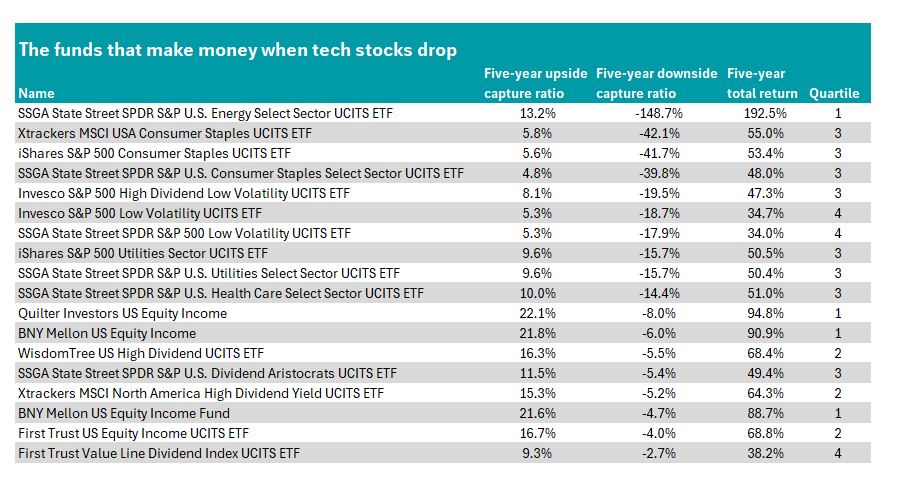
Source: FE Analytics
Oil has rallied over the past few years but in particularly in 2026 as the outbreak of the war between the US and Iran caused the closure of the Strait of Hormuz, through which roughly a fifth of the world’s oil supply passed.
This, along with the Russia-Ukraine war, has limited the supply of oil around the world and pushed a barrel of Brent crude above the $100 mark several times this year.
Second in the table above is the Xtrackers MSCI USA Consumer Staples UCITS ETF, which had a downside capture ratio of 42.1%. It was one of three consumer staples specialists on the list alongside iShares S&P 500 Consumer Staples UCITS ETF and State Street SPDR S&P U.S. Consumer Staples Select Sector UCITS ETF.
All made between 48% and 55% over the past five years, a third-quartile return, with an upside capture ratio of between 4.8% and 5.8% and a downside capture ratio of -39.8% to -42.1%.
Worries over inflation putting pressure on the cost of living have impacted consumer stocks, while higher bond yields have dimmed the attractiveness of quality names known for offering predictable dividends. However, the data suggests that when investors have moved out of tech names, these stocks have held up well.
Other specialist areas to make gains when the Nasdaq has fallen over the past five years include low volatility funds, utilities and healthcare ETFs.
The bottom half of the table above is dominated by income funds, which tend to avoid the tech titans and their relatively low yields.
John Bailer is responsible for the only three active funds above. His BNY Mellon US Equity Income fund has a -6% downside capture ratio, meaning it has been up 0.06% for every 1% fall in the Nasdaq over the past five years.
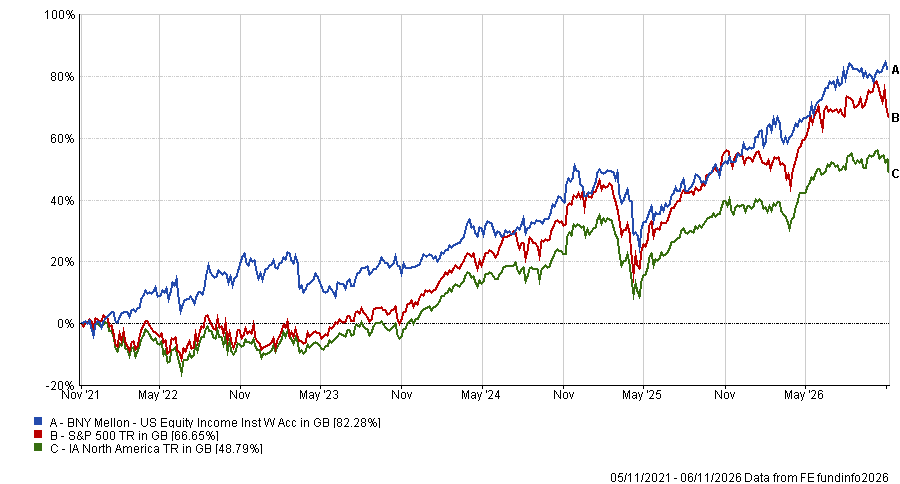
It also has more upside than many of the funds above it, culminating in a total return of 90.9% – good enough to place the fund in the top quartile of the IA North America peer group over the period.
Performance of fund vs sector and benchmark over 5yrs
Source: FE Analytics
The managers of the £2.1bn fund look for companies with a combination of higher starting dividend yields and durable dividend growth. They also have a macroeconomic overlay, which ensures the fund is not overly exposed to any single market environment.
Analysts at FE Investments rate BNY US Income among the firm’s ‘Approved List’. They said: “This fund occupies a distinctive space in the US equity market, combining a meaningful income premium over the broad market with a disciplined focus on companies that look cheaper relative to their fundamentals, without resorting to the highest-yielding names that are often in structural decline.
“The requirement for every holding to contribute to income generation is a genuine differentiator, producing a portfolio that is a purer expression of cheaper US stocks than many peers, making the fund appropriate for investors seeking returns from stable, established firms over richly valued popular stocks.”
Its Irish-domiciled sister fund – BNY Mellon US Equity Income Fund – also made the list. This version of the strategy is four spots lower than the onshore version.
Meanwhile, Quilter Investors US Equity Income sits just above the UK-domiciled BNY Mellon US Equity Income portfolio. The wealth manager outsources management of the fund to Newton Investment Management, so is run by the same team.
There were also five other income specialists in the table above, although all were passive. WisdomTree US High Dividend UCITS ETF was the next-best at making money when the Nasdaq fell, with a downside capture ratio of -5.5%.