


The companies driving AI investment dominate equity indices, and their borrowing is now reshaping bond benchmarks too. As unconstrained bond managers, how should we be thinking about this?
Today, many investors’ holdings, directly or indirectly, include a significant amount of AI exposure, sometimes more than is obvious.
Without the constraints of a benchmark, the deciding factor in security selection is absolute return versus risk, rather than relative return, and risk mitigation strategies have an important role to play.
AI exposure is increasingly pervasive
Exposure to AI reaches through multiple industries, from technology to utilities and power generation, as well as adopters across a range of sectors from healthcare to advertising. A sector-level look at a portfolio will not necessarily find all of it.
AI is also penetrating multiple capital markets as tech firms have broadened their mix of funding sources, which means investors with a traditional asset allocation run the risk of becoming increasingly exposed to the fortunes of the AI buildout.
In the public markets, bonds issued by Amazon, Alphabet, Meta, Microsoft and Oracle are expected to account for 5.1% of the Bloomberg US Corporate Index in 2026, compared with about 3% before the buildout.
That concentration looks modest compared with the roughly 40% weight of the top 10 names in the S&P 500 in mid-2026, but the hyperscalers’ footprint on the bond market is greater if you take duration into account.
More than 40% of their issuance in 2026 has come at maturities of 20 years or more, according to CPR Asset Management, against 15% for the US investment-grade (IG) market as a whole.
The issuance wave has further to play out. JP Morgan estimated in June that the broader AI buildout could require $5.5trn of investment by 2030, with IG bonds providing a cumulative $2.1trn of the funding.
The trend goes beyond IG. As tech issuers have started tapping more corners of the capital markets, investors may have additional layers of AI exposure via high-yield bond funds, leveraged loans, securitisation, real estate, infrastructure and private credit vehicles.
Hyperscaler financing in the US investment-grade corporate market
Annual bond issuance and share of index market value
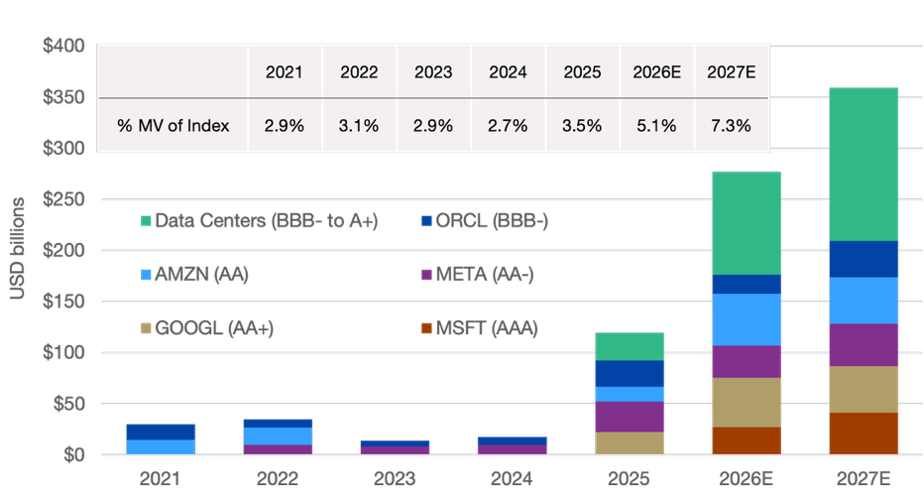
Source: JP Morgan Asset Management. Hyperscalers are MSFT, GOOGL, META, AMZN and ORCL. Ratings are S&P for senior unsecured. Market value of Bloomberg US Corporate Index as of 29 July 2026.
Unlike benchmark-constrained equity or credit managers, we don’t face the pressure of the index composition, and fear of missing out (FOMO) is not a factor. No position gets in because of its index weight and every holding earns its place on its own merits.
On a risk-adjusted basis, we currently think the most attractive opportunities are outside the tech space, including selected emerging-market sovereigns and subordinated financial debt.
One reservation we have about hyperscalers is that they borrow long against unproven future returns on AI spending. Bondholders typically suffer the downside if an investment disappoints, while shareholders capture the upside if it succeeds, so we do not find sufficient spread in these issuers to compensate for the level of uncertainty.
Another concern is that circular financing and hidden debt make some of these issuers’ total potential leverage increasingly difficult to assess. Items such as guarantees and vendor financing sit off the balance sheet, and the same few companies may appear on several sides of a deal, acting as supplier, customer, investor and guarantor.
In recent years, we have selectively held non-hyperscaler tech exposure through convertible bonds, and this has enabled us to add diversification through an alternative return stream, benefit from some of the AI equity market rally and build other thematic positions into the portfolio.
A key objective of our convertible bond exposure is to offer upside potential from blue-chip companies, combined with downside protection. When we do take tech exposure, this is typically via downstream beneficiaries of the AI buildout that are less exposed to the risks of overvaluation, financing, regulation or competition.
Elsewhere, we have exposure to companies sitting across the defence and industrial spectrum that can benefit from increased defence spending in regions like Europe and broad industrial growth in markets like Asia.
Preparing for downside scenarios
Avoiding hyperscaler bonds does not remove AI risk from a portfolio. A crisis of confidence in the AI buildout would not be limited to the hyperscalers.
Volatility would likely rise, with credit spreads widening across risk assets, including the emerging-market sovereigns and subordinated financials where we currently see value.
Hedging strategies are an important way to manage those risks. Equity put options can soften the impact of a stock market shock and single-name and index credit default swaps protect against spread widening.
Protection costs money and can hold back returns in a rising market, so we aim to buy it when volatility, and therefore its price, is low.
In a world where many investors' other holdings are more exposed to AI than they may realise, an unconstrained bond strategy should diversify investors’ core holdings, providing resilience to their portfolio, rather than adding to existing concentration risk.
Richard ‘Dickie’ Hodges is lead portfolio manager of the Nomura Global Dynamic Bond fund. Richard Hastings is client portfolio manager for fixed income at Nomura Asset Management. The views expressed above should not be taken as investment advice.