


The UK is home to some of the world’s most innovative businesses, yet investors fixated on the economic gloom are pricing them as average, according to James Smith, co-manager of the Baillie Gifford UK Growth investment trust.
“There’s this idea that the UK economy is dreadful and that there is no innovation and that is simply not the case,” Smith said.
“While the UK is not as big a hotbed of innovation and large companies as the US, it’s far from dead.”
With valuations so depressed in the UK, these innovative businesses can also be snapped up at bargain prices.
“We believe that, over the long term, share prices follow fundamentals – so we gear ourselves up to find the companies with the most compelling above-average earnings growth,” Smith said.
“It’s not about waking up and finding the fastest-growing company tomorrow but about identifying where you can build conviction in durable earnings growth through a cycle.”
Below, Smith highlighted four companies in the trust’s portfolio that he believes the market is ignoring.
Genus
Smith said animal genetics business Genus is one of the most innovative in the Baillie Gifford UK Growth Trust portfolio.
“As one of the best genetics businesses in the world, it has a really compelling competitive advantage over its peers, being the biggest and having the largest herds,” Smith said.
The company sells genetics for pigs and cows globally, with the US proving one of its biggest markets. More recently, it is developing business avenues in China.
Genus grew its adjusted pre-tax profit 35% to £100.2m in the year to 30 June 2026, despite revenue slipping by 2% to £658.1m.
Its pig genetics business delivered an adjusted operating profit of £130.8m, while its bovine division added £22.9m.
Free cashflow for the business rose 52% to £62m and the total dividend was raised 10% to 35.2p.
Smith also pointed to the company’s longer-term development, noting it has been granted FDA approval for its gene-edited pigs resistant to porcine reproductive and respiratory syndrome (PRRS). PRRS is a viral disease that causes breeding failure in sows and respiratory illness in young pigs.
“Genus has used its technology to gene edit and produce a herd which is resistant to PRRS,” Smith said.
“It is going to take at least 10 years for that herd to feed through to farmers but, if it is successful, the profit impact could be huge.”
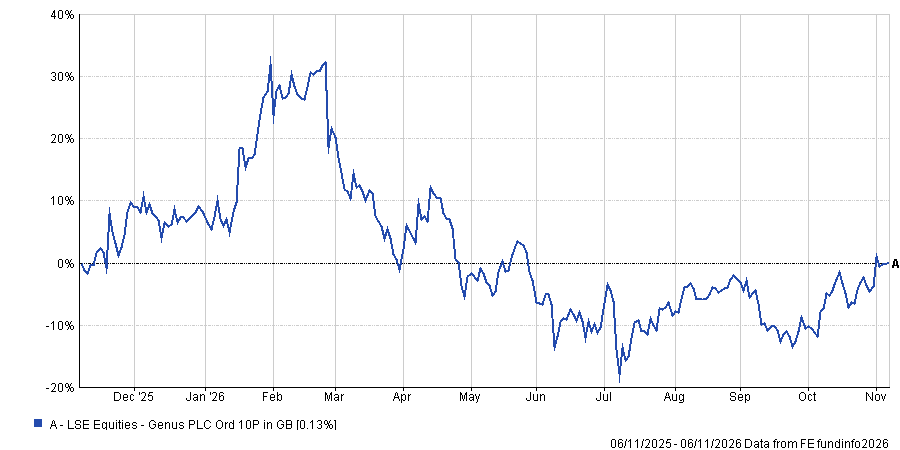
Stock price performance change over 1yr
Source: FE Analytics
Renishaw
Smith also pointed to Renishaw, a FTSE 250 engineering group based in Gloucestershire that makes precision measurement and manufacturing technology. It is benefiting from increased investment in AI and the tech hardware value chain.
“Global investors are scouring the world for how to play AI – and Renishaw is the best in the world at what it does,” Smith said.
He noted that the company encapsulates the juxtaposition between how the market views the UK market versus the actual opportunity set.
“The company houses the brains of Britain and is growing really strongly,” he said.
Renishaw posted a 14% increase in revenue to £815.8m in the 12 months to 30 June 2026, while adjusted operating profit rose 36% to £152.9m. Its position measurement division, which includes the encoders, led the way, with profit up 53%. The ordinary dividend rose 5% to 82p, alongside a special dividend of 70p.
Renishaw is also starting to invest in 3D printing, an area Smith noted “could be quite a compelling new division for it as well that is starting to bear fruit”.
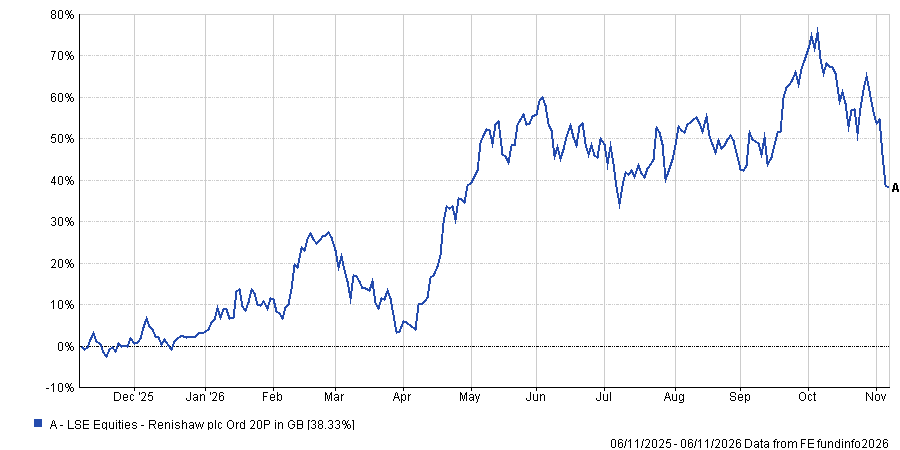
Stock price performance change over 1yr
Source: FE Analytics
Autotrader
As an example of a strong UK business that is cheap to buy, Smith highlighted Autotrader, the UK’s largest online marketplace for new and used cars.
“This is a business trading on around 13x forward price-to-earnings (P/E) – so the market is telling you this is pretty much an average business,” Smith said.
Yet he noted it is around 11x the size of its nearest rival and “doesn’t really have a competitor”, which makes it an attractive business for his portfolio.
“Nothing about this business is average and we believe it can really outperform over the next five years – and yet we can buy it on an average multiple.”
However, it has been a tough few months for Autotrader, as its revenue slipped 1% to £313.4m in the six months to 30 September 2026, with operating profit also down 1% to £198.5m.
Despite this, Smith noted that the company still managed to grow earnings by 8%, “and its cash conversion is amazing – it gives all that cash back to investors”.
It returned £330m to shareholders in the six months to September 2026, raising its interim dividend by 11% to 4.2p.
When looking at future growth of the business, Smith highlighted Autotrader’s continued ability to innovate and create new products, pointing to the Deal Builder feature it has built into its website and app.
This allows buyers to value their part-exchange, get pre-approved for finance and reserve a car online before completing the purchase at the dealership.
The number of retailers using Deal Builder has more than doubled over the past year, to around 9,300.
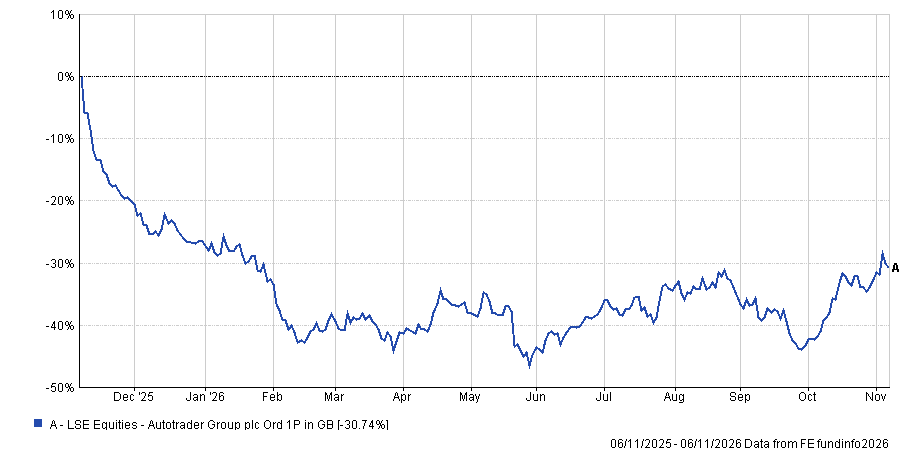
Stock price performance change over 1yr
Source: FE Analytics
Wayve
Looking at the private side of the Baillie Gifford UK Growth Trust portfolio, Smith highlighted Wayve, a London-based AI company developing self-driving technology.
Founded in 2017, the company was valued at $8.6bn in a $1.2bn funding round in February 2026, backed by investors including Nvidia, Microsoft, Uber and carmakers Mercedes-Benz, Nissan and Stellantis, with Smith arguing this shows that many companies see Wayve as “the partner of choice” to compete with the likes of Tesla.
“When the company first started out, an end-to-end approach to autonomous driving was quite against the grain,” Smith said.
It launched its first autonomous rides with Uber in London this September, with Smith arguing the investment case for driverless vehicles “is de-risked now”.
“But we haven’t gone through commercialisation yet, so Wayve is still at the very early stages,” he added, noting that this is therefore an investment for the very long term.
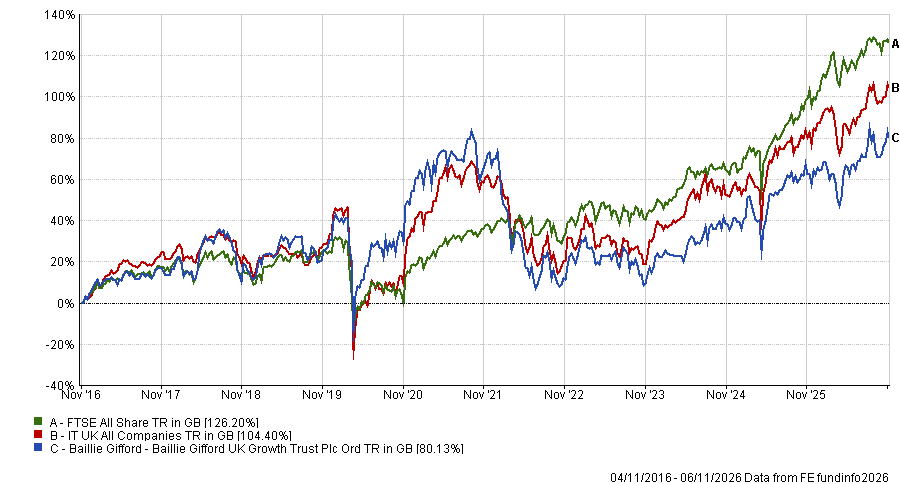
Performance of the trust vs sector and benchmark over 10yrs
Source: FE Analytics