






The UK and Japan have been the biggest success stories for investors over the past 12 months, with both markets up double-digits during this time. However, when picking between the two there is a clear preference for the Asian powerhouse over the domestic market among fund managers.
As we covered earlier today, Japan and the UK have historically been put together as examples of ‘value markets’ as both were out of favour with international investors for some time.
Yet they did not arrive at the same place due to the same dynamics, experts overwhelmingly pointed out. As such, Trustnet asked global fund managers which market they preferred if they could only choose one.
All saw merits in both, but the scorecard stood three to one in favour of Japan. Barry Glavin, head of equities at Amundi, said although the market is no longer cheap on a price-to-earnings multiple basis relative to other markets, he would still consider it a value opportunity.
“Japan’s exit from four decades of deflation continues, while corporate governance reforms advance. The efficiency of company balance sheets is gradually improving as non-core assets are sold and capital is returned to shareholders,” he said.
“The resulting improvement in metrics such as return on equity should continue to drive a normalisation of price-to-book ratios relative to other markets.”
He said the country is therefore the more attractive opportunity for long-term investors as it has compelling valuations and its own independent tailwind that should sustain growth for some time.
It was a similar case for Martin Schulz, head of international equities at Federated Hermes, who said he can “see an argument for having exposure to both” but said he would prefer Japan for the next few years.
“Whether the UK's relative lack of exposure to mega-cap technology can be viewed as an advantage is debatable as being the primary buy case for the market. While both markets have demographic and high public debt headwinds, Japan’s reform agenda, more competitive currency and trade balance metrics and its more innovative corporate makeup (higher AI oriented plays) lead us to prefer Japan,” he said.
The third backer of the Asian powerhouse was Lisa Wang, head of EMEA investment strategy at Franklin Templeton Investment Solutions, who said she would lean towards Japan through exposure to the broader TOPIX rather than the narrower Nikkei index, arguing that the latter trades more in-line with global AI-related stocks.
“We believe reform is still delivering, with continued buybacks, fewer companies trading below book value and foreign investors increasing their allocations. The risks, of course, involve such potentials as a further AI sell-off, moves in the yen and Bank of Japan tightening,” she said.
The lone dissenter was Ian Rees, head of the multi-manager team at Premier Miton, who said the UK is “a very compelling destination for capital” at present.
He noted that the stability the market brings to a portfolio in terms of diversifying away from higher growth, higher valuation and higher-risk areas such as the US means it should have more appeal than purely a valuation argument.
Rees highlighted that UK companies have “the best dividend provisions” versus other developed peers, while also giving shareholders an “extra boost” from share buybacks. Both take the total shareholder return in the UK “head and shoulders above other developed markets”.
Funds to play both
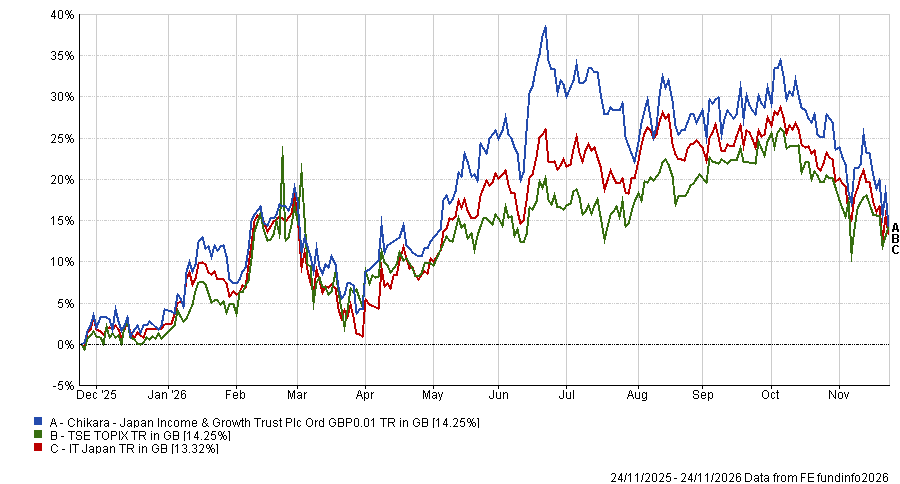
Rees highlighted funds in both markets he likes. In Japan, he uses Chikara Japan Income & Growth fund, run by Richard Aston.
“I really like his approach to trying to focus on getting companies which can show improvement with corporate governance, but can also demonstrate underlying fundamental earnings growth,” he said.
“It's not just reliant on the corporate governance angle, it's actually good, solid companies that have a good growth outlook combined with a corporate governance benefit on top.”
Aston also runs an investment trust version of the portfolio: Chikara Japan Income & Growth Trust.
Performance of trust vs sector and benchmark over 1yr
Source: FE Analytics
In the UK, quality stocks have become extremely unfashionable, having previously been market darlings during the 2010s. Rees noted that funds that were once at the head of the performance tables find themselves at the bottom today, but this could be a good time to invest.
“When you've got great macroeconomic and political uncertainties in the background, I'm a little surprised the market hasn't rewarded more stable businesses better,” he said.
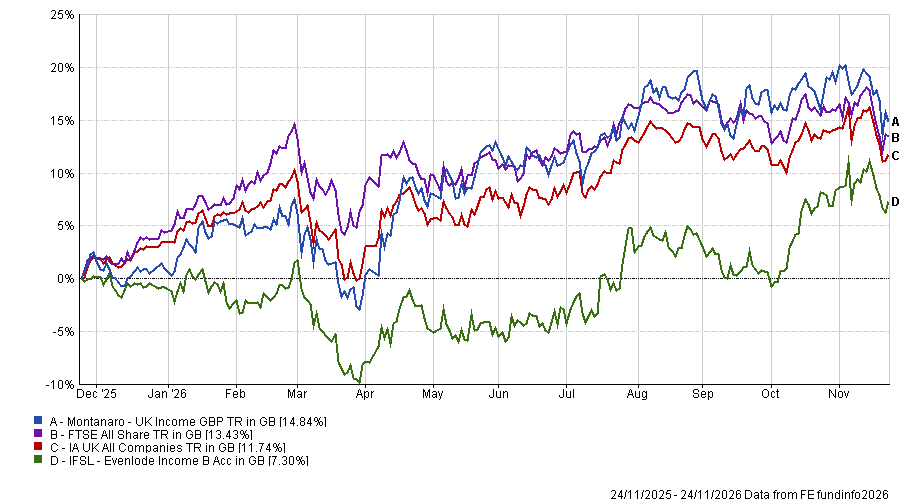
His first selection was IFSL Evenlode Income, managed by Hugh Yarrow and Chris Moore. The large-cap, UK income-focused fund invests in quality stocks.
Given the difficult time for these companies, the fund trades “on one of its cheapest relative valuations since the strategy was launched in 2010”.
To complement it, he suggested WS Montanaro UK Income, which focuses more on the mid-cap space than the Evenlode fund above, but also with a quality tilt.
Performance of funds vs sector and FTSE All Share over 1yr
Source: FE Analytics
“What I like about both funds is not only their quality discipline, but also their awareness of income. Because to me, if they're investing in these high recurring, stable cashflow businesses, that should be demonstrated by quite a healthy income or dividend output,” said Rees.
“You can actually be paid quite an attractive bird in the hand return of income, and provided you can instil the discipline of patience, you can wait for an improvement in those capital values to come through, which I think is justified and should be happening.”