






Historically viewed as traditional ‘value’ markets, Japan and the UK have seemingly little else in common. Yet for investors in both markets, the past year has been a prosperous one.
The Nikkei 225 and Topix indices in Japan and the UK’s FTSE All Share and large-cap FTSE 100 indices are all up between 18.4% and 13.2% over the past 12 months, compared with an 8.6% return from the MSCI World, which was dragged lower by US and European markets.
In fact, they are the only two major developed markets to produce double-digit gains over the past year.
Performance of indices over 12 months
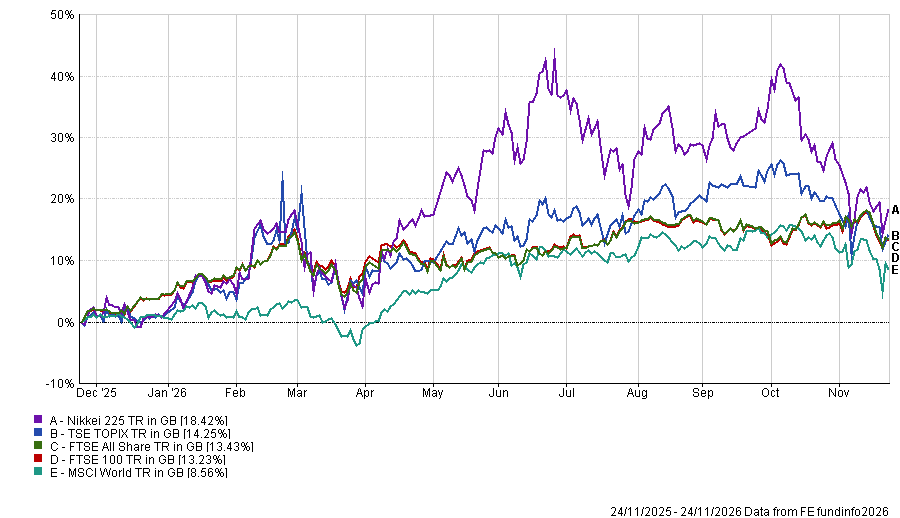
Source: FE Analytics
Carlota Estragues Lopez, equity strategist at St. James's Place, said both markets retain more of a value bias than markets such as the US, with greater exposure to traditional industries, including financials and industrials, and less dependence on a handful of mega-cap growth companies.
“That perceived lack of momentum stocks has historically contributed to both markets being overlooked,” she said.
However, the recent performance introduces some nuance, according to Michaël Nizard, head of multi-asset and overlay at Edmond de Rothschild Asset Management, who highlighted Japan in particular as no longer being the same good value it once was.
The FTSE 100 trades on a forward price-to-earnings (P/E) ratio below 12x – a discount to its five-year average of 14.5x – and offers a dividend yield of around 3%, according to Edmond de Rothschild Asset Management figures. Japan, by contrast, has become more expensive as the Nikkei has re-rated materially. It is now on a forward P/E of 17.6x.
Martin Schulz, head of international equities group at Federated Hermes, said this is because the two have outperformed for contrasting reasons.
“The UK is seen as more cyclical as the global economy has recovered while Japan is seen as more tech oriented,” he said. The former has therefore been a beneficiary of the recent rotation out of tech.
“Investor confidence in the UK government has also improved somewhat, though it remains conditional. Additionally, its October Budget was benign: fiscal rules were left intact, there were no large unfunded giveaways and gilts barely moved. There was no repeat of the 2022 Budget fiasco, which remains fresh in the minds of global investors,” he said.
On the contrary, Japan is a tech-heavy market, he said. In particular, Schulz noted that the Nikkei index is dominated by technology and consumer goods, although the broader Topix market is more weighted to other areas such as pharmaceuticals, financials and industrials.
Here, the long-discussed initiatives to improve corporate governance started by former prime minister Shinzo Abe more than a decade ago are finally coming to the fore.
“Japan’s prime minister is reaping the gains from the decades long reform process but has also introduced growth oriented fiscal policies as the Bank of Japan normalises interest rates as the country has escaped decades long deflation,” noted Schulz.
Ian Rees, head of the multi-manager team at Premier Miton, could only see one similarity between the two markets. “I think the only unifying factor which supports both the UK and Japan performing at the same time is the deliberate move to diversify away from the US,” he said.
Lisa Wang, head of EMEA investment strategy at Franklin Templeton Investment Solutions, agreed. While both benefited from investors rotating toward cheaper markets this year, the two markets have “arrived at the same place via different routes”.
“The UK has an edge with its energy exposure and defensive tilt. Communication services and tech together are just 3% of the FTSE 100, which makes it a genuine non-AI diversifier and a more resilient market when geopolitical tensions rise,” she said.
“In Japan, the story is fundamentals. Manufacturing looks robust in the sectors well represented in the equity market, such as machinery and transport equipment, reforms are supporting steady margin expansion and forward earnings revisions are rising rapidly.”
Will both markets continue to rise together from here?
Experts agreed this could be the end of an era for Japan and the UK, with the markets unlikely to move in similar directions for much longer.
Wang said: “We don’t expect the two to keep moving in lockstep. Japan will likely stay the more volatile of the two, given its higher AI exposure, while the UK is held back by gilt yields above 5%.
“Slow growth is not exactly the issue for the UK. Its GDP grew 0.7% quarter over quarter in Q3, when it showed its fastest quarterly expansion since the first quarter of 2024. The bigger difference is earnings momentum, which is currently much stronger in Japan.”
Shulz was another to highlight the divergence between the two. Japan will continue down its reform and growth-oriented in an effort to compete with local rivals China and South Korea, he said.
Meanwhile, the UK will be dominated by three factors: domestic growth rates, fiscal credibility and gilt yields, and the continuation of the broadening out narrative away from US markets.
“Steady-state conditions could be fine, but a broad global rotation back into tech and growth would be a strong headwind for a market with almost no tech exposure,” he said.
However, Estragues Lopez noted that while both have differing drivers, there is still a case for both markets to continue higher for some time to come, the next phase of may involve looking further down the market capitalisation.
“As valuations at the larger end of both markets have recovered, some of the more interesting opportunities are increasingly appearing among small and mid-sized companies, where discounts remain wider,” she said.
“There is also a diversification argument. Global indices remain heavily influenced by a relatively small number of large technology companies, so the UK and Japan offer exposure to a different mix of sectors and return drivers. If market leadership continues to broaden, or investors become more selective about the prices they are willing to pay for growth, both markets could continue to benefit.”
Regardless, Mark Ellis, fund manager of Nutshell Growth fund, said investors in both markets will have to be more selective moving forward.
In the UK, he is focusing on high-quality, cash-generative businesses on valuations “you'd rarely see elsewhere”, while in Japan “the value is in the broader Japanese market, where many companies still trade close to or below book value despite real progress on corporate governance”.