



Past performance does not predict future returns. You may get back less than you originally invested. Reference to specific securities is not intended as a recommendation to purchase or sell any investment.
This article is featured in the Q3 2026 Future Strategist newsletter, you can read the rest of the newsletter here.
Against a backdrop of uncertainty over the USMCA (United States-Mexico-Canada Agreement), Mexico’s position in the US market continues to strengthen. As the chart below shows, its share of US goods imports has climbed to 17%, leaving both Canada and China well behind. In the first seven months of 2026, US imports rose by just 1% while imports from Mexico increased by 16%, reinforcing its position as the country’s largest foreign supplier.
Market share of US imports
12m average
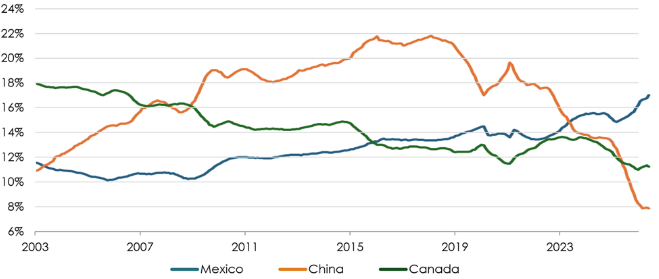
Source: US Census Bureau. 12 month average through July 2026.
For decades, that commercial success was led by the automotive industry. Cars, trucks and components became symbols of Mexico’s transformation into a North American manufacturing powerhouse. Now, however, the composition of exports is changing. Mexico exported $82.9 billion of computer servers in the first half of 2026, putting the category on course to surpass autos and auto parts for the full year. By May, Mexico was supplying 40% of US computer server imports, underlining how quickly it has become part of the infrastructure behind America’s AI expansion.
The surge has made Mexico an important supplier to the US technology sector and created an opportunity to build a much deeper, higher value domestic technology ecosystem. Mexico has spent decades developing sophisticated manufacturing clusters, beginning with consumer electronics and extending into vehicles, aerospace, medical devices and industrial equipment. Ciudad Juárez, Guadalajara and other northern and central hubs offer experienced workers, established industrial parks and networks of logistics and manufacturing service companies.
Mexico’s proximity to the US is another important advantage. Servers made in Mexico can reach US customers more quickly and with less logistical risk than equipment shipped across the Pacific. This combination has attracted leading contract manufacturers, particularly Taiwanese companies such as Foxconn and Pegatron. Their Mexican plants assemble advanced servers for global technology companies, integrating processors, memory, networking equipment and cooling systems into the high-performance racks required by modern data centres. These plants show that Mexico can handle complex electronics production and not just traditional, labour-intensive assembly.
Mexico has become a major assembly hub for the servers powering US AI infrastructure. The next opportunity is to produce more of the components locally.
Many of the most valuable components inside these servers are currently imported. Processors, specialised memory and other advanced electronics largely arrive from Taiwan and other Asian production centres. Industry estimates suggest that Mexican content represents only 3% to 7% of a server’s value, compared with around 39% for a vehicle assembled in Mexico. This reveals the scale of the next opportunity – each imported circuit board, power supply, connector, cooling system or piece of testing equipment represents a potential target for local production. Mexico does not need to manufacture the world’s most advanced processors immediately to capture substantially more value from the AI supply chain.
The most accessible opportunities include server racks and enclosures, printed circuit boards, cables and connectors, power distribution equipment and liquid cooling systems. Mexico could also expand in testing, certification, repair and refurbishment, building on skills already present in its automotive, aerospace and electronics industries. Higher up the ladder are product engineering, firmware, cybersecurity and systems integration. Semiconductor assembly, testing and packaging could provide another bridge between Mexico’s established manufacturing strengths and the capital-intensive world of chip production. Over the longer term, semiconductor design offers the possibility of creating Mexican owned intellectual property, particularly in areas such as automotive electronics, medical devices, sensors and power management. The aim is to build a larger network of Mexican suppliers, engineers and technology companies around final assembly.
The continuing USMCA review adds uncertainty, but it could also accelerate this process. The July review did not extend the agreement, but USMCA remains in force while negotiations continue. The US is pressing for stronger regional supply chains and tighter controls on components originating outside North America, particularly from China and other “non-market” economies. Such rules could initially appear challenging for Mexico’s server industry, given its reliance on Asian inputs. Yet the experience of the automotive sector suggests this could represent an opportunity. When USMCA increased the regional value requirement for vehicles from 62.5% under NAFTA to 75%, manufacturers adapted their sourcing and invested across North America. Mexican vehicle and parts exports to the US rose from $99 billion in 2019 to almost $183 billion in 2024.
Technology hardware could follow a similar path. Tighter North American content requirements would give component manufacturers a reason to locate alongside the server assembly plants already operating in Mexico. Regional requirements would create clearer opportunities for Mexico than measures reserving a specific proportion of production exclusively for the US. Even so, Mexico enters these negotiations with considerable strengths: existing factories, growing export volumes and an increasingly important role in US technology infrastructure.
President Claudia Sheinbaum’s Plan México provides a domestic policy framework for converting this export surge into broader industrial development. Its objectives include increasing national content in strategic value chains by 15%, creating 1.5 million specialised manufacturing jobs and training 150,000 technicians and professionals each year. The plan also offers accelerated depreciation for new investment and additional deductions for eligible employee training.
The Kutsari National Semiconductor Design Centre takes this ambition a step further. With activities planned in Puebla, Jalisco and Sonora, Kutsari is initially concentrating on chip design, the part of the semiconductor chain that generates the greatest intellectual property value. Delivering on this ambition will require reliable electricity, adequate water and transport infrastructure, faster permitting and sustained investment in technical education. It will also require close co-operation among international manufacturers, Mexican suppliers, universities and government. These are significant tasks, but Mexico is beginning from a position of demonstrated strength. The country has already secured a central place in one of the world’s fastest growing industries.
The next stage is to translate the scale of today’s exports into greater local content, better paid engineering work and more Mexican technology. If the automotive story is any guide, assembly can be the beginning of an industrial transformation. Mexico is already a major producer of AI servers, the next step is to make more of their components in Mexico.


