


Past performance does not predict future returns. You may get back less than you originally invested. Reference to specific securities is not intended as a recommendation to purchase or sell any investment.
This article is featured in the Q3 2026 Future Strategist newsletter, you can read the rest of the newsletter here.
Headlines on the economic outlook and consumer confidence have been consistently negative, yet equity markets have kept grinding higher. It is tempting to call this a classic wall of worry but we think that misreads what is happening. A series of cross-currents is playing out, and one of them – the AI capital spending cycle – is strong enough to override the rest… for now.
Earnings, not hope
On a macro view, the backdrop looks bearish: geopolitical uncertainty, rising rates, rising inflation and mounting concern over government debt. Against this sits the huge impetus of AI capex, which is underwriting corporate earnings growth, and, to a degree, economic growth more generally.
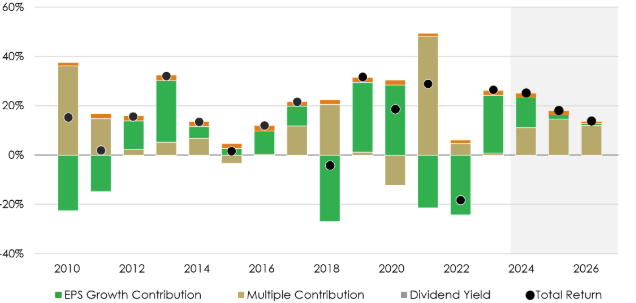
The return decomposition makes the point. Almost all of the S&P 500's gain this year has come from earnings growth, with valuation multiples broadly unchanged. This is not a hope-driven re-rating, it is totally profits driven.
S&P 500: earnings versus valuation
Annual total-return decomposition: 2010-2026 YTD to 31 August
Source: MUFG, 10 September 2026. S&P Down Jones Indices, FactSet, Bloomberg.
The logic of the AI spending cyclone is strategic rather than necessarily financial, but it is real and it is continuing. Mark Zuckerberg put it bluntly: misspending “a couple of hundred billion dollars” would be unfortunate, but “the risk is higher on the other side”. While this mindset holds at the largest companies in the world, the money keeps flowing and so do the earnings of those receiving it; rarely have the spoils of investment fallen almost exclusively to the infrastructure equipment suppliers and this is almost certainly not sustainable. The SOX semiconductor index rose almost 80% in the first nine months of 2026, even after an 11% pullback in the third quarter. This is not a wall of worry being climbed; it is the AI trade driving share prices regardless of the backdrop.
A fine balance
None of this means energy prices, inflation and interest rates do not matter. We interpret them cautiously; for now, they are simply second order to what is driving markets. However, we believe it is a fine balance and if the AI trade starts to feel suspect, these global pressures will quickly dominate the narrative and bring markets lower.
These two opposing forces are also more connected than they appear. AI is itself adding to the macro pressure; data centres are a significant new source of power demand, and the way the buildout is now funded is adding to the supply of long-dated debt – we have written about this impact a number of times in this and previous newsletters. The early phase of capital spending was paid for out of hyperscaler cash flows, the current phase relies increasingly on bonds, leases, private credit and vendor financing. AI-related issuance running at several hundred billion dollars a year competes with Treasuries for the same pool of long-duration capital, just as government borrowing needs are rising.
This has two consequences. First, upward pressure on long-dated yields, which acts as a volatility amplifier for long-duration growth and capex-heavy stocks. Second, fragility at the edges of the ecosystem – the neoclouds and AI labs whose contracted revenue is only as good as their customers' ability to keep raising money.
Does concentration mean a bubble?
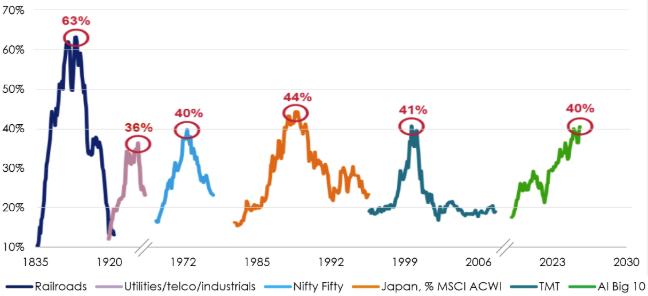
The scale of the trade is now historic. The largest AI-linked companies account for around 42% of global market value – comparable to Japan's 44% weight in global equities in 1989, TMT at 41% in 2000 and the Nifty Fifty at 40% in the early 1970s. Each of those episodes ended with leadership reverting, often sharply.
Peak Concentration of previous Bubbles = 40%; except the Railroads = 60%
Source: Bank of America Securities October 2026.
The difference this time is that the leaders are generating the earnings to support much of their valuation and remain among the most profitable companies ever built. A recent All-In podcast likened the AI spending cycle to a number of these past super builds put together. There is no clear logic to say 40% is the top here and if its 60% (who knows) then there is further to go. Bubble timing is notoriously difficult so we have to manage the risk through position sizing and diversification rather than a binary call on when it ends.
Calm indices, volatile stocks
Concentration at the top also helps explain an apparent paradox: volatility is high at the stock level but subdued at the index level. Passive and momentum flows play a part – they amplify moves and shape the route prices take – but the trigger is, again, AI.
Everyone has a view on what will and will not be disrupted by AI, and this is reflected in significant single-stock volatility. The truth is that no one really knows, so news flow has a disproportionate impact. Accenture is a case in point; it was written off for much of the year as an AI loser, it reported fiscal fourth-quarter results with record annual bookings and rose close to 20% in a day – the largest one-day gain in its history – as the AI-loser thesis was comprehensively challenged. The market doesn't know and commentators don't know; in fact, no one knows so volatility is accentuated as news starts to confirm reality one way or the other.
Finding the real winners
If the losers are hard to call, the winners are clearer in some places than others. Clarity is greatest in the physical layer – power, memory, optics and cooling – where shortages show up in lead times and pricing. It is far less clear in software and services, where the disruption debate is very much live.
We are focused on businesses with room for volume growth, price increases or both. Siemens Energy illustrates the point – the shares have performed very well, but it is now well known that the company is booked out for years, with its gas turbine backlog and reservations totalling around 95 GW. This position has developed over the last 12 to 18 months. It was only six months ago that one could order a turbine for a data centre on a few months' notice – you might even get a second-hand one quicker; now you wait years. The share price has adjusted higher, but to go higher still the company needs to create more capacity or raise prices.
This dynamic is more readily available elsewhere. Memory is a good example, although some investors struggle to buy names that are already up several times over 12 months.
What would change our mind
Because so much rests on the AI trade, we watch closely for signs that it is turning. Four indicators matter most. The first is hyperscaler capex guidance, where the rate of growth matters more than the level. The second is lead times and pricing at the bottlenecks; when turbine, memory and optical lead times start to shorten, pricing power fades. The third is financing conditions – spreads on AI-related debt and funding costs for the more leveraged players. The fourth is monetisation; evidence that revenue at the application layer is growing fast enough to justify the investment beneath it. Any two of these turning together would make us materially more cautious.
When the trade broadens
A pause in the AI trade would not necessarily be bad for equities as a whole. We expect the dispersion of returns away from the US to continue, with one caveat – a meaningful part of non-US outperformance has itself been AI-driven through the Asian semiconductor and memory supply chain and European power and electrical equipment. The real broadening comes if the AI trade flattens or pauses. Opportunities would then spread quickly to the laggards – the S&P 500 Equal Weight, non-US equities more broadly and mid and small caps.
How we are positioned – barbell approach is the only way
Therefore, we take a barbell approach across AI and non-AI. Within AI, the focus is on price setters and volume growth. Outside AI, we look for undervalued companies reflecting opportunities missed by a market with a myopic focus – in healthcare and industrials and more broadly where the use of AI, rather than the making of it, can deliver big productivity gains.
One discipline matters above all; a sector label is not diversification. Many industrials and utilities are, in practice, AI-capex proxies. Genuine diversification means owning businesses whose earnings do not depend on the buildout continuing. Markets are being carried by the AI trade, and for now this is the right trade to own – but the portfolio has to be built, balanced and risk managed for the day it is not.
Read, watch and listen to more insights from Liontrust fund managers here >
Key risks
Past performance does not predict future returns. You may get back less than you originally invested.
We recommend this fund is held long term (minimum period of 5 years). We recommend that you hold this fund as part of a diversified portfolio of investments.
The Funds managed by the Global Equities Team:
-
May hold overseas investments that may carry a higher currency risk. They are valued by reference to their local currency which may move up or down when compared to the currency of a Fund.
-
May encounter liquidity constraints from time to time. The spread between the price you buy and sell shares will reflect the less liquid nature of the underlying holdings.
-
May invest in smaller companies and may invest a small proportion (less than 10%) of the Fund in unlisted securities. There may be liquidity constraints in these securities from time to time, i.e. in certain circumstances, the fund may not be able to sell a position for full value or at all in the short term. This may affect performance and could cause the fund to defer or suspend redemptions of its shares.
-
May have a concentrated portfolio, i.e. hold a limited number of investments or have significant sector or factor exposures. If one of these investments or sectors / factors fall in value this can have a greater impact on the Fund's value than if it held a larger number of investments across a more diversified portfolio.
-
May invest in emerging markets which carries a higher risk than investment in more developed countries. This may result in higher volatility and larger drops in the value of a fund over the short term.
-
Certain countries have a higher risk of the imposition of financial and economic sanctions on them which may have a significant economic impact on any company operating, or based, in these countries and their ability to trade as normal. Any such sanctions may cause the value of the investments in the fund to fall significantly and may result in liquidity issues which could prevent the fund from meeting redemptions.
-
May invest in companies predominantly in a single country which maybe subject to greater political, social and economic risks which could result in greater volatility than investments in more broadly diversified funds.
-
May hold Bonds. Bonds are affected by changes in interest rates and their value and the income they generate can rise or fall as a result; The creditworthiness of a bond issuer may also affect that bond's value. Bonds that produce a higher level of income usually also carry greater risk as such bond issuers may have difficulty in paying their debts. The value of a bond would be significantly affected if the issuer either refused to pay or was unable to pay.
-
May, in certain circumstances, invest in derivatives but it is not intended that their use will materially affect volatility. Derivatives are used to protect against currencies, credit and interest rate moves or for investment purposes. The use of derivatives may create leverage or gearing resulting in potentially greater volatility or fluctuations in the net asset value of the Fund. A relatively small movement in the value of a derivative's underlying investment may have a larger impact, positive or negative, on the value of a fund than if the underlying investment was held instead.
The risks detailed above are reflective of the full range of Funds managed by the Global Equities Team and not all of the risks listed are applicable to each individual Fund. For the risks associated with an individual Fund, please refer to its Key Investor Information Document (KIID)/PRIIP KID.
The issue of units/shares in Liontrust Funds may be subject to an initial charge, which will have an impact on the realisable value of the investment, particularly in the short term. Investments should always be considered as long term.
Disclaimer
This material is issued by Liontrust Investment Partners LLP (2 Savoy Court, London WC2R 0EZ), authorised and regulated in the UK by the Financial Conduct Authority (FRN 518552) to undertake regulated investment business.
It should not be construed as advice for investment in any product or security mentioned, an offer to buy or sell units/shares of Funds mentioned, or a solicitation to purchase securities in any company or investment product. Examples of stocks are provided for general information only to demonstrate our investment philosophy. The investment being promoted is for units in a fund, not directly in the underlying assets.
This information and analysis is believed to be accurate at the time of publication, but is subject to change without notice. Whilst care has been taken in compiling the content, no representation or warranty is given, whether express or implied, by Liontrust as to its accuracy or completeness, including for external sources (which may have been used) which have not been verified.
This is a marketing communication. Before making an investment, you should read the relevant Prospectus and the Key Investor Information Document (KIID) and/or PRIIP/KID, which provide full product details including investment charges and risks. These documents can be obtained, free of charge, from www.liontrust.com or direct from Liontrust. If you are not a professional investor please consult a regulated financial adviser regarding the suitability of such an investment for you and your personal circumstances.


