



Past performance does not predict future returns. You may get back less than you originally invested. Reference to specific securities is not intended as a recommendation to purchase or sell any investment.
Recovery Discoveries: Bifurcation, bonds and a broad opportunity set
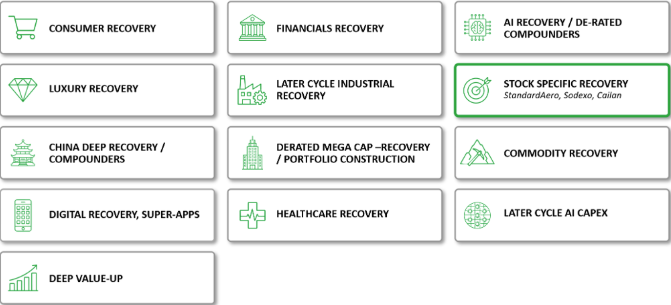
The opportunity set for recovery investing is currently extremely broad, driven by bifurcated markets (AI versus everything else) and a volatile macro backdrop (elevated bond yields). In this article, we discuss three stocks that we believe offer strong investment cases for specific reasons related to each company (aero-engine repair firm StandardAero, foodservice operator Sodexo and diversified services company Calian). We call such stocks “Recovery Discoveries” and they fall within the Stock Specific Recovery theme.
Beyond classic value investing (buying businesses at low multiples for less than they are worth), our Recovery process aims to buy shares in companies which are temporarily out of favour. This encompasses a broad range of opportunities, including de-rated quality (StandardAero), relative value (Calian) and special situations (Sodexo), as well as more classic cyclicals, asset backed companies and out of favour sectors.
Turbines and tailwinds: StandardAero’s overlooked Quality
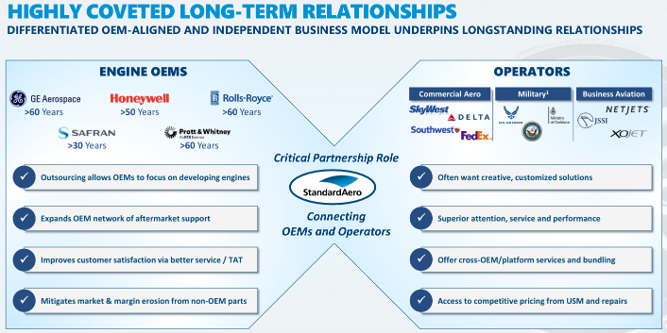
Kicking off our trifecta of talent is StandardAero, a leading US provider of aeroengine aftermarket services (maintenance, repair and overhaul or MRO) to Commercial (60% sales), Military & Helicopter (20%) and Business Aviation (20%) end markets. The group sits between the engine manufacturers (e.g. Safran) and the operators (e.g. Delta), allowing the manufacturers to focus on developing engines, and the operators to receive superior service and customised solutions, highlighted below.
Source: Company Investor Presentation
Barriers to entry are both numerous and formidable, including the highly regulated nature of the industry (due to the significant cost of failure), the technical expertise required to repair cutting edge engines and the capital investment required to set up an MRO facility. Further barriers exist in the form of long-term agreements with operators, who value safety track records of trusted providers (like StandardAero), and license agreements with original equipment manufacturers (OEMs), which are hard to come by.
While the longer-term demand profile is undoubtedly attractive (smoothing cyclicality), short-term concerns have arisen around margin pressure from the ramp in immature growth projects (LEAP/CFM56 engines) and delayed business in the Component division, depressing the shares.
This allows longer-term investors to access StandardAero at an attractive enterprise value (EV) to EBITDA (earnings before interest, tax, depreciation and amortisation) multiple of ~9 times (a trough level since the 2024 IPO) and a discount to the ~11 times multiple recently paid by AAR Corp for peer MRO Holdings. The ~5% free cash flow yield provides valuation support.
Anatomy of a turnaround: CPR for Sodexo
Second is French food services and facilities management provider Sodexo, which serves around 80 million consumers daily across schools, hospitals and workplaces.
Years of operational missteps and underinvestment culminated in a major profit warning in April 2026, depressing the shares, leading investors to question the group's ability to close the operational gap with peers. Issues largely relate to weak contract management, underinvestment in sales capability, organisational complexity and poor utilisation of its procurement platform, Entegra. As a result, operating margins are currently around 3-4%, well below its historic average (>6%) and peers Compass Group (>7%) and Aramark (~6%).
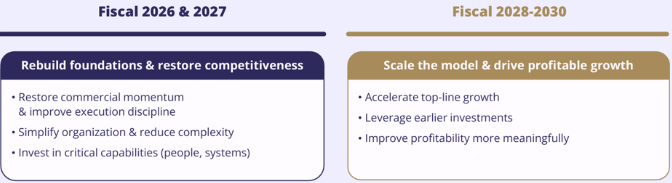
To spearhead the turnaround, the group appointed its first external CEO, Thierry Delaport, who is already busy re-building the North American leadership team, expanding the sales force, simplifying decision-making and improving procurement discipline.
Sodexo transformation plan
Source: Company Investor Presentation
We believe the issues appear largely self-inflicted, rather than structural, as the contract catering market remains large, fragmented and supported by long-term outsourcing trends. At an EV/EBITDA multiple of 8.5 times, Sodexo is trading in line with peer Aramark in 2019 when faced with the same temporary operational issues. We see Sodexo at the start of the same recovery journey as Aramark, which has since re-rated to 11 times EV/EBITDA, highlighting the valuation uplift for successful recovery execution. With a new management team, clear self-help opportunities and a depressed valuation, Sodexo has all the ingredients for a classic recovery stock.
Off the Grid: Calian’s underappreciated satellite and defence activities
Calian is a small cap diversified Canadian services firm with activities across Defence and Space (around 70% sales) and Essential Industries (around 30%) split 50/50 across commercial/government end markets.
Defence activities include training simulation software and communications hardware, aligned to increasing global defence budgets and shifts to electronic warfare. Key products include anti-jamming GNSS antennas and the Virtual Command and Control Interface (VCCI). VCCI acts as a middle-man software programme allowing (often incompatible) military simulation systems to speak to each other (such as a Finnish tank driver simulator and a German Air Force pilot simulator on a joint NATO training exercise).
Calian also provides exposure to the space economy through manufacturing satellite ground stations, a sector which should continue to benefit from the surge in satellite launches and the need for ground infrastructure to support expanding constellations.
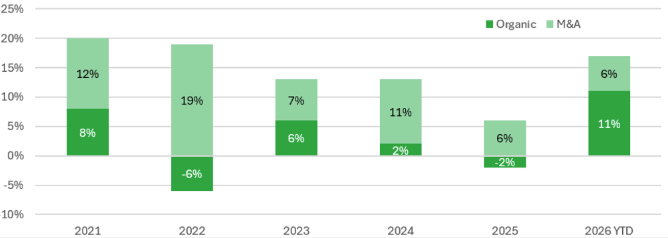
We first took positions in January 2026 after a period of negative organic growth and withdrawal of guidance midway through 2025, viewing activist engagement, a strategic review and management transition as a potential catalyst for positive change.
Calian revenue growth
Source: Company Investor Presentation Sept 2026.
Organic growth has reaccelerated (16% at the third quarter of 2026 results) and coupled with some positive news flow around portfolio change, buybacks and contract wins, it is clear to see why the shares have had a good run (up~50% year to date). Despite this, we still think shares offer good value trading at over 6% free cash flow yield for a company with clear tailwinds, aiming to compound revenue at 10-15% (or mid-to-high single digits in organic terms) into the medium/long term and increase profitability, with strong cash conversion, a robust balance sheet and a multi-year backlog. Trading on 10 times EV/EBITDA, the shares also offer a relative value opportunity to defence peers like CAE (~11 times) and L3Harris (~12 times) and satellite peers like MDA Sace (~14 times).
Read, watch and listen to more insights from Liontrust fund managers here >
Key Risks
Past performance does not predict future returns. You may get back less than you originally invested.
We recommend this fund is held long term (minimum period of 5 years). We recommend that you hold this fund as part of a diversified portfolio of investments.
-
Credit Counterparty Risk: outside of normal conditions, the Fund may hold higher levels of cash which may be deposited with several credit counterparties (e.g. international banks). A credit risk arises should one or more of these counterparties be unable to return the deposited cash.
-
Diversification Risk: the Fund is expected to invest in companies predominantly in a single country which maybe subject to greater political, social and economic risks which could result in greater volatility than investments in more broadly diversified funds.
-
Liquidity Risk: the Fund may encounter liquidity constraints from time to time. The spread between the price you buy and sell shares will reflect the less liquid nature of the underlying holdings.
Smaller Companies Risk: The Fund may invest in companies listed on the Alternative Investment Market (AIM) which is primarily for emerging or smaller companies. The rules are less demanding than those of the official List of the London Stock Exchange and therefore companies listed on AIM may carry a greater risk than a company with a full listing. -
Emerging Markets Risk: the Fund may invest in emerging markets which carries a higher risk than investment in more developed countries. This may result in higher volatility and larger drops in the value of the fund over the short term.
-
Style Risk: The Fund’s investment approach follows a specific style. This means the Fund may perform differently from the broader market or other funds that adopt a different style. For example, growth stocks often trade at higher valuations and can be more sensitive to changes in interest rates or market sentiment, which may lead to greater volatility. Conversely, value stocks may underperform during periods when growth investing is favoured. Although quality companies with strong balance sheets, stable earnings, and robust governance practice may reduce certain risks, they can underperform in markets that favour higher-risk or cyclical investments. If the chosen style is out of favour, the Fund’s performance may be adversely affected regardless of overall market conditions.
-
ESG Risk: there may be limitations to the availability, completeness or accuracy of ESG information from third-party providers, or inconsistencies in the consideration of ESG factors across different third party data providers, given the evolving nature of ESG.
-
Costs: Investment research costs paid via joint payments may vary over time as a Fund’s assets and the strategy’s research requirements change. There may be factors that increase research costs, such as a greater than expected requirement for specialist research.
The issue of units/shares in Liontrust Funds may be subject to an initial charge, which will have an impact on the realisable value of the investment, particularly in the short term. Investments should always be considered as long term.
Disclaimer
This material is issued by Liontrust Investment Partners LLP (2 Savoy Court, London WC2R 0EZ), authorised and regulated in the UK by the Financial Conduct Authority (FRN 518552) to undertake regulated investment business.
It should not be construed as advice for investment in any product or security mentioned, an offer to buy or sell units/shares of Funds mentioned, or a solicitation to purchase securities in any company or investment product. Examples of stocks are provided for general information only to demonstrate our investment philosophy. The investment being promoted is for units in a fund, not directly in the underlying assets.
This information and analysis is believed to be accurate at the time of publication, but is subject to change without notice. Whilst care has been taken in compiling the content, no representation or warranty is given, whether express or implied, by Liontrust as to its accuracy or completeness, including for external sources (which may have been used) which have not been verified.
This is a marketing communication. Before making an investment, you should read the relevant Prospectus and the Key Investor Information Document (KIID) and/or PRIIP/KID, which provide full product details including investment charges and risks. These documents can be obtained, free of charge, from www.liontrust.com or direct from Liontrust. If you are not a professional investor please consult a regulated financial adviser regarding the suitability of such an investment for you and your personal circumstances.
Understand common financial words and terms See our glossary


