






Investors looked at US funds with greed in the first half of 2023, as inflation across the pond seems to have come off the boil and technology stocks rose following the enthusiasm for artificial intelligence (AI).
The IA North American sector has experienced significant inflows of UK money in the past six months, as people felt more bullish about the market beyond the Atlantic than the European, even though they might be missing out on some opportunities closer to home.
Beginning with the former market, the list of most bought funds is crowded with trackers, led by iShares North American Equity Index. This portfolio added £1bn of investors’ money while also achieving the third-best performance of the period, with returns adding net assets of £662.2m.
In second position for investors’ preference was the active strategy HL US, which attracted £490.1m.
The vehicle is managed by four different teams each responsible for a quarter of the portfolio and employs a “best-of-all-styles” approach with the aim to outperform in any market conditions, although it only returned a below-average £56.9m over the past six months, investors were keen to add to the fund.
ES AllianceBernstein Concentrated US Equity also stood out for being the only other active strategy to attract more than £100m. FE Investments analysts highlighted it as “a good option for exposure to large-sized companies with strong growth potential” but also warned investors about the fund’s concentration in only 20 stocks and certain industries (healthcare and IT make up almost 50%).
 Source: FE Analytics
Turning to the least backed, the opposite situation emerged, with only one passive fund, Vanguard US Equity Index, appearing in the list for shedding money (despite making a £1.2bn return).
The most shunned fund was Artemis US Select, with investors withdrawing £382.4m. The other strategies in the list were mainly focused on valuation, due to the resurgence in popularity of growth investing after a brief spell in 2022 when value was outperforming.
Royal London US Equity Tilt also made the list, with £6.6bn leaving the fund. A spokesperson for Royal London Asset Management said: “This movement of assets is largely between different Royal London funds and reflects internal client portfolio restructuring and product development activity.”
Turning to Europe, as stressed by the European Central Bank (ECB) today, inflation is expected to stay above the target for ‘an extended period’, but according to Edward Park, chief investment officer at Brooks Macdonald, “the ECB and the market, don’t know how inflation and economic growth will unfold over the coming months.”
“Early signs appear to show European inflation following the path of the US and edging downwards but there is no real clarity as to where inflation will settle and therefore what the ‘new normal’ will look like for interest rates,” he said.
Due to this uncertainty, investors’ money has flowed in and out of European funds in a manner that seems more indiscriminate, with value and recovery-focused funds both gaining and losing investors’ confidence.
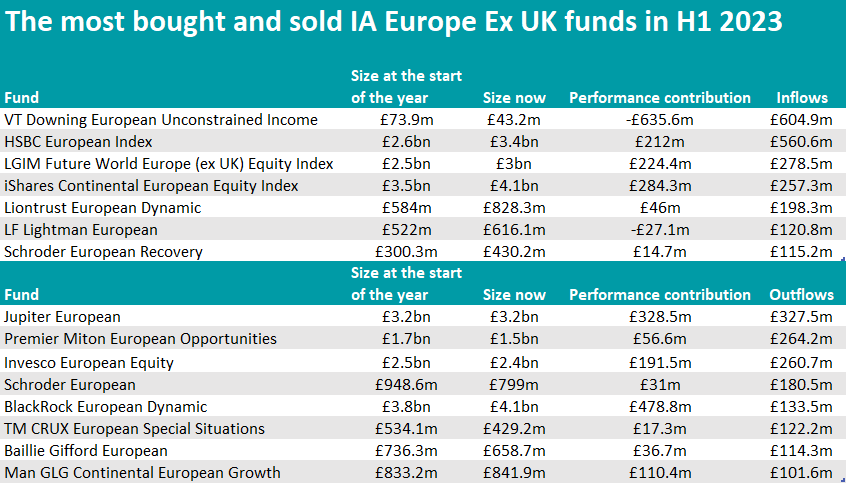 Source: FE Analytics
Coming out on top was VT Downing European Unconstrained Income, which investors bought for a total inflow of £604.9m, despite it losing a similar amount in performance. HSBC European Index came in second-best, followed by two other large, multi-billion passive portfolios.
Liontrust European Dynamic was also among the winning strategies and the biggest actively managed fund on the list.
This FE fundinfo five-Crown rated fund invests in attractively valued companies with strong cash generation and was praised by Square Mile analysts for its “excellent” long-term track record.
On the flip side, Jupiter European was the biggest loser, although its outflows didn’t make much of an indent to its size. Premier Miton European Opportunities suffered the biggest loss, accounting for both performance and outflows.
Despite investors getting out of Blackrock European Dynamic, the positive performance offset the outflows and the AUM increased by £345.3m.