






Multi-asset funds run by Orbis, M&G and Credo have topped the competitive IA Mixed Investment 40-85% Shares sector on multiple fronts over the past three years, research by Trustnet has found.
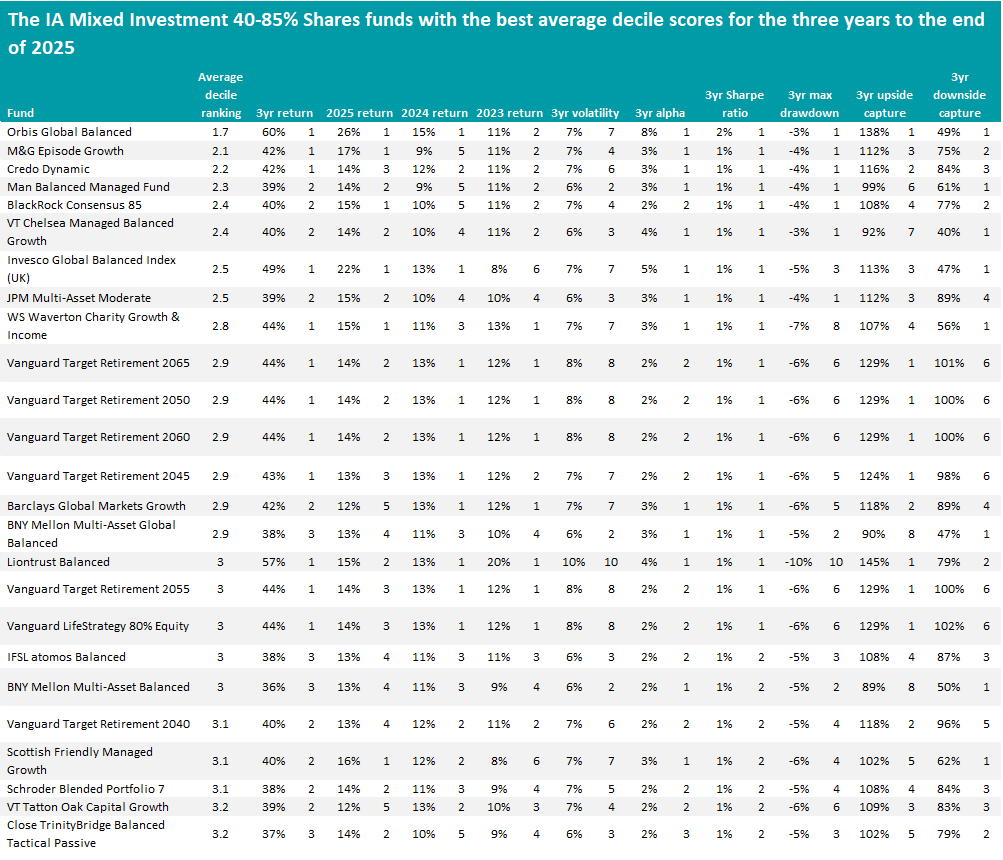
In this annual series, Trustnet scores funds on 10 key metrics: cumulative three-year returns to the end of 2025 as well as the individual returns of 2023, 2024 and 2025 (to ensure performance is not down to one great year), three-year annualised volatility, alpha generation, Sharpe ratio, maximum drawdown and upside and downside capture, relative to the sector average.
We then rank funds on their average decile for the 10 metrics, in order to discover which were most consistently at the very top of their sector. As such, the lower a fund’s average decile score, the stronger it has been on multiple fronts over the past three years.
Below, we apply this methodology to the IA Mixed Investment 40-85% Shares sector – formerly known as the ‘balanced’ multi-asset sector and a source of core holdings for many investors’ portfolios.
Performance of Orbis Global Balanced vs sector over 3yrs to end-2025
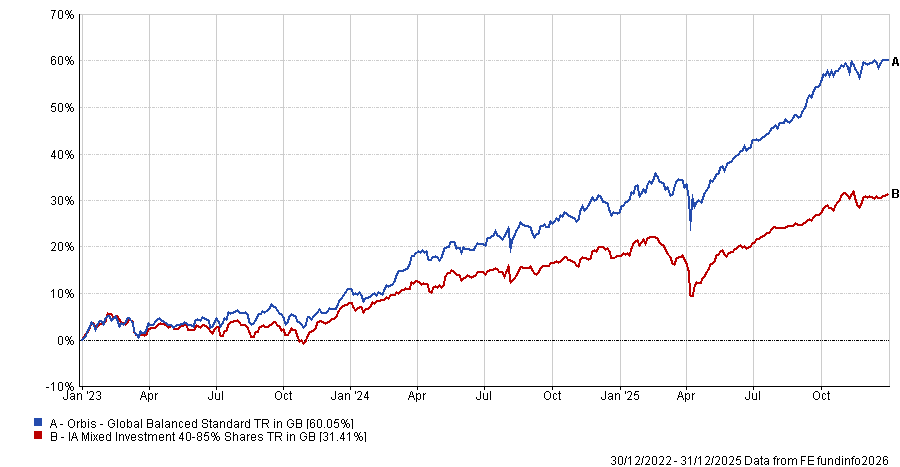
Source: FE Analytics. Total return in sterling between 1 Jan 2023 and 31 Dec 2025.
In first place by a clear margin is the £1.8bn Orbis Global Balanced fund, with an average decile score of 1.7. Over the three years covered by this research, the fund has made a 60.1% total return – the highest in the peer group.
Furthermore, the fund is in the peer group’s first decile for its returns in 2025 and 2024, alpha generation, Sharpe ratio, maximum drawdown, upside capture and downside capture. It’s worth noting that its annualised volatility is in the seventh decile but higher-than-average volatility is a common feature of all the funds with the sector’s highest returns.
Managed by Alec Cutler and Mark Dunley-Owen, Orbis Global Balanced follows a bottom-up investment process that looks for companies that are trading below intrinsic value. The managers will build a concentrated ‘best ideas’ portfolio that can look very different to the market.
Among its top holdings are information technology stocks Samsung Electronics and Taiwan Semiconductor Manufacturing Corporation, US energy infrastructure firm Kinder Morgan, US inflation-linked treasuries and a physical gold ETC.
Commenting on the fund’s strong recent returns, Cutler said: “While only half our stock selections outperformed, we put more capital behind our winners [in 2025] and some of those winners were substantial.
“Defence contractors continued to perform well as the reality sets in that Europe must defend itself. Energy infrastructure providers outperformed as investors came to appreciate the demand growth from ageing grids and power-hungry datacentres. Semiconductor manufacturers rose strongly, as the worst memory downcycle since the global financial crisis gave way to an extreme – and extremely profitable – supply crunch.”
Source: FE Analytics. Total return in sterling between 1 Jan 2023 and 31 Dec 2025.
M&G Episode Growth, managed by Craig Moran, Craig Simpson, Tony Finding and Alex Houlding, is in second place in this research with a 2.1 average decile score and a three-year total return of 42.2%.
This is another fund with a contrarian, albeit top-down, approach: the managers aim to hold investments with strong long-term fundamentals that are trading cheaper than ‘fair value’ because of short-term or emotional overreactions from the rest of the market.
Most of the portfolio’s largest holdings are index trackers (Lyxor FTSE 100 UCITS ETF is the biggest at 21.8%) and long-dated government bonds. M&G Asian, which is outperforming its average peer significantly, over one, three and five years, is the only active fund pick in its top 10.
In third place is Rupert Silver and Ben Newton’s Credo Dynamic fund. It outperformed M&G Episode Growth by the slimmest of margins over the three years examined in this research but has an average decile score of 2.2.
The managers have a flexible approach combining long-term core holdings with tactical opportunities. The core of the portfolio tends to be high-quality equities (often held through trackers) and high-quality bonds, with more tactical, higher turnover investments being used as satellites.
Analysts at FundCalibre said: “With an equity allocation ranging between 40-65%, this fund is one of the more defensive options available to investors in the highly competitive IA Mixed Investment 40-85% Shares sector.
“The managers use a mix of bottom-up and top-down selection to find the best risk-adjusted opportunities. The managers can (and have) gone ultra-defensive when they feel market conditions dictate. We would consider it a strong multi-asset offering for anyone looking for a flexible solution in this market.”
Vanguard LifeStrategy 80% Equity – one of the best-known multi-asset funds in the UK and a core holding for many investors – also appears among the best funds in this research. It is ranked in 18th place thanks to an average decile score of 3 and a 44.1% three-year return.
This is far from the only Vanguard to be highlighted in this research, however, as another six funds – all in the asset management giant’s Target Retirement range – have made it onto the list of the 25 strongest funds across the 10 metrics examined.
Source: FE Analytics. Total return in sterling between 1 Jan 2023 and 31 Dec 2025.
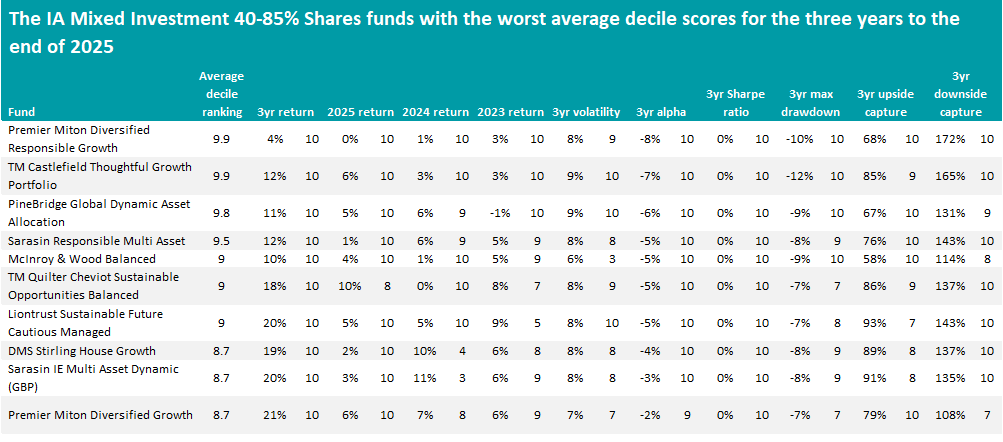
At the very bottom of the IA Mixed Investment 40-85% Shares sector is Premier Miton Diversified Responsible Growth, with an average decile score of 9.9 and a three-year total return of just 3.9%. The fund is in the bottom decile for every metric we looked at, aside from volatility (which is ninth decile).
As its name suggests, the fund invests with an eye on sustainability characteristics, with at least 70% of its assets assessed against relevant environmental and social criteria, displaying a good governance profile and aligning to themes with responsible or sustainable characteristics.
Sustainable investing is a common theme among the balanced multi-asset funds with the worst scores in this research, as half of the above list use this kind of approach. The investment style has been hampered in recent years by higher interest rates and a pushback on sustainability from the Trump administration in the US.