






Shareholders of the Fidelity Special Values made a 23.1% return over the six months to 28 February 2026, beating the FTSE All-Share benchmark, which returned 18.9%.
However, the trust’s net asset value return of 17.1% underperformed, with manager Alex Wright explaining that this shortfall was driven by the performance divergence between large and mid-cap stocks in the UK market.
“Given the company's substantial exposure to mid-cap stocks, this large-cap driven market environment weighed on relative returns, although this was partly mitigated by strong stock selection within large-cap companies,” he said.
The FTSE 100 gained 20% over the period, while the FTSE 250 rose 11.5%.
Wright has been running the trust since 2012 using a value-orientated, contrarian approach. The strategy has delivered double-digit annualised returns over one, three, five and 10 years, but the current environment has tested the portfolio's positioning.
Performance of fund against index and sector over 6 months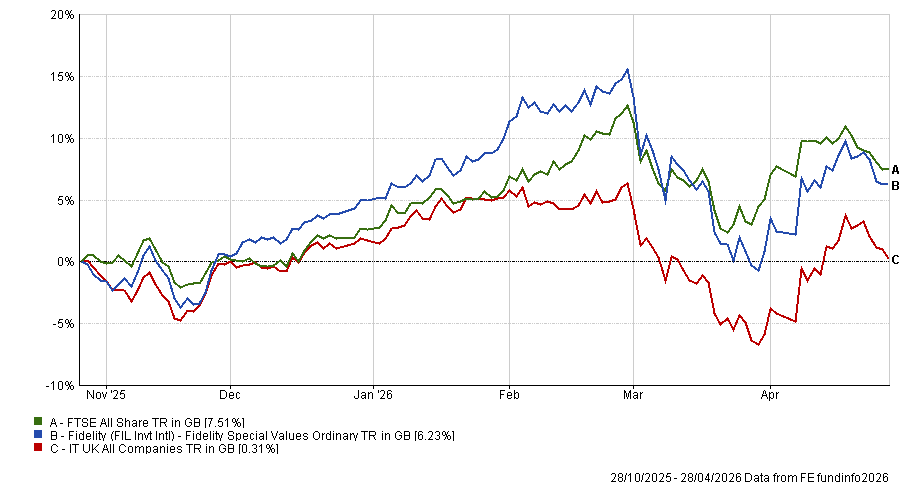
Source: FE Analytics
The detractors
The main detractors from performance included beverage company C&C Group, which declined primarily due to weaker performance in its distribution channels; staffing companies Hays and PageGroup also weighed due to weak underlying recruitment markets, while investor concerns focused on job displacement from artificial intelligence.
But Wright pushed back against the AI-disruption narrative: “We believe these concerns are overstated and have yet to see clear evidence that AI has structurally impaired these businesses,” he said.
“Current challenges appear largely cyclical and we are already seeing signs of improvement in staffing activity in certain markets such as the US, where AI adoption is the most advanced.”
Within the consumer discretionary sector, media agency WPP and digital media company Future also declined. WPP has lost market share, exacerbated by a cyclical downturn in advertising spending; Future's underperformance was driven by a valuation de-rating, reflecting concerns over the impact of AI on its web traffic. Wright noted that its shares are trading on low single-digit multiples, with the valuation underpinned by its price comparison business.
The positive contributors
Despite the challenges, stock selection among large-cap companies contributed positively to performance. Wright's lack of exposure to “expensive quality” companies was beneficial, as several of these were impacted by market fears of AI disruption, including RELX, Experian, Compass and London Stock Exchange Group. Collectively, they de-rated sharply.
Not holding Diageo and 3i Group also contributed positively, as both companies came under pressure from weaker earnings. In Diageo's case, structural concerns around future demand for spirits added to the pressure.
Energy company SSE was the top contributor to relative performance. In November, the company unveiled a £33bn five-year investment programme focused on regulated networks and renewables, including a £2bn equity raise.
Geotechnical engineering company Keller also outperformed, supported by a continued run of earnings upgrades. The business is also benefiting from strong demand linked to data centre activity and infrastructure projects in the US.
Gold miners benefited from the continued shift in central bank reserves away from US treasuries and strong retail demand for precious metals. South Africa-focused gold miner Pan African Resources advanced against this backdrop, alongside delivering strong production updates and the ramp-up of its new mine.
Defence remained a key market theme, supporting holdings in defence contractor Babcock and outsourcing company Serco. Babcock's highly specialised operations, growing international order book and ongoing self-help initiatives continued to support share price performance.
Portfolio moves
Wright has actively recycled capital from areas of strong performance and leaned into unloved businesses with attractive turnaround potential. He increased positions in staffing companies, where he sees “an attractive risk/reward profile over three to five years”.
Current valuations reflect significant disruption to these businesses, while offering upside should hiring recover.
He also sees opportunities in consumer-related sectors, housing and construction, where valuations remain depressed.
“Many of these businesses combine attractive stock-specific opportunities with depressed industry volumes, offering multiple catalysts to support a turnaround,” he said.
The trust’s gearing increased from 5.4% at the beginning of the period to 8.5% at the end of February 2026. Financials remain the largest absolute sector weight, diversified across banks, insurance and asset managers.
Wright maintains a positive view on banks and continues to see value across holdings, including Standard Chartered, Lloyds Banking Group, NatWest Group and Close Brothers.
Looking ahead, Wright remains positive on the long-term outlook for UK equities.
“UK valuations continue to trade at meaningful discounts to other major regions – both on absolute price to earnings multiples and after adjusting for structural sector differences,” he said. “The UK still offers many pockets of value, particularly among smaller and mid-sized companies.”