






For many years Europe has been viewed as the unfashionable corner of the global equity market. A region that has lurched from one crisis to another (as pictured), burdened by sluggish growth, political complexity and ageing demographics, and perpetually overshadowed by the dynamism of the United States and the growth potential of Asia.
Figure 1 – Large macro events affecting European equity markets

For much of the past decade, this characterisation was difficult to argue with. Yet 2025 marked a striking turning point: the European equity market outperformed the US by double digits for the first time since the global financial crisis (+26.2% vs +9.8%).* Investors began to reassess the merits of European equities as returns became less concentrated around technology, benefitting the more diversified European market. At the same time, Germany’s announcement of increased government spending gave European equities an added boost.
Whether this represents a durable regime change or a temporary reversal remains to be seen, but it has served as a timely reminder that Europe can still pull its own weight. After all, Europe has a diverse investment universe of truly global businesses and, as some investors look to diversify away from the more concentrated technology market in the US, Europe is a well-placed alternative.
The countries that make up the European stock market
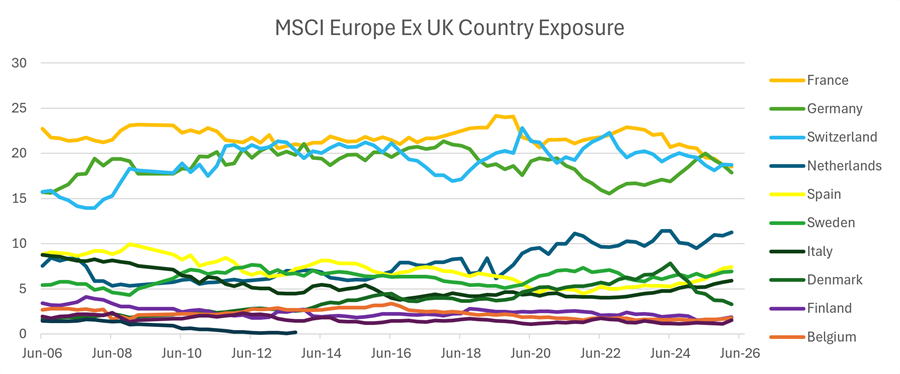
The European stock market (as captured by the MSCI Europe ex‑UK Index) is concentrated in a relatively small number of countries, with France, Germany and Switzerland accounting for approximately 55% of the index as of March 2026 (see graph). Despite this concentration, the index remains broad, encompassing 15 countries in total and underlining the range of investment markets available across the region.
Figure 2 – MSCI Europe Ex UK Country Exposure through time
Source: Morningstar
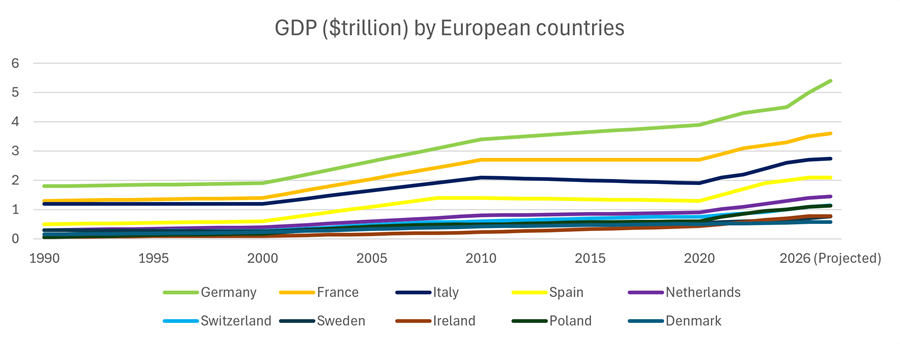
Whilst the respective weightings of the three largest countries have fluctuated over time, they have consistently accounted for the lion’s share of the index over the past 20 years. However, this allocation is not reflective of the relative economic size of these countries. For example, Switzerland has only the joint sixth-largest GDP in the bloc, alongside Poland, yet it is the largest weight in the stock market. Underscoring that stock markets are determined by global profitability, rather than raw economic scale.
Figure 3 – GDP of European countries through time
Source: 1990 – 2024 World Bank 2025 & 2026 estimates IMF
As such, while concerns around European growth and ageing demographics persist, the performance of the index is not solely dependent on domestic economic conditions. Indeed, according to Morningstar, only c.40% of European company revenues are derived from Europe.
The industries in the mix
The strength of the European market lies in the diversity of its underlying industries. Ask a group of investors what stands out in European markets, and the answers will vary; Swiss healthcare companies, Germany’s industrial backbone, French luxury goods, or the bloc’s defensive consumer staples franchises. This breadth characterises a market that is far from uniform and would not be achievable in any single European country. It is the integration of these distinct markets and their constituent industries that underpins the strength of the European equity market, providing true diversification for investors across nations and industries.
Figure 4 – Sector breakdown of MSCI Europe Ex UK and by country

Source: Morningstar
Our allocation to Europe
Within our equity allocations at AJ Bell we have around a 12% allocation to Europe across funds and portfolios (as at May 2026). We’ve opted for this allocation on the basis of our long term expected returns for the market, as well as its correlation with other regions. We are not currently looking to ‘overweight’ the region given its economic growth indicators look weaker, not least due to the region’s heavy reliance on energy imports. We note that German fiscal support could offer a partial offset, however broader policy backing is limited, leaving the chances of economic recovery fragile.
FUNDS TO CONSIDER
Lightman Asset Management is a focused, single‑strategy boutique specialising in European equities. Founder and fund manager Rob Burnett has applied his contrarian (valuation-focused) investment style since his time at Neptune, before launching this fund in 2018. The strategy centres on identifying companies where market valuations fail to reflect underlying franchise strength, targeting businesses with resilient earnings, strong competitive positions and depressed share prices. The fund typically invests in out‑of‑favour areas of the market, where negative sentiment has created compelling valuation opportunities, resulting in a portfolio that often looks materially different to both peers and index. While the manager’s primary focus is mainland Europe, the portfolio retains some flexibility to allocate to UK‑listed companies where attractive opportunities arise.
BlackRock has a long and established pedigree of actively investing in European equities, offering a broad suite of European equity funds. BlackRock European Dynamic adopts a flexible, high‑conviction approach, typically biased towards higher‑growth businesses. The fund is led by Giles Rothbarth, Co‑Head of BlackRock’s European equity team, and supported by a 20 strong team of analysts. Giles combines top‑down macroeconomic and industry views with the team’s bottom‑up search for companies with strong earnings trajectories and cash flow generation.
Vanguard FTSE Developed Europe ex-UK Equity Index
This passive fund offers a low cost and efficient way to gain exposure to large and medium sized businesses in Europe. The fund has an excellent long term track record of tracking its benchmark, having launched in 2009 and, is at a good scale, with over £5bn AUM. Vanguard, as it is commonly known, is the group of companies that comprise The Vanguard Group Inc and its subsidiaries. It was established in 1975 and is a pioneer in index investing, introducing the first index fund for individual investors in the United States, in 1976. It now operates globally, with over $9trn in assets under management and is one of the world's largest asset managers.
Paul Angell, head of investment research at AJ Bell. The views expressed above should not be taken as investment advice.
*Source: Indices, MSCI Europe ex UK and the S&P 500