






Multi-asset funds run by BNY Mellon, Fidelity and TrinityBridge are all returning to form after an off-decade, research from Trustnet suggests.
This year has been an interesting time to invest in multi-asset. The AI trade has moved on from US hyperscalers, known as the 'Magnificent Seven', to semiconductor stocks in the emerging markets (namely Taiwan and Korea).
Despite this, global developed market equities have performed quite well, up 11.2%, as other parts of the world (led largely by the likes of Europe, the UK and especially Japan) have gained ground.
Japanese equities have made the highest returns in sterling (37%), with emerging markets in second place, up 23.3%.
But the best asset to own in 2026 has been oil. The war between the US and Iran caused oil prices to spike when the Strait of Hormuz was closed, limiting the transport of the black stuff through the narrow waterway.
A barrel of Brent crude is up 46.9% year-to-date, although this was higher earlier in the year when the war was at its peak.
Bonds haven't made investors much money so far this year. While yields are high, the war has kept inflation high, which has limited the prospect of interest rate cuts around the world.
It could be argued fixed income is the best defensive asset class, as gold (often a good option at times of crisis) has fallen 6%. Prices coming into the year looked high as the precious metal had been on a strong run.
Additionally, the prospect of higher rates for longer increases the opportunity cost of the yellow metal, as it does not provide investors with a yield.
All of this still does not touch upon other areas that multi-asset funds can invest in, from property to infrastructure and private equity, which has gone completely off the boil in 2026.
The range of different returns and outcomes in the first half of the year has allowed some unfamiliar names to climb towards the top of the rankings.
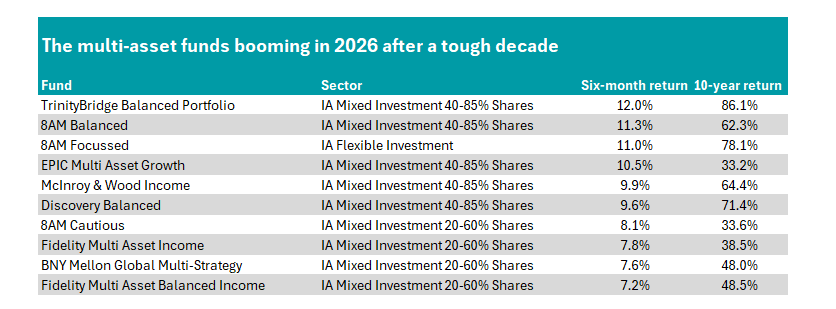
Source: FE Analytics
For example, TrinityBridge Balanced Portfolio has made 12% so far this year, the 10th-best return in the IA Mixed Investment 40-85% Shares sector. This follows a decade-long run of disappointment, in which the fund has made a bottom-quartile return of 78.1%.
The £1bn fund has been managed by Giles Parkinson since 2021 with Henry Frewer and Richard Stroud joining him in 2022.
Despite its weaker long-term returns, the fund is part of a range that is rated by analysts at RSMR, who said a key draw was the "interaction between the various parts of the business", such as committees, research team, asset class specialists and fund managers.
"In saying that, each manager is responsible for all decisions made within their funds, so how they interpret the tactical asset allocation vote and weight the individual securities from the core universe in their portfolios is key to performance," the analysts noted.
Using direct investments rather than third-party funds is also a differentiator from the majority of other fund ranges, they added.
It was one of five funds from the IA Mixed Investment 40-85% Shares sector to make the above list alongside 8AM Balanced, EPIC Multi Asset Growth, McInroy & Wood Income and Discovery Balanced.
8AM Focussed was the only fund from the IA Flexible Investment sector struggling over 10 years but turning things around in 2026. Meanwhile, 8AM Cautious was the third offering in the table above from the firm.
All three are managed by Tom McGrath, although Andy Merricks is co-manager of the Focussed fund. Between them, the funds have a combined £12.5m in assets under management.
The only other fund group with multiple entrants is Fidelity, with Becky Qin's Fidelity Multi Asset Income and Fidelity Multi Asset Balanced Income funds both on the list. They reside in the IA Mixed Investment 20-60% Shares sector.
The former aims for a long-term income target of between 4% and 6%, while the latter is slightly lower (3-5%), but also charges half the cost.
The funds are rated by analysts at RSMR, who said they "combine flexible asset allocation with investment selection, splitting the potential investments into four underlying categories". These are: core yield, growing yield, alternative yield and flexible assets.
Allocations vary depending on the fund's risk profile and the team's views on the asset classes, but they are managed by the same team, using the same investment process, asset allocations and asset selection.
"The core of each portfolio is invested in funds, but they also have stocks in their equity and bond components making them hybrid portfolios rather than purely fund of funds," RSMR analysts said, adding that it is a "high-quality managed solution for income investors across different risk profiles".