






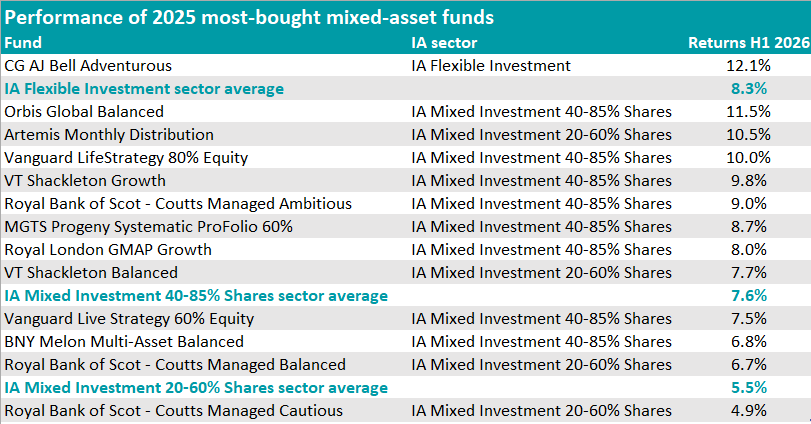
CG AJ Bell Adventurous, Orbis Global Balanced and Artemis Monthly Distribution were the best performers of 2026 so far among the most popular mixed-asset funds of yesteryear.
In this series, Trustnet has been assessing investors' short-term instincts by checking how 2025's most-bought funds have performed in the first half of this year.
Across the IA Flexible Investment, Mixed Investment 40-85% Shares, Mixed Investment 20-60% Shares and Mixed Investment 0-35% Shares sectors, the crowd has mostly called it right so far, with 10 of the 13 funds that took in more than £200m in 2025 going on to beat their sector average between January and June.
Source: FinXL
The only IA Flexible Investment member to make the list, CG AJ Bell Adventurous returned 12.1%, well above the sector average of 8.3%.
Its process is to actively choose between passive holdings, with the top names in the portfolio including the SPDR S&P 500 exchange-traded fund (ETF), the Vanguard FTSE UK All-Share index and the Vanguard FTSE Developed Europe ex UK Equity index.
With £1.6bn of assets under management (AUM), it has an ongoing charges figure (OCF) of 0.31%, one of the lowest in its peer group.
In a close second place, Orbis Global Balanced returned 11.5% against a 7.6% average for the average fund in the IA Mixed Investment 40-85% Shares. Co-run by FE fundinfo Alpha Manager Alec Cutler, the Orbis fund carries the maximum FE fundinfo Crown Rating of five.
It has no official ongoing charge figure (OCF) but charges a performance fee, which is refunded to clients during periods of underperformance.
RSMR analysts pointed to its "fundamental, long-term and contrarian investment approach", while the firm's own view highlighted a concentrated portfolio of global stocks bought at a steep discount to their worth.
Concluding the top three with a gain of 10.5% was Artemis Monthly Distribution, comfortably above the 5.5% average of the 20-60% Shares sector.
The five crown-rated fund is run by Jacob de Tusch-Lec, Alpha Manager James Davidson, David Ennett and Jack Holmes, and has an OCF of 0.82%.
It was part of interactive investors' best-buy picks and among the best performers in that list last year. Analysts at the platform noted its high-yield bias may bring deeper drawdowns during weak markets but said "performance remains impressive even when adjusted for higher-than-average risk".
Outside the top three, a pair of Vanguard's LifeStrategy funds split either side of their sector average.
Vanguard LifeStrategy 80% Equity returned 10.0%, beating the IA Mixed Investment 40-85% Shares sector’s 7.6% average. At £18bn it is the largest fund on the list, carries a Square Mile "recommended" rating, an RSMR rating and five Crowns, and is popular for, among other things, its low charges figure of 0.20%.
At 7.5%, Vanguard LifeStrategy 60% Equity was marginally below the average, reflecting its lower equity allocation. Just like the AJ Bell fund above, these two strategies are an actively managed collection of passive funds.
Just over a percentage point away was the final passive name to feature – MGTS Progeny Systematic ProFolio 60%, which uses a rule-based investment process to create the asset allocation and underlying investment selections across a ‘self-rebalancing’ range.
Returning to active names, two Shackleton funds did well, with VT Shackleton Growth up 9.8% and VT Shackleton Balanced 7.7%.
Previously known as ‘Esprit’, the range was renamed to Shackleton on 1 May 2026, with the change affecting naming only. There was no alteration to management, risk profile or investment objectives.
Both typically hold between 15 and 25 underlying funds, exchange-traded products, equities or bonds.
Next up, the Royal London GMAP Growth fund returned 8%. Managed by RLAM's multi-asset team, which is headed by Trevor Greetham, it sits within what RSMR analysts called “a risk-controlled framework where any changes need to be within pre-defined risk budgets”. The rated range uses in-house funds and passive vehicles to keep costs down, with a 0.60% charge.
Failing to beat its sector average, BNY Mellon Multi-Asset Balanced returned 6.8% but remains popular. At £4.3bn, it is run by Simon Nichols, who took over as lead manager in 2017.
It is part of Hargreaves Lansdown’s Wealth Shortlist, with analysts at the firm describing Nichols as a “naturally conservative investor”, noting his funds have typically fallen less than peers in sell-offs but can lag during strongly rising markets.
Finally, three Coutts funds round off the table, headlined by Coutts Managed Ambitious, which is the largest actively managed fund on the entire list, at £7.3bn.
No funds in the 0-35% Shares sector managed to attract over £200m in 2025, so they were omitted by the study.