






Oil prices touched $100 a barrel on Friday 24 July, after hostilities between the US, Israel and Iran escalated again. This in turn reignited fears of stagflation, as inflation stays sticky and government borrowing continues to climb.
Further clouding the global outlook in 2026, renewed trade tensions are adding to unease, with the US imposing new tariffs on more than 60 other countries, including the UK, EU and China.
The term ‘stagflation’ essentially refers to an economic condition characterised by the simultaneous occurrence of high inflation, stagnant economic growth and elevated unemployment.
The likelihood of stagflation is not a base case for many asset managers. In a note published in June, economists at IFM Investors said the landscape today is “not yet” a 1970s-style stagflation shock “but it has reintroduced a familiar and uncomfortable trade-off for policymakers and investors: weaker real income growth on one side and renewed inflation pressure on the other”.
Should regions slip further and indeed enter a new period of stagflation, this would spell trouble for stock markets, as businesses and consumers spend less and demand – and therefore growth – weakens.
However, Duncan Lamont, head of strategic research at Schroders, said that there are still stocks that can perform well in stagflationary periods – “just not as well as at other times”.
The table below shows the performance of different sectors in the US during 10 stagflationary years between 1974 and 2025.
US sectoral performance during periods of stagflation
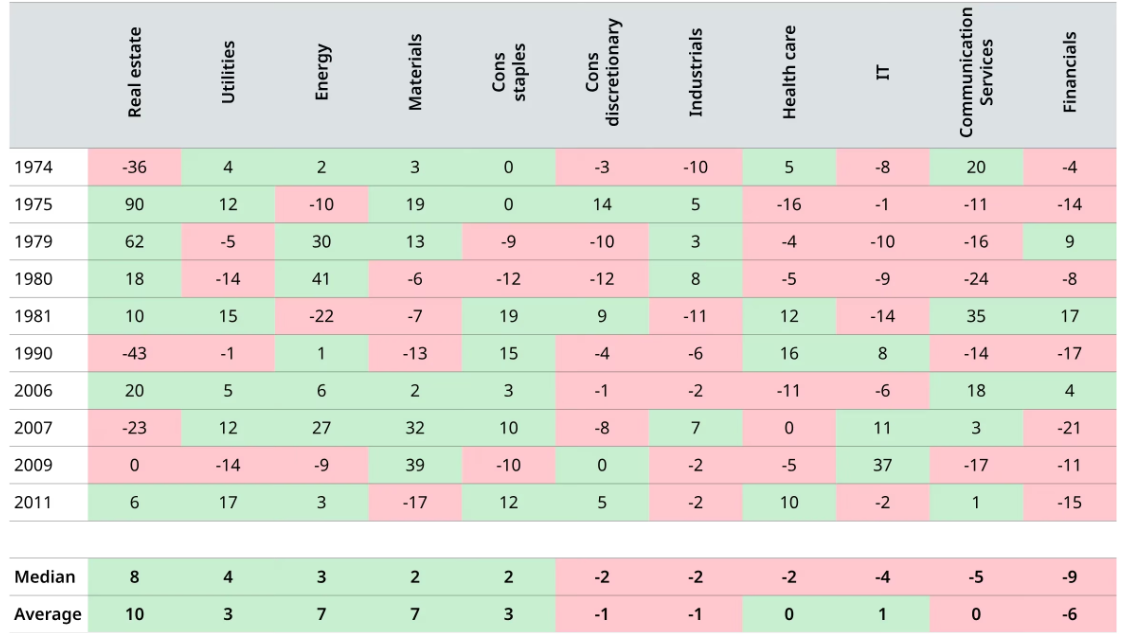
Source: Schroders, LSEG Datastream. Based on analysis of data on US equity market sectors, 1974-2025.
Schroders’ research shows that defensive sectors such as utilities and consumer staples performed relatively well, with Lamont noting that “demand is less sensitive to the economic cycle”.
“Energy and materials companies have typically performed well because high commodity prices have often been a cause of the high inflation during stagflation, as is the risk present,” he added.
In contrast, the healthcare sector has typically underwhelmed during stagflationary periods, despite also being considered a defensive sector. It outperformed during just four of the 10 assessed periods.
“It performed well in the 1940s, 50s, 60s, 70s, 80s and 90s episodes of stagflation but less well in the 2000s,” Lamont said, which “allows us to take a more positive view on the sector’s performance during stagflation than the table would suggest”.
Meanwhile, consumer discretionary, IT and communication services and financials have typically performed poorly during stagflationary periods, impacted by consumer spending behaviours, valuation impacts and inverted yield curves.
Lamont then considered how these findings may translate to different global equity markets, considering how heavily each region is exposed to different industry sector.
Regional market composition
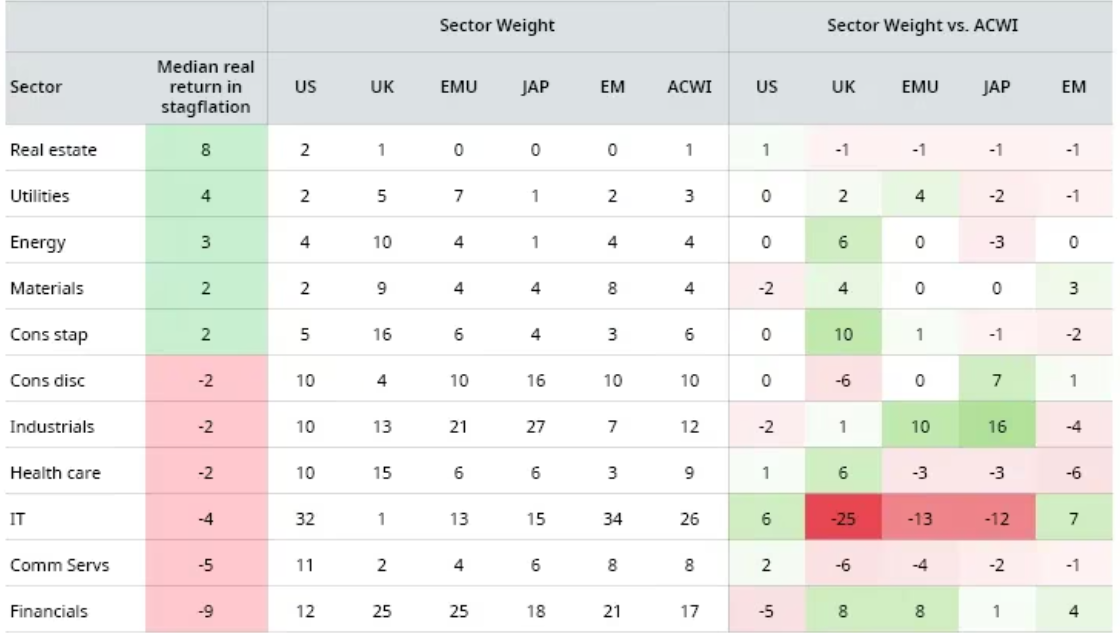
Source: Schroders, LSEG Datastream. Benchmarks used: MSCI USA, MSCI UK, MSCI EMU, MSCI Japan, MSCI ACWI. Sector weightings as at 28 February 2026.
The US is likely to be more vulnerable during periods of stagflation because of how the tech mega-caps dominate the market, Lamont argued. At the same time, US allocations to the sectors that have performed better during stagflation “are all relatively low in absolute terms”, he said, totalling 15%.
Sector composition is also “not particularly favourable” for emerging market equities, according to the research, where consumer discretionary companies, communication services and financials abound.
Japan and Europe would also potentially suffer due to their large focus on the industrials sector, although Europe’s utilities and lack of tech could provide a counterbalance, Lamont suggested.
Meanwhile, the UK is “an intriguing proposition”, he said, highlighting 16% of the market is made up of consumer staples and 10% of energy – more than double any other major market.
“Plus, it has barely any exposure to the IT or communication services sectors compared with elsewhere,” Lamont said, albeit adding that the UK has plenty of stagflation-sensitive financials.
“While not without risk, there is definite potential for negative perceptions about the UK market’s boring, defensive nature to turn to its advantage,” he said.
“It also remains cheaply valued compared with overseas markets and therefore has a more favourable starting point.”
Moving from equities to fixed income and recent research by T. Rowe Price also highlighted disparities during periods of stagflation, noting that energy-importing economies have often been the most vulnerable, while commodity exporters and countries with credible monetary policy frameworks proved more resilient.
Historical stagflation episodes and fixed income outcomes
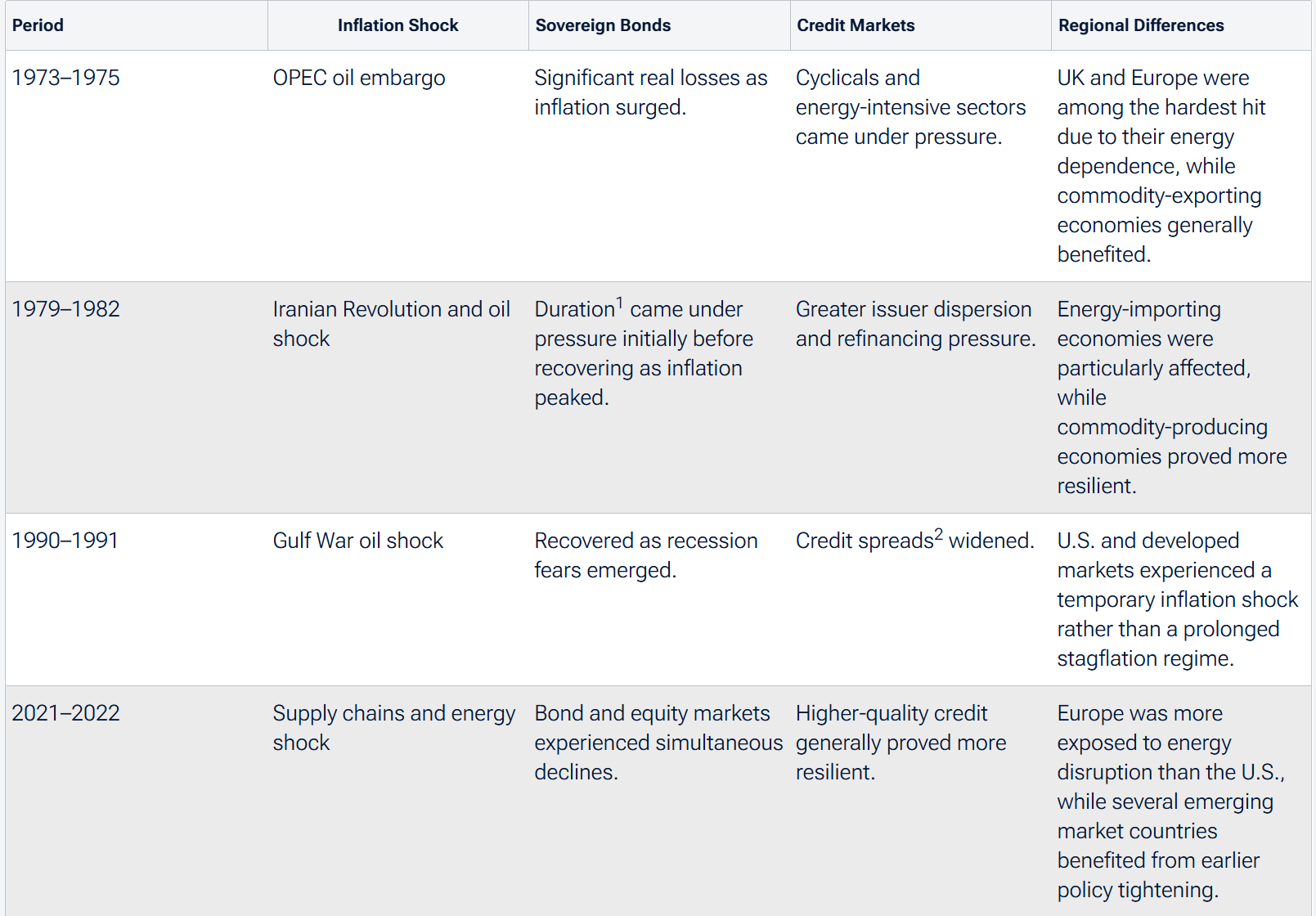
Source: T. Rowe Price
A recent example of stagflation is 2022, when inflation surged and central banks aggressively tightened policy. In response, bond yields rose, credit spreads widened and most fixed income sectors experienced significant drawdowns.
As shown in the table below, fixed income sectors rebounded strongly in the recovery that followed, as inflation moderated and markets began pricing the end of tightening cycles.
Bond sector performance during the 2022 stagflation
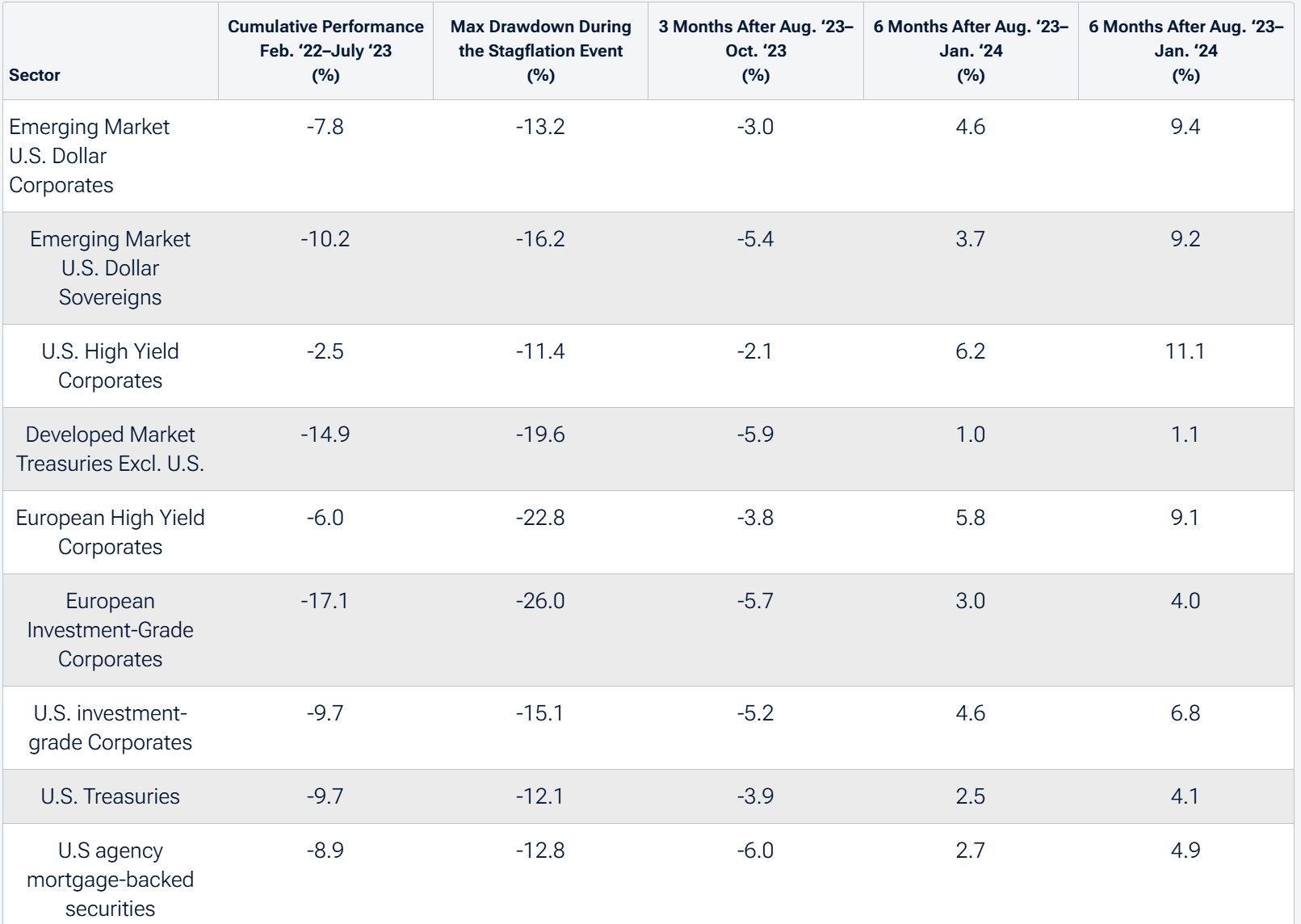
Source: T. Rowe Price
“The episode highlights an important lesson: inflation shocks can create short-term pain but they have often been followed by attractive fixed income returns,” the research noted.
However, it added that there are differences between the environment in 2026 to that in 2022 – most notably, that investors are starting from significantly higher bond yield levels, which “can provide a larger income cushion against rising yields and improve prospective return potential relative to the starting point investors faced in 2022”.