






No exposure to the US mega-cap AI winners and moving towards smaller companies and emerging markets could have been a disaster five years ago. But over the past half a decade these trades are exactly where the Liontrust Global Income and Growth fund has been positioning – and to great effect.
The £198m fund, previously named RGI Global Income and Growth, is co-managed by Alasdair Birch and Bettina Edmondston and has thrived despite some surprising portfolio moves.
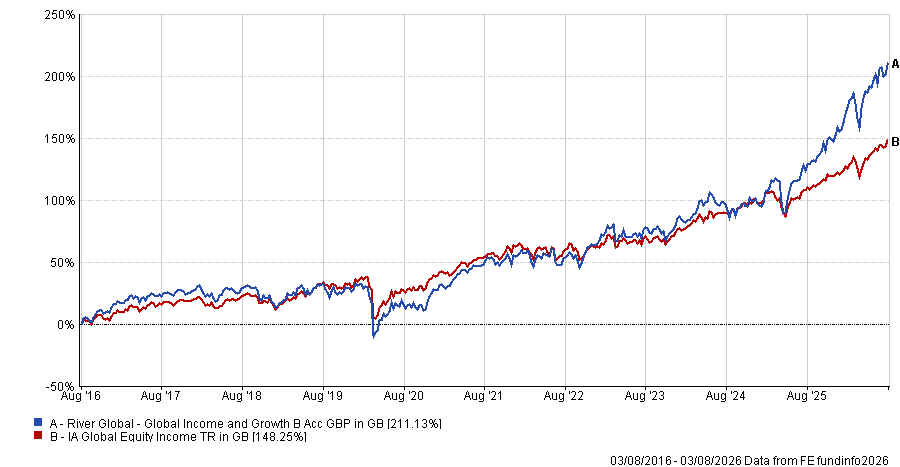
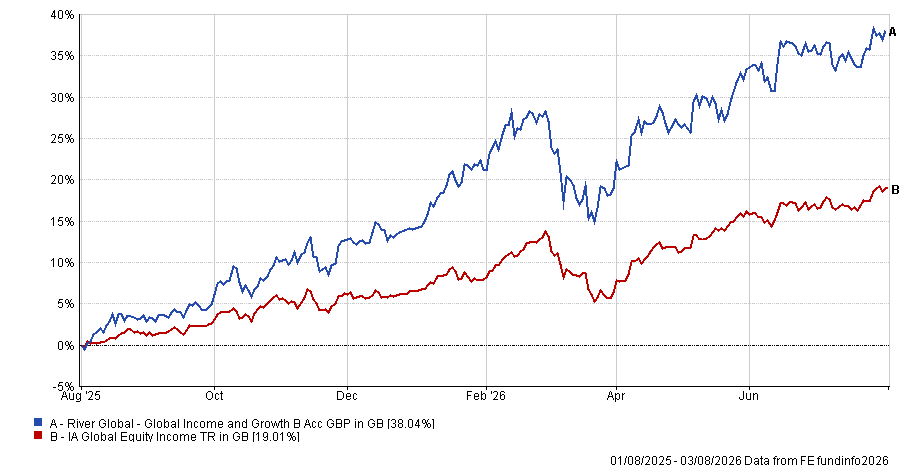
Indeed, it has been the best performer in the IA Global Equity Income sector over one year and it is a top-10 performer over three, five and 10 years too.
Performance of fund vs sector over 10yrs
Source: FE Analytics
Below, Edmondston explains why the dividend picture is better in emerging markets (EM) than the US, how the fund moved away from tech before Covid and why small-caps are becoming a much larger part of the portfolio.
What is your process?
The process is to buy high-quality businesses that can sustainably grow earnings, cash and dividends. But more importantly, we want to buy companies where the valuation doesn't compare to our five-year growth outlook.
For quality, we look at net debt to EBITDA, looking for low leverage, especially with interest rates rising. In terms of growth, we do our own template based on the next five years. We look at earnings growth, dividend growth and the cash dividend cover.
In valuation terms, we look at cash earnings – everything a company adjusts we add back in most of the time, so it's pure earnings – and we look at the P/E [price-to-earnings] in year five. Roughly, a year-five P/E below 10x is a buy, 10x to 15x is a hold, and above 15x is a sell.
Why should investors pick your fund?
I think there are two reasons. One is that we're really differentiated; you can't replicate our fund with an ETF or an index. We've always had different holdings than the peer group, or even the [IA] Global peer group. We've also had really strong performance, even while being totally different and having had little or nothing in consumer defensives or IT.
This fund is the best performer in the IA Global Equity Income sector over 12 months. How have you achieved this?
I think it's because we only have 40 holdings, so we can be really nimble and quick in reassessing things. I'll give you an example. On Liberation Day, Dell was down 25% within three days and we doubled our holding because we were convinced it wasn't going to get hammered. We normally have really low turnover but when volatility rises, which has been the case over the past two or three years, our trading moves up too.
Performance of fund vs sector over 1yr
Source: FE Analytics
If you need to be nimble, is there a maximum size that this fund can reach?
I don't think it's necessarily the size that makes us nimble – it's the 40 holdings and the fact that we know every company inside out.
We reckon we can grow the fund, in its current composition, up to £2bn. If we look at every company we own and keep the same holding size – 2%, or whatever it is – we can easily scale and still have the same holdings.
Why does this fund have such large positions in mid- and small-caps (18.8% and 30%, respectively)?
It has got a bit bigger in the past three to five years because we find more opportunities in that area, but you have to think about this on a global basis: small-cap means [a market cap of] up to £10bn.
When the fund was launched, we were looking for globally leading businesses as a whole, whereas sometimes we now look for businesses that are leaders in just one or two areas.
Overall, nothing is static in this fund; it's very process-driven, very bottom-up. The sector weightings have been quite cyclical over the past five years: we were very much into tech in the late 2010s and into consumer stocks before that, when the fund was launched.
It's going to look totally different in five years; I have no idea exactly how. It's just wherever the process takes us, wherever we find attractively valued ideas with a decent dividend yield.
Why do you have very little technology today?
It really started coming out of Covid when we saw this capex cycle coming and we decided we wanted to own the picks and shovels rather than the nameplate. That applies to capex, to AI, really to every sector, because then you don't have to decide who's going to be the winner in the end.
It doesn't matter whether Nvidia, TSMC, or Intel wins [the semiconductor market share], they need Ebara's machines. It doesn't matter whether Google, Amazon, or Microsoft wins in data centres, they need servers from Dell. So that's why we like to go a little further up the value chain.
The other reason we don't own a lot of the large-cap names is that we want a 2% dividend yield, ideally either immediately or within year one or two, and a lot of them are still well below 2%.
We don't run a barbell approach; everything in the portfolio has to pull its weight on valuation, growth and yield. With only 40 companies, they all have to do the same job and improve the characteristics of the fund.
Does this fund invest in emerging markets?
We've moved more into EM in the past five years. The overwhelming reason is that the dividend picture looks much better in emerging markets. If you look at the US dividend yield on the S&P, it's gone from top-left to bottom-right over the past 20 years and I think the S&P yield is now around 1%, so it's very difficult to find a sustainably growing 2% yield there.
The other factor is that we now have a bit more leeway in what counts as a ‘leader’; it can be regional.
But [investing in the emerging markets] does take much more work. For example, we have a Mexican bank in the portfolio, Banorte. When we first invested, we had five calls and it took us about six weeks to get comfortable. It takes a long time but it's really worth it.
What has been your best performer over the past year?
For the 12 months to the end of July, the best performer was Dell, up over 200%. It's probably the most volatile stock we've ever owned in the portfolio, just given what's going on in AI, but it was definitely the best contributor.
When we bought it in November 2023, everybody thought: ‘Well, it's a laptop company, it's going to get destroyed by AI’. But it has a really big server business and that's what the hyperscalers need. So it's these little pockets within companies that get overlooked sometimes, which we try to find, and then we extrapolate the growth out five years.
And your worst?
The worst were two companies in the construction space: Saint-Gobain, the French building materials company that makes plasterboard, and Wienerberger, which makes bricks, piping, and similar products. They were both down just over 20% in the past 12 months.
When we entered the year, we were looking for a pick-up in construction, especially residential construction in North America, but that unfortunately hasn't come through. They're still very good long-term holdings and we're still holding on to them.
What do you do outside of fund management?
During the week, I try to go to the gym after work every day just to clear my head. Sitting at a desk for eight, nine, or ten hours a day, you just have to get your body moving and your mind to relax. On the weekend, to get away from the screen, I either go out on the motorbike to clear my head or go for a walk.