






Vistry Group and a host of other construction names are the most-shorted UK companies, Financial Conduct Authority (FCA) data shows, while investors are also betting against firms exposed to the under-pressure UK consumer and firms at risk of AI disruption.
Investors must report short positions in UK-listed stocks that reach or exceed 0.2% of a company's issued share capital to the FCA, to increase transparency and allow potential manipulation or systemic risk to be monitored.
With 19.7% of its shares disclosed to the FCA's short-selling regime, housebuilder Vistry Group is currently the most-shorted company in the UK market. The stock is down 50% over the past 12 months, according to FE Analytics.
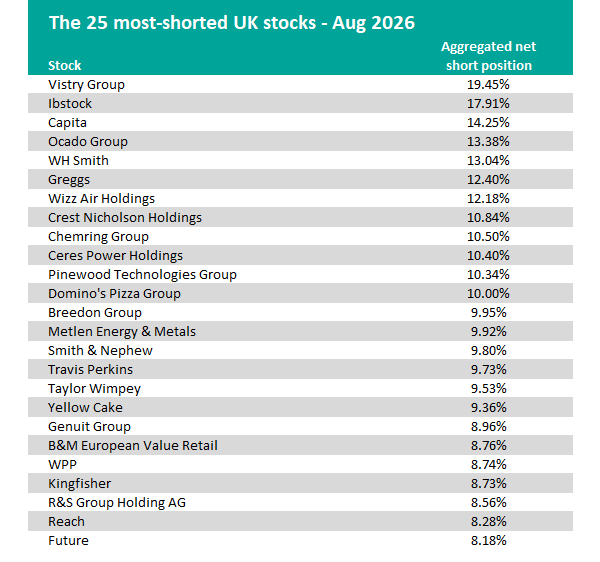
Source: FCA, as at 3 Aug 2026
Last month, the firm revealed a £30m first-half loss in an unscheduled update to shareholders, citing a "challenging period for the industry" and noting that it had reduced prices on slower-moving housing stock. It also announced that chief financial officer Tim Lawlor will leave in October.
In March this year, Vistry announced that Greg Fitzgerald would depart from the combined chair/chief executive role; Adam Daniels is now chief executive, with Rob Woodward serving as chair. In May, the company issued a sharp profit warning – saying adjusted pre-tax profits for 2026 would likely be in the "middle of the range" of forecasts – and suspended its buyback.
Dan Coatsworth, head of markets at AJ Bell, said of last month's update: "Investors have been getting jumpy about the state of the housebuilding and broader construction industry. Raw material and labour cost pressures have haunted the sector of late, and the prospect of possible interest rate hikes is bad news for mortgage affordability and housing sales.
"Vistry only recently changed CEO and a review of the business is still ongoing. New boss Adam Daniels strikes an optimistic tone, but he's putting on a brave face in what's clearly a tough market."
Performance of Vistry Group vs FTSE All Share over 12 months
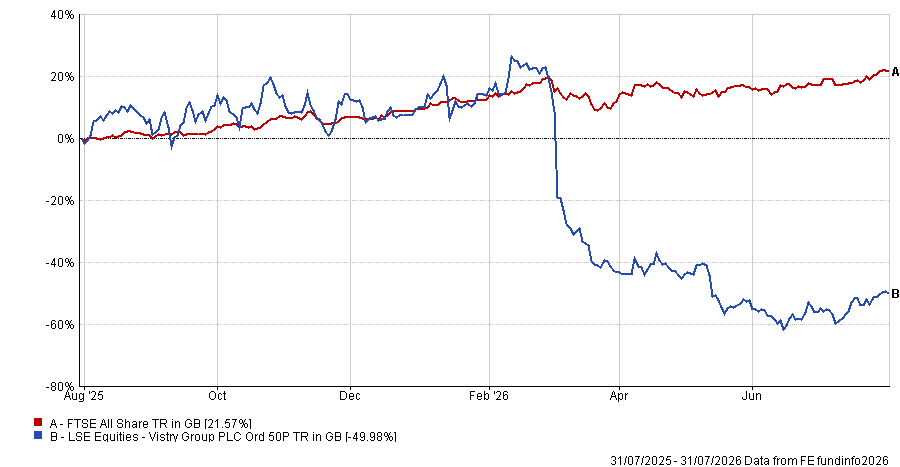
Source: FE Analytics. Total return in sterling between 1 Aug 2025 and 31 Jul 2026
But Vistry Group is far from the only UK housebuilder on the list of the market's most-shorted companies, as it is joined by Taylor Wimpey and Crest Nicholson.
The housebuilders are joined by several other members of the construction space: Ibstock (bricks), Breedon (aggregates and cement), Genuit (plastic piping and ventilation), Travis Perkins (builders' merchant) and Kingfisher (DIY retail).
Coatsworth recently said of the sector: "UK housebuilders have faced the perfect storm in recent years, from higher interest rates impacting affordability to rising costs reducing profitability. This situation is weighing on the sector. Several housebuilders have this year issued gloomy updates."
The Bank of England held its base rate at 3.75% at its July meeting, disappointing markets that had expected a cut, citing inflation risks linked to the Middle East conflict, and the average two-year fixed mortgage rate has risen from below 4% in early 2026 to 5.11% today, according to Rightmove.
In addition, rising energy prices caused by the conflict between the US and Iran have pushed up build-cost inflation, squeezing margins across the whole chain, while adding to consumers' cost-of-living pressures.
This is linked to another theme among the most-shorted companies: a weaker UK consumer combined with higher labour costs. Greggs, WH Smith, B&M, Domino's Pizza, Ocado and Kingfisher are all UK consumer-facing companies being shorted.
The common squeeze on these companies is cautious spending from the consumer, plus wage and employer National Insurance cost inflation, which hits labour-intensive food and retail businesses hardest.
Of course, there are stock-specific reasons for many of these shorts also. WH Smith, for example, has seen its pre-tax profits fall and suspended its dividend in April, while investors are shorting Greggs on worries that it has expanded too fast (although its shares surged in July on strong profits).
Another theme among shorted companies is seen through the likes of advertising giant WPP and publishers Reach and Future. Investors worry AI and shifting digital distribution will erode the moats protecting these companies' earnings.
WPP faces disruption to the agency model itself, as AI enables clients to carry out some of its creative, media and data services in-house. The firm has suffered heavy client losses and has embarked on a multi-year strategic plan to restore growth.
Reach is the UK's largest commercial news publisher, putting out the Mirror, Express, Daily Star, Daily Record and around 120 regional titles, while Future is a specialist publisher. Both have high-margin advertising and e-commerce revenue that relies on Google sending traffic to its sites, but AI Overviews and search changes have cut that traffic and caused revenues and profits to fall.