






Value investing has surged to the fore in recent years, as markets have increasingly been driven by expensive, momentum-driven stocks.
With value in the ascendent, Trustnet asked fund selectors which value-focused funds and investment trusts they would back.
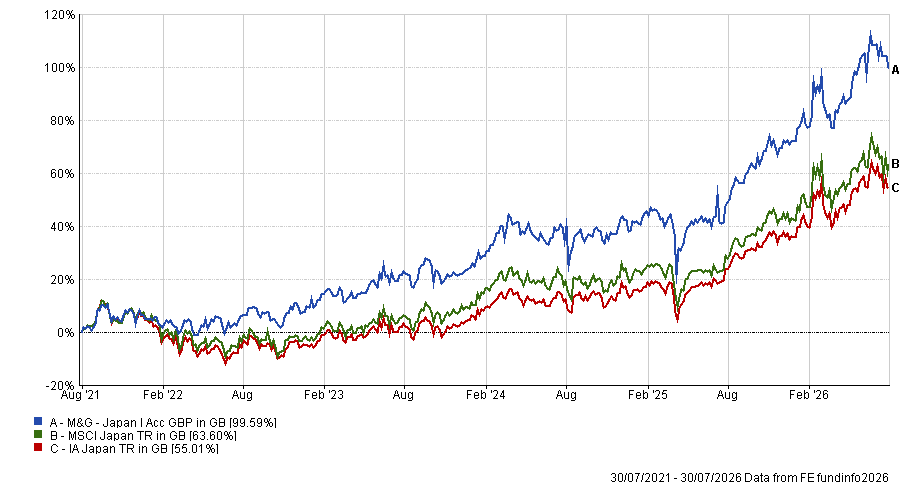
Simon Woodacre, fund research analyst at Quilter Cheviot, suggested the £5.4bn M&G Japan fund.
The strategy has demonstrated its ability to generate alpha across a range of market environments, driven by “a combination of strong stock selection, effective portfolio construction, a comprehensive approach to risk management and robust corporate governance practices,” Woodacre said.
Managed by Carl Vine and FE fundinfo Alpha Manager Dave Perrett, the fund aims to provide a combination of capital growth and income to deliver a higher return than MSCI Japan over any five-year period.
Woodacre noted that Vine’s “disciplined investment approach and strong portfolio-management skills have enabled him to identify attractive opportunities within the Japanese market while actively managing existing positions”.
The strategy does not pursue a deep value strategy, he added, and is therefore less exposed to style headwinds and to some of the macroeconomic challenges that may weigh on that part of the market.
“The fund’s more pragmatic interpretation of value allows it to invest selectively in higher-growth companies, including businesses benefiting from the ongoing build-out of AI,” Woodacre said.
M&G Japan’s 60-stock portfolio includes overweights to Sony, Orix Corporation and Nikon.
Woodacre viewed it as a core Japanese equity holding, ideally complemented by a strategy with “a stronger growth orientation, particularly one focused on companies benefiting directly from AI adoption or participation in the AI supply chain”.
Last month, Trustnet identified M&G Japan as the only actively managed fund in the IA Japan sector to combine lower cost with a top-decile 10-year return. It has an ongoing charges figure (OCF) of 0.47%.
The fund has performed especially strongly since 2021, logging first- or second-quartile returns in every calendar year since that point.
Performance of the fund vs sector and benchmark over 5yrs
Source: FE Analytics
Meanwhile, Nicholas Hyett, lead alternatives analyst at Hargreaves Lansdown, chose T Rowe Price Global Value Equity, a fund that typically holds between 80-100 stocks spread across the value spectrum, from deep value to out-of-favour quality companies.
The fund, managed by Sebastien Mallet and Marta Yago, does not stray too far from the MSCI World benchmark and as a result its top holdings include tech giants Alphabet, Microsoft and Micron Technology.
“This makes it a core holding but the fund is still substantially different to a tracker,” Hyett said, noting that it has 15% less in the US than the MSCI World index, with meaningful overweight positions in Japan, Canada and France.
The fund also has an average price-to-earnings ratio of 17.8x versus the benchmark’s 23.5x.
“T Rowe Price Global Value Equity’s broad exposure, backed by significant resources, could make it appealing to investors that still want broad stock market exposure but are nervous about valuations in the US, or who simply want to diversify a portfolio dominated by global trackers,” Hyett said.
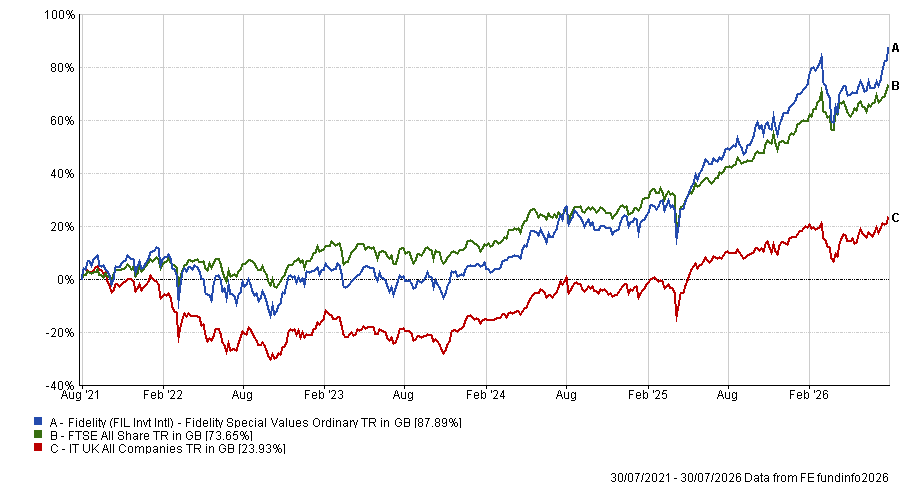
He next suggested the Fidelity Special Values investment trust, highlighting its “excellent pedigree”, having previously been managed by Anthony Bolton.
“[Alpha Manager] Alex Wright took over the investment trust and has continued to deliver appealing returns for investors,” he said.
Indeed, the trust has logged first-quartile returns and outperformed its FTSE All Share benchmark over one, three, five and 10 years to the end of June 2026 – gaining 201.8% over a decade.
“That is no small achievement given its strict value style in a period when value has mostly been out of favour,” Hyett noted.
Unlike its sister fund Fidelity Special Situations, which is also managed by Wright, the trust owns smaller, less liquid companies – with around 30% invested in FTSE 250 companies and 10% in the FTSE Small Cap. Its top positions include Smith & Nephew, AIB Group and Derwent London.
“Being able to fish in these under-covered corners of the market is a significant benefit of the trust structure, as is the ability to add gearing to enhance returns – albeit at the expense of increased risk,” Hyett said.
“We also think the trust structure is well suited to Wright’s deeper value approach, which often requires patience and as investors will know only too well can go through periods of substantial underperformance.”
The trust is currently trading at a slight 0.4% premium to net asset value (NAV).
“The scope for the trust to move to a discount, together with the volatility inherent in a deeper value approach with exposure to smaller companies, means it is likely to be a satellite holding for most investors, sitting as part of a broader, more diversified portfolio,” Hyett noted.
Fidelity Special Values was also the pick of Tom Bigley, fund analyst at interactive investor, noting its “impressive long-term track record”.
“What makes the strategy stand out is its disciplined, bottom-up approach to identifying businesses trading on depressed valuations before improving fundamentals become widely recognised,” Bigley said.
Performance of the trust vs sector and benchmark over 5yrs
Source: FE Analytics
Bigley also suggested the Dodge & Cox Worldwide Global Stock.
Rather than purely screening for low valuation multiples, the management team – the firm’s global stock investment committee – targets established businesses which they believe have long-term earnings power and competitive strengths not yet fully reflected in their share prices.
“This often leads them to capitalise on periods of market uncertainty when quality companies become temporarily mispriced,” Bigley said.
The fund is currently overweighting financials and healthcare but does not completely neglect tech stocks.
“Geographically, the portfolio is also less reliant on the US market than most global funds, providing valuable diversification,” he added.
“The differentiated sector and regional positioning can help diversify portfolios that are heavily concentrated in US mega-cap technology stocks, while providing exposure to attractively valued companies across global markets.”