






The case for UK pension funds buying more British shares has never been stronger, yet fear of being different, not poor fundamentals, is what’s keeping them away, according to the experts.
Private sector defined benefit (DB) schemes, which guarantee a set retirement income, have largely moved into bonds to match their liabilities, meaning concerns of falling investment mainly lie with defined contribution (DC) schemes, where retirement pots depend on investment returns. They have increasingly turned to investing in global assets outside of the UK.
According to UK government data, UK pensions’ share of equities held in domestic assets now sits at 8% in DC and 11% in private DB schemes. This falls short of the domestic equity share in other regions, such as Canada (22%), New Zealand (42%) and Australia (45%).
This prompted the 2025 Mansion House Accord, in which 17 providers managing around 90% of active DC assets pledged to invest 10% of workplace portfolios into growth assets like infrastructure and private equity by 2030, with at least 5% ringfenced for the UK, which is expected to unlock £25bn for the economy.
Critics argue this falls far short of the roughly 50% once invested domestically by pensions, leading listed UK equities especially exposed – some business leaders have called for up to 25% of pension assets to go into UK equities.
Assets held by UK pension type
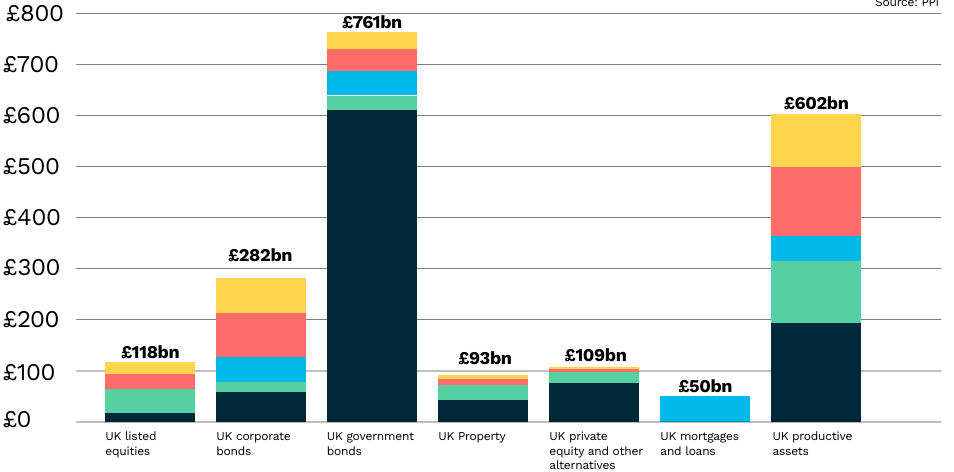
Source: Pensions UK, Pensions Policy Institute. Black (DB private), green (DB public), blue (annuities), red (workplace DC) and yellow (individual).
A senior expert in the investment and pensions industry said, “a lot is being done to polish the car, but no one has done anything to put any petrol in it”.
He believes the main reason UK pensions aren’t investing enough in listed UK equities boils down to one base emotion: fear.
“There aren’t many pension providers with the nerve to be different from their peers, and it’s been a bit of a race to the bottom, allocating down and down – even when there is an economic and valuation argument to be made for the UK,” he said. “No one wants to be dramatically different from their peers or benchmarks.”
Instead, providers are turning to global tracker funds which, on the surface, appear to be the lower risk option to ensure the long-term returns.
“But they are instead taking on concentration risk because that means they are all overweight the US – and more specifically US tech,” the expert pointed out.
Looking at the geographic composition of MSCI ACWI, as of the end of August 2026, the UK makes up just 3.1% of the benchmark versus 63.6% for the US.
Country weights of MSCI ACWI
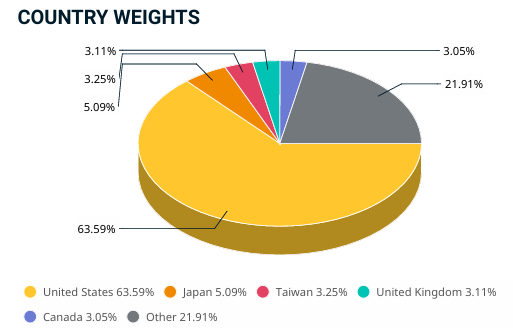
Source: MSCI
“At the same time, they are leaving behind a UK market where valuations are lower, so there is a higher cost of equity for UK businesses and it is harder for them to expand,” the expert added.
“Because UK equities are undervalued, but people are still selling them, the balancing item has been takeovers and acquisitions and share buybacks.”
But Pensions UK, a trade body representing UK pension schemes, offers a slightly different explanation – one focused less on appetite and more on the practicalities.
It described the UK market as “confusing and fragmented”, leaving schemes unsure where opportunities sit or how to get involved.
The body called for better policy coordination across the government, easier pension access to public finance vehicles, a more stable regulatory environment and training and engagement across trustees, advisers and consultants.
Tiffany Tsang, head of DB, investment and LGPS at Pensions UK, acknowledged that there are legitimate questions about concentration risks in some overseas markets but argued that asset allocation “cannot be reduced to a choice between supporting the domestic economy and investing abroad”.
“The right approach is to create opportunities that stand on their own merits so, for policymakers, the focus should be on making the UK a more attractive destination for long-term capital through a stronger pipeline of investable opportunities, greater policy certainty and investment structures that meet pension schemes’ needs,” she said.
Committed to the cause
But pension providers are far from turning their backs on the UK market altogether.
Elizabeth Fernando, chief investment officer at Nest, told Trustnet that the pension provider is committed to acting in the best financial interests of its members, noting that the provider currently invests £13.7bn (or 20%) of its assets in the UK.
“We take a diversified approach to investing across public and private markets,” she said. “We continue to see the UK as an attractive place to invest and a source of long-term opportunities for our members.”
But Fernando argued that focusing only on listed equities misses the full range of opportunities to support domestic growth.
“Investment in UK listed equities often involves the purchase of existing shares from other investors on the secondary market, rather than providing businesses with new capital to support growth,” she added.
Private equity and other private markets, she said, offer a more direct route for pension capital to help UK businesses scale.
“The UK’s later-stage venture capital and growth private equity markets are where we see compelling opportunities,” she said, noting that the country “has a strong pipeline of high-growth businesses, yet there remains a widely recognised scale-up funding gap, with many promising companies continuing to rely on overseas capital as they grow, resulting in many young companies leaving the UK”.
Similarly, Julia Diez, head of UK productive assets at Railpen, also emphasised the scheme’s commitment to the UK growth story.
“Most of our members are in the UK, so we naturally want to see the UK capital markets and economy thrive,” she said. Diez pointed to a recent consortium of UK pension funds, including Railpen and Nest, exploring a fund dedicated to scaling UK businesses.
What is the longer-term solution?
Incentivisation rather than mandation has been deemed the most effective way to get UK pensions investing domestically.
One suggestion is to bolster pension tax relief for savers prepared to invest in the UK – an approach taken by other countries like Australia.
Pension tax relief currently tops up savings into regulated personal and occupational retirement funds at the marginal rate of tax. These reliefs are currently provided without explicit rules requiring investors to channel funds into UK-domiciled companies.
Anthony Cross, co-manager of Liontrust UK Growth, agreed “there should be a recognition that, in return for a tax break or some of that tax break, some money should go into supporting the UK stock market, which is then supporting the UK economy”.
“If we don’t invest enough in our own economy and the growth of our businesses, then guess what? We’re not going to prosper.”
Along a similar vein, think tank New Financial suggested that pension savers should be allowed to take a 35% tax-free lump sum from their pensions (up from the current 25%) if their pension pots have a higher allocation to UK equities.
The investment and pensions expert also suggested that people’s default workplace pension schemes should be required to carry a higher weighting to the UK.
“You could argue this is a pension fund for a UK citizen, so they should be more exposed to their own domestic economy,” he said – adding that this wouldn’t be mandation, since savers could still opt out of the default fund.
In contrast, debate around mandating UK pension funds to invest a set portion of assets has split opinion. Pension funds have argued that this interferes with their fiduciary duty, which legally requires them to make the best investment decisions for the end beneficiaries.
UK pension funds may be right to be cautious of out and out mandation, the expert acknowledged. Regulatory and accounting changes introduced in the early 2000s pushed DB pension schemes out of equities and into government bonds to reduce perceived risks – but with yields at historic lows, this locked schemes into weaker returns in the name of safety.
“At that time, it was a massive destruction of value and an example of the perceived risk aversion leading [pension providers to] non-economic decisions,” he said.
Whatever mechanism wins out, fund managers who invest directly in UK companies believe the underlying goal isn’t in dispute.
Cross said: “We all want UK businesses to stay and grow within the UK – and therefore we need a stock market environment they can grow into, where there is active money and people like me who can back the businesses and buy the shares and fund their growth.