






There's an Italian saying for wanting two things at the same time that were never on offer together. We say: you want the flask full and the wife merry.
Looking beyond the slight misogyny, the point is that one excludes the other. A more elegant way of putting it might be that it’s an aut aut, an either or.
Yet I have the impression that we don’t always extend the same understanding to fund managers. We want to make all the money we can but also never lose a penny. The protection of a diversified portfolio and the upside of someone willing to bet everything on being right. Sometimes we want that from the same person, in the same fund.
But even the best can’t do it. Two of the most scrutinised managers in the country, Terry Smith and Nick Train, are behind the market in each of the past five discrete 12-month periods to the end of July.
The numbers look pretty dire. Fundsmith Equity rose 0.8% in 2025 against the MSCI World's 12.8%, then fell 2.9% in the first half of 2026 while the index gained 11.2%. Assets have roughly halved.
Lindsell Train Global Equity went from £5.2bn of assets under management to £2.2bn. The closed-ended Finsbury Growth & Income's net asset value fell 21.3% in the year to March 2026, against a 16% rise for the MSCI World, with a 14.4% loss in the first half alone.
Performance of funds against indices and sectors over 5yrs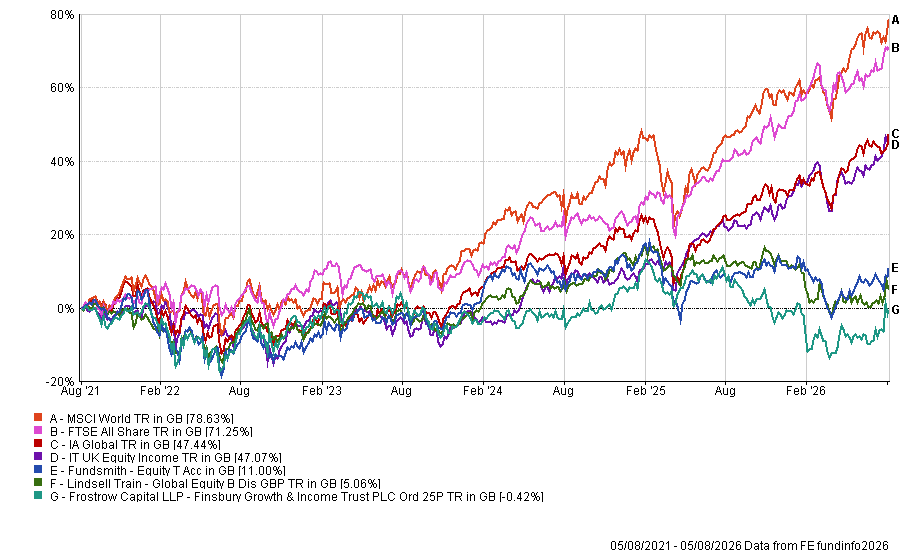
Source: FE Analytics
Maybe what we want is for managers to follow one process without wavering, whatever the market is doing. If that's the real job, underperformance needs reframing, and so does how we work out when a manager has lost the plot rather than just gone quiet for a while.
But then in July, as Fundsmith Equity was heading for a fifth discrete 12-months running behind the MSCI World, the manager tore up his own “buy good companies and do nothing” rule, turning over 51% of the portfolio to buy into Uber and Netflix.
Admitting you had been wrong and changing your process is a bold move but one that some commentators, like Brian Dennehy, founder of FundExpert.co.uk, appreciated.
“Fundsmith basically made no money last year, and the fund went from £20bn to £12bn as people left. Lindsell Train was down 11% last year and went from £4bn to £2b. I'm always surprised how much money stays on board when you've underperformed by about 20% in a year,” he said.
“Adapting is absolutely vital. Only in the last couple of weeks has Terry Smith announced he's making changes. It's taken him a while to get there.”
So then maybe we want managers to adapt. But not too frequently, because that would mean we investors wouldn’t know what we’re buying…
Compared to Smith, Train went the other way. In the closed-ended Finsbury Growth & Income, the board raised gearing on towards £100m rather than change process: the decision was to take up more risk, doubling down on the portfolio.
Was this a better response? Is the risk justified and what happens if he is wrong?
Laith Khalaf, head of investment analysis at AJ Bell, said that a bad five years is simply the cost of backing conviction over an index.
“If you ask professional fund selectors what the most challenging part of their job is, deciding what to do about an underperforming manager comes near the top of the list,” he said.
“Terry Smith is no shrinking violet and his pugilistic defence of his strategy stands in stark contrast to the deeply apologetic tone struck by Nick Train. You have to accept the fallow with the fertile.”
When we buy into a manager's philosophy, we must accept the losses that come with it and be able to tell them apart from the losses that come from a manager breaking his own rules, which is what undid Neil Woodford.
Alternatively, we can choose to sell and move on, rather than staying loyal to a manager that we lost conviction in. There’s no third option. So do you choose the wife or the flask?
Matteo Anelli is deputy editor at Trustnet. The views expressed above should not be taken as investment advice.